Longyearbyen is, to all intents and purposes, the only town on Svalbard. It’s home to the harbour and the international airport, as well as pretty much all the shops, accommodation, and resources. Therefore you’re likely to spend a significant amount of time here on any visit to Svalbard, regardless of what tours you take around the rest of the islands.
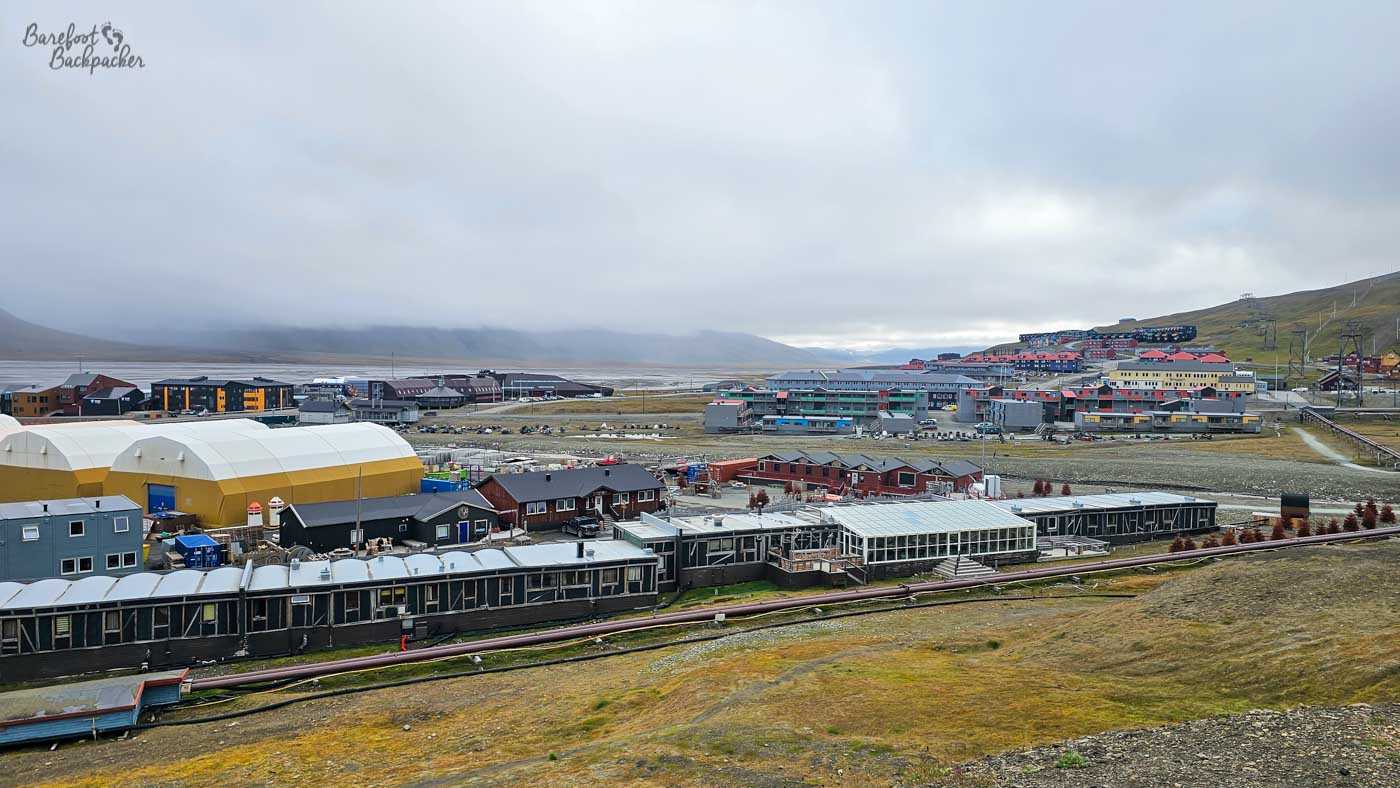
An overview of Longyearbyen.
Here’s a few things I found to see and do in Longyearbyen while I was there.
Getting in and away
Longyearbyen Airport is only about 4km from the town centre, but you can’t walk it because of the danger of polar bears. Indeed there have been reported attacks on people camping near the airport itself. Instead there is a shuttle bus. This bus meets every flight and, on return, drops off a couple of hours before every flight leaves, so the timetable is dependent on the flights and isn’t exactly fixed. The airport isn’t very big, however, so if you have luggage it won’t take long to get through the terminal; even if it does you can just pop out to the bus and go ‘I’m just waiting for my bags’. At the time of my visit the bus cost about 110 NOK (about USD $11), which is relatively expensive for a 4km shuttle but if you were worried about costs, you wouldn’t be travelling to Svalbard. When flying out, by the way, the airport has a decent enough shop and a couple of places to buy food.
Near the airport
Immediately on leaving the airport there are two notable tourist-photo-opportunities (and one inside if you count the polar bear. Stuffed, of course). One is an example of the famous polar bear sign, that is pretty much the symbol of Svalbard – you can buy t-shirts and mugs with it on. There are better places to see this sign, don’t worry.
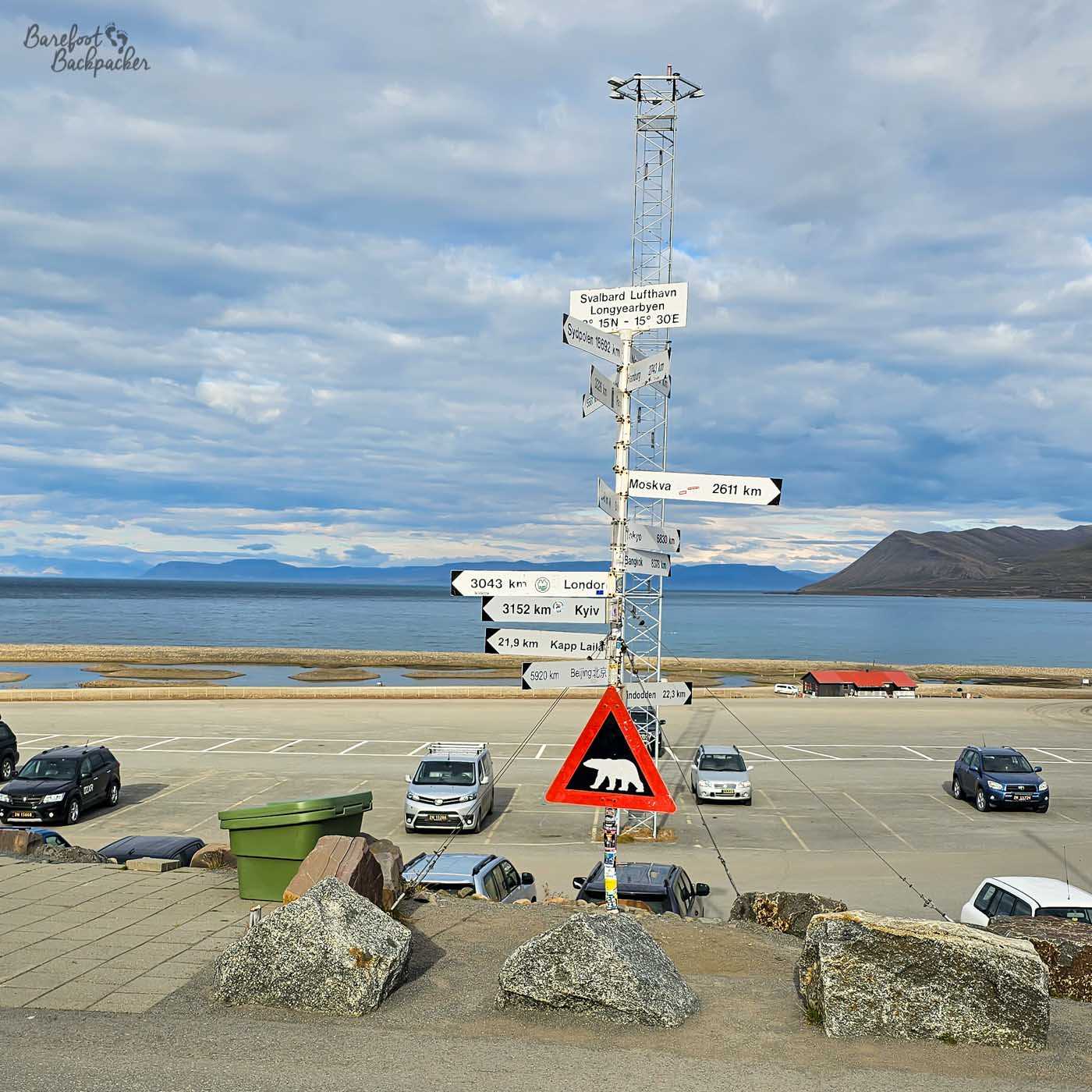
The signpost outside Longyearbyen airport.
The other sight here is a signpost with distances to many places in the world, including the North Pole (1309km, feels almost walkable), the South Pole (18692km, absolutely not), and several of the world’s most notable cities (for example London, Moscow, Bangkok, and New York, which is slightly closer than Beijing), alongside some nearer hamlets on the island itself.
Then, on a hill overlooking the airport, is the famous seed vault. Essentially it’s Earth’s backup system. It’s an underground vault. There’s about four rooms, each of them is about 300 meters squared that contains seeds for pretty much all the world’s agriculture. It’s used as a storage system so that if something goes extinct, we have a backup copy in the seed vault that we can just duplicate, clone and repopulate that part of the world with. We’ve actually done this with a plant eradicated during the Syrian Civil War and then repopulated from here to Syria. It’s in Svalbard because of its remoteness and climate – of all the places in the world it’s the one that’s least likely to be affected by, well pretty much anything, well, climate-change willing. It’s quite deep down, and you can’t go inside, so all you get to see is two sheds. I think here though the important thing is to be there, see where it is, and think about how something that looks so innocuous could be so important.
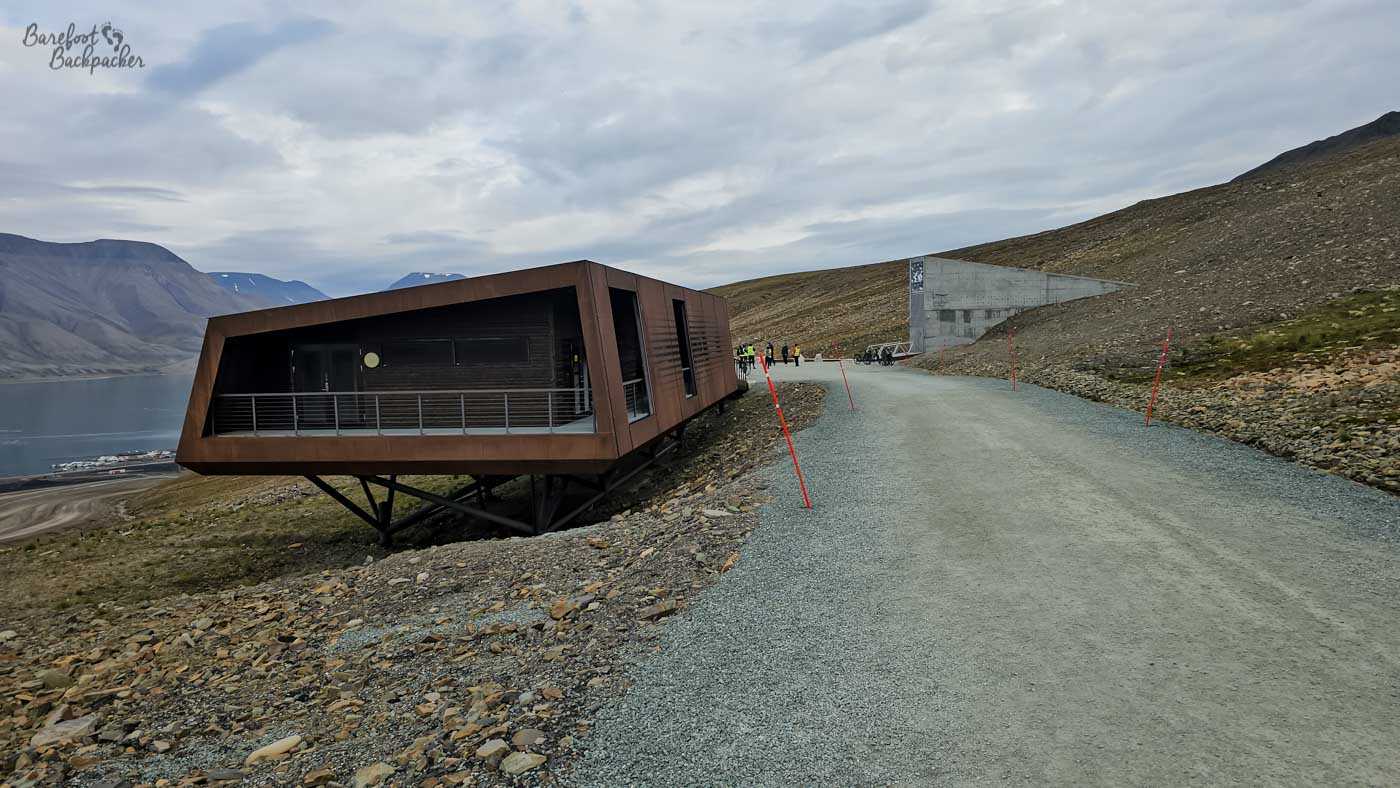
The two buildings at the Seed Vault.
Museums in Longyearbyen
Longyearbyen town centre has two museums, pretty much opposite each other at the centre of town, at the junction where the three roads meet. One of them is The North Pole Exploration Museum, which I didn’t visit because the reviews suggested it was very similar to other polar museums I’d been to, including one in Tromsø and the Fram museum in Oslo. But if you’ve not visited either, then definitely visit this one. It covers the polar explorations that took place in and around Svalbard, and a bit about the fur trappers too who based themselves here. The other museum is the Svalbard Museum, which looks at Svalbard as a whole. There’s sections on its history, on why people have been here, not just the traders and the explorers but also the miners and speculators, and why Svalbard has some of the specific and unique laws and culture that it does. It also shows the culture of the island, its wildlife, its resources, and a bit about its future.
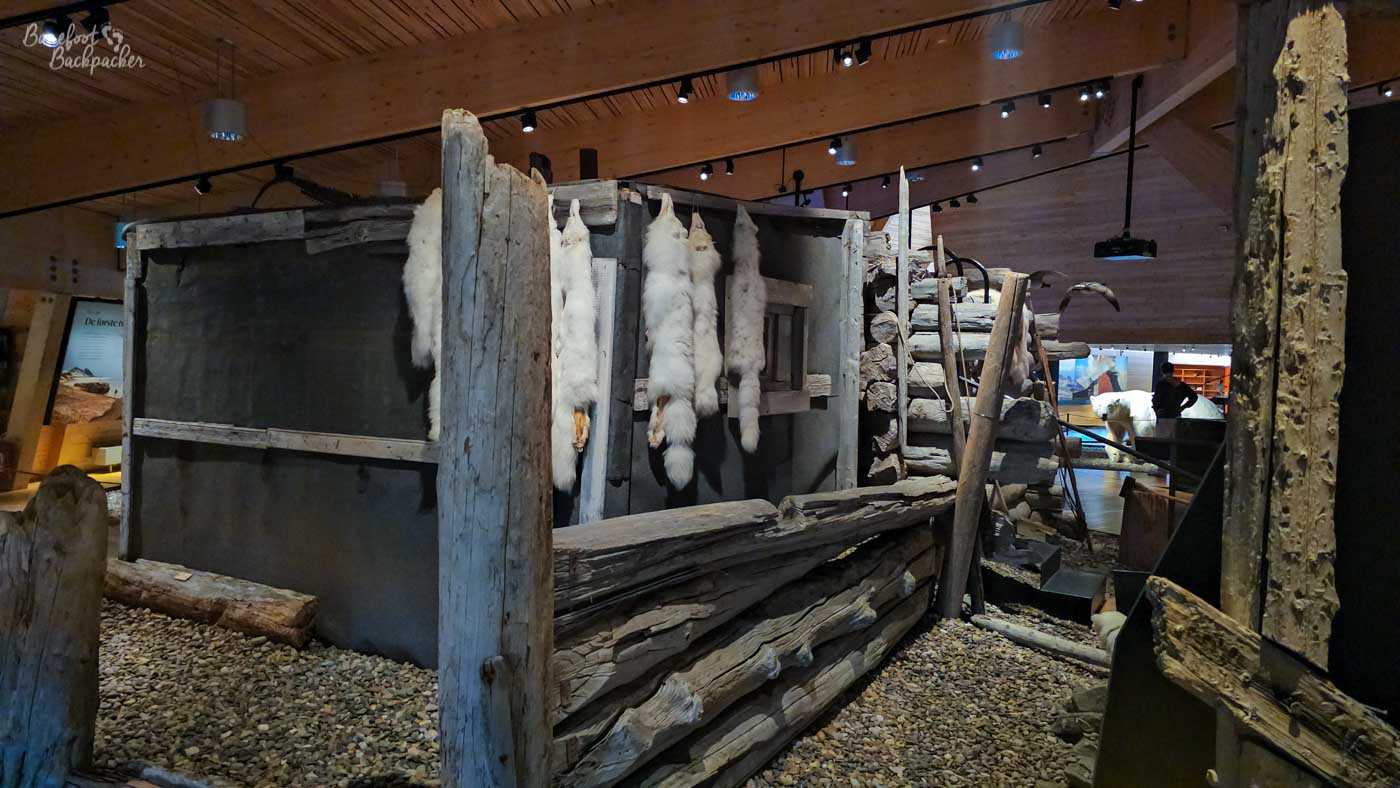
Example of a historic fur trapping hut.
Another museum is called “Mine Number 3”. Svalbard exists mainly because of coal mining. Although they’re all closed now, one of the seven or so that operated in the vicinity of Longyearbyen is still in use as a museum. It wasn’t a large mine – the coal seam it mined wasn’t more than 90cm thick, and it was pretty much only in operation during the 1970s and 1980s. It was also what’s known as a drift mine – essentially it was one you walked into rather than took a lift down to, meaning working conditions were somewhat less onerous (and presumably safer) than the typical deep mines. Still a dark, messy, dirty, job though. Anyway, these days you can follow in the miners’ footsteps, see the equipment they used, and even clamber a bit through a replica tunnel to get a feel for how they worked.
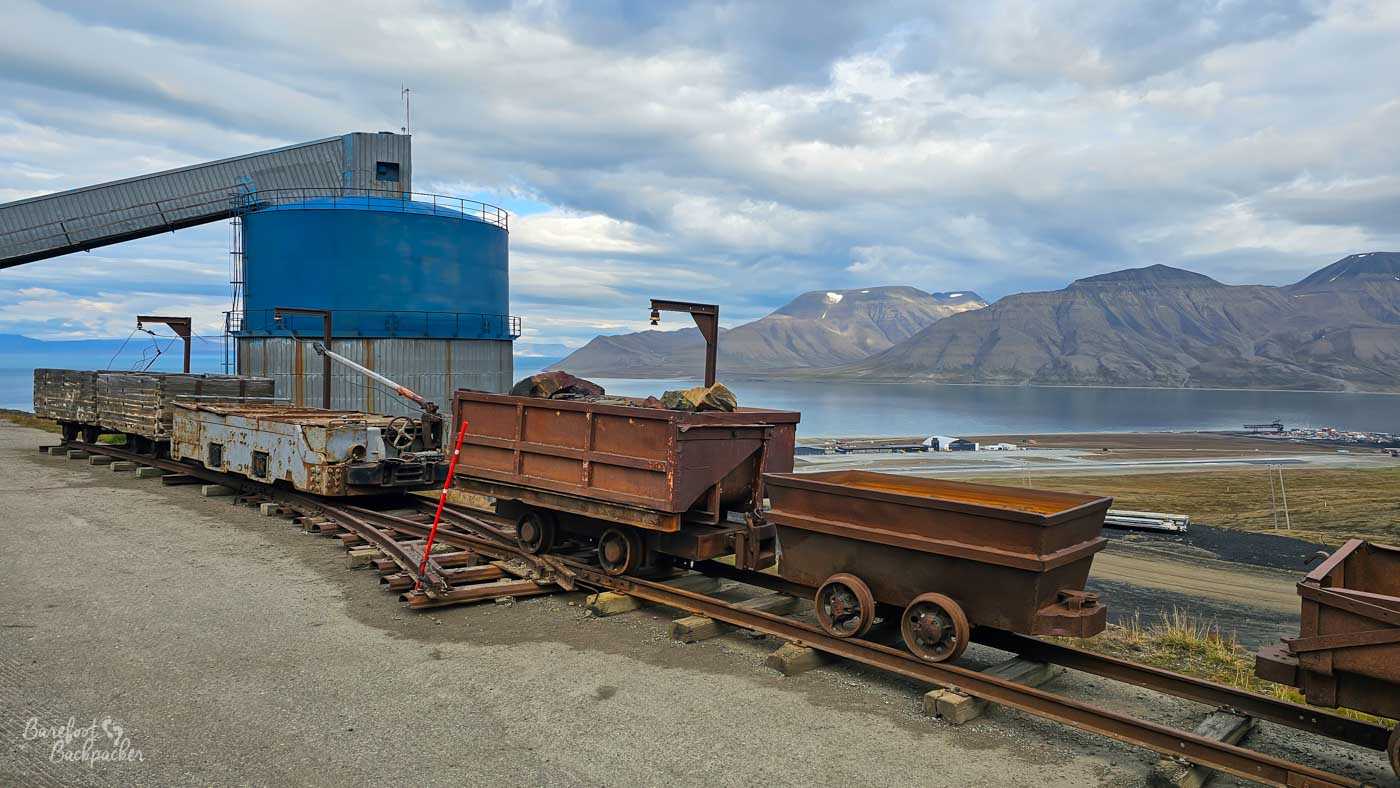
The remains of an old mining railway at one of the mines.
Around the town there are also remnants of the mining industry, especially parts of the ‘mining railway’ – the system of conveyor belts and collection ‘stations’ across the ridges that allowed easy transport of coal from the the mines to the harbour. They look a bit like electrical transmission or viaduct stands. There’s also a life-sized statue of a miner in the high street, not far from the plastic dinosaur – Svalbard’s a really good place for fossil-hunting.
Other interesting sites
Longyearbyen is home to the world’s northernmost civilian church (there’s a Russian Orthodox church at an airbase in Franz Josef Land). It was built on a ridge overlooking the town in 1958 to replace an older church burnt during World War 2, it’s made with wooden panels, is red with a conical tower, with a longer blue-grey admin section to the side, and serves not just as a church but as a kind of communal meeting place. It’s open 24/7, it’s not large (seating space is reported to be 140 people), but it is very bright and airy inside. The main section is up a flight of stairs, and part of it is a dedicated cafe space, with shop selling local crafts, that runs on an honest box type system. There’s also a polar bear inside. Again stuffed, which is as near to one as you want to get, let’s be real. On my visit people were using it as a place to read and do some work.
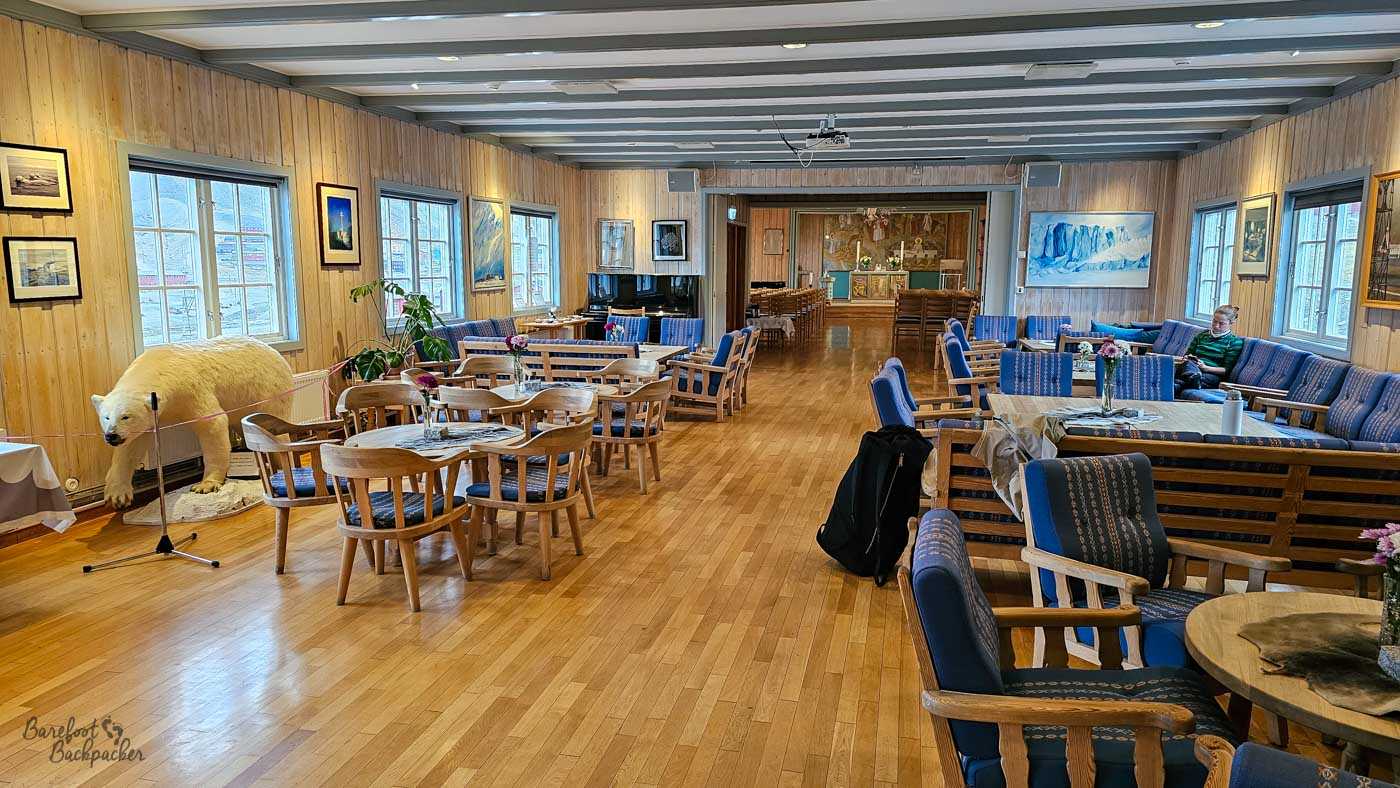
The inside of the church.
Nearby is the “old town”, with a handful of the oldest houses, and the associated graveyard. One of the many things people know about Svalbard is it’s illegal to die there. In fact that’s not exactly true, although if it’s clear you’re close to the end of life, they do like to put you on the first available plane to Tromsø. Indeed there’s no real elderly care industry here at all. But it is now illegal to be buried here. The permafrost is so hard and the climate so generally cold that it’s almost impossible to dig a grave deep enough that will allow the body to decompose. In addition, the thawing and refreezing of the ground surface has a tendency to regurgitate what’s underneath. In addition, any pathogen or bacteria that may have caused your death might not decompose either; locals were particularly worried when people who died in the 1918 flu epidemic and buried in the graveyard were examined in the 1990s and were found to potentially still contain a live virus.
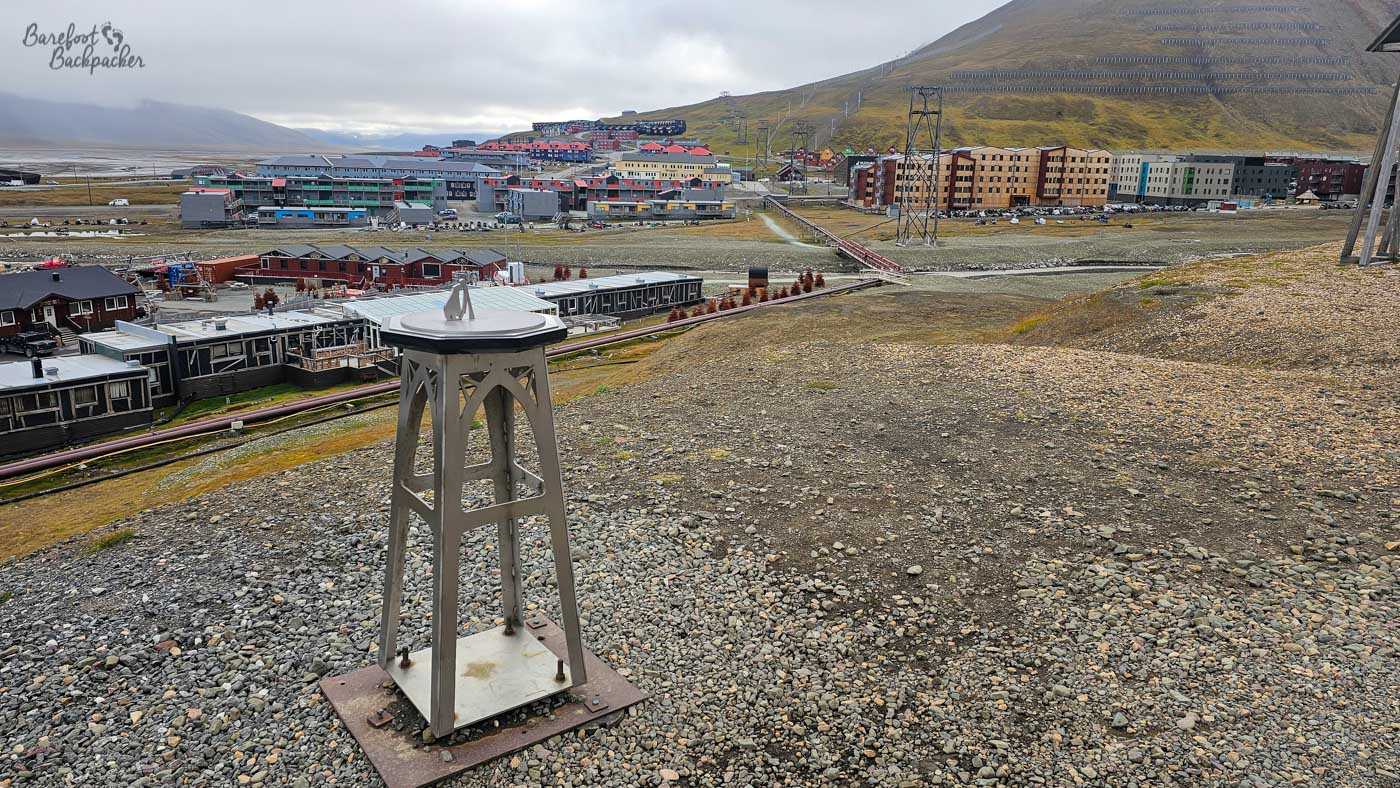
The polar bear sundial overlooking the town.
Also on the ridge near the church, almost at the edge, is a lovely little sundial that instead of having a simple plane to indicate the time, it has a small polar bear. From here you can look out over most of the town, and across the harbour to the fjord and the hills beyond on the other side of the small fjord the town stands on.
The Midnight Sun and the Polar Night
One of the reasons people come to Svalbard is to experience the Midnight Sun. In 2025, the sun rose around 18 April and set just after midnight on 25 August – the day I left. Even on that last night you couldn’t honestly tell – it was only below the horizon for an hour and a bit and civil twilight is still pretty bright – but it was a signpost of the oncoming winter. The Polar night began when the sun set around 26 October, and didn’t rise again until 15 February 2026.
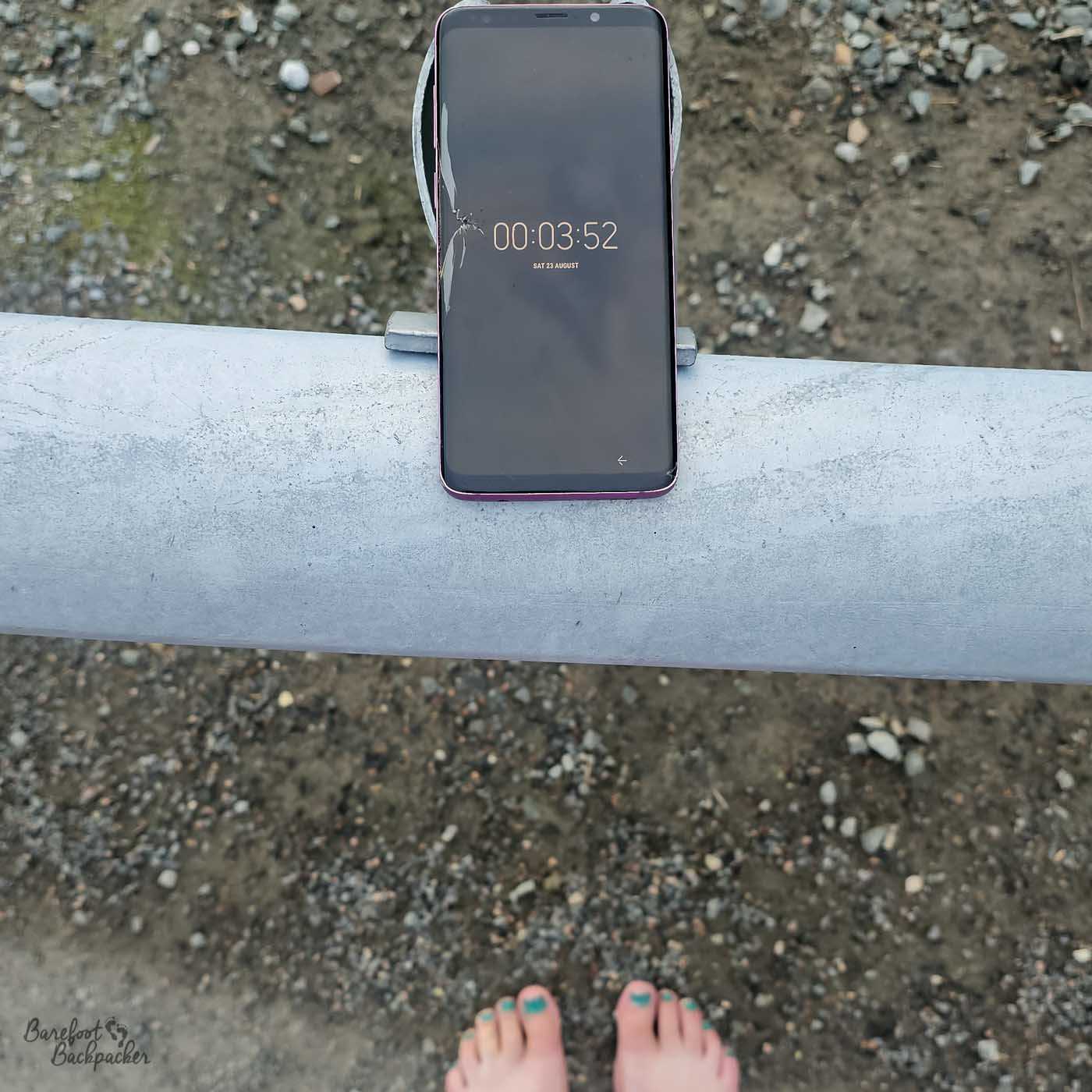
Proof it was light enough for a foot-selfie under the midnight sun.
It is a little weird to be in daylight in an otherwise empty and quiet town; it felt a bit like the Pandemic. They cope with it through very dark curtains, and it definitely helps to have a bedroom that faces one of the ridges.
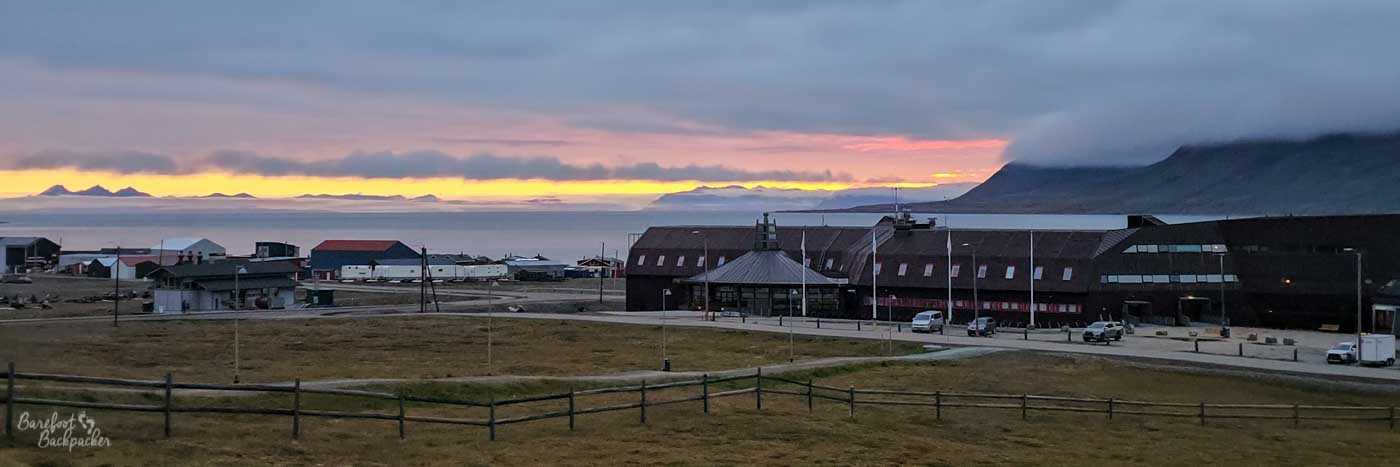
Almost sunset after midnight.
I didn’t visit during the Polar Night; that would make for a somewhat different experience – you lose the sights and the hiking but you gain the sleigh rides and a bit more aesthetic. It is possible to see the Northern Lights in Svalbard, but weirdly it’s a little too far North for them to be guaranteed; ideally you need to be within about 3° of latitude either side of the Arctic Circle, which, in this area, covers Iceland and Tromsø.
Shopping and Eating
Just along the south road from the main junction is what passes as the High Street, where the supermarket, the local shops, and a couple of the cafes and restaurants are. The supermarket itself (the ‘co-op’) is quite large and sells almost everything – on one side is a section selling clothes, tourist souvenirs, and some electrical white goods, while the other is entirely food and drink, mostly at reasonable prices too. One interesting thing I noticed was that only locals are allowed to use the self-service machines; tourists have to use the staffed checkouts. I’m assuming this is for quota and tax reasons.
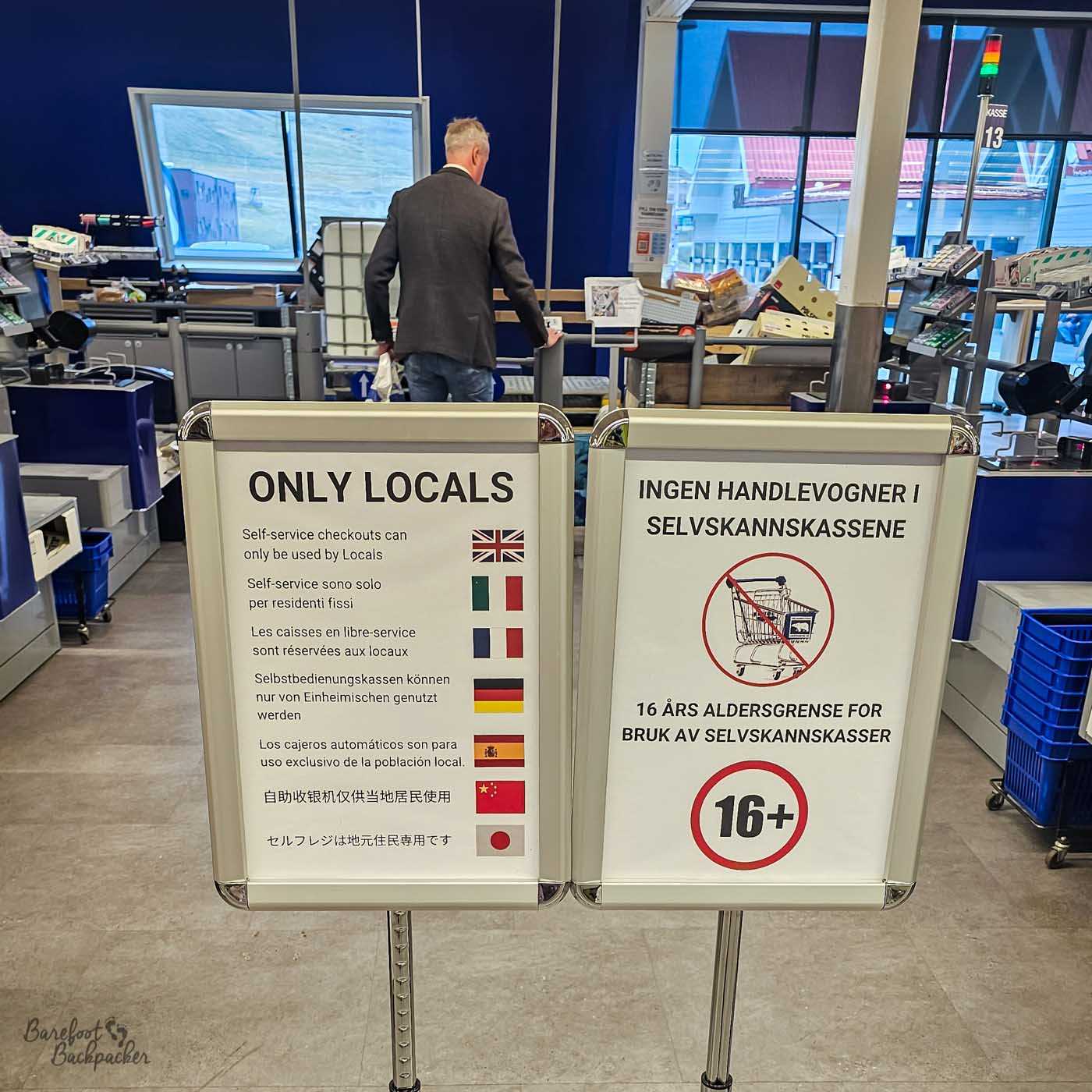
The self-checkout sign in the supermarket.
While I just bought food from the co-op most days I was there, on my last night I visited one of the restaurants around here – Vinterhagen. It’s an interesting interior – full of plants and flowers, making it feel very green and open. They serve a menu full of local food; I had reindeer stew as a starter, seal steak for main, and loganberry cheesecake made from Norwegian soft cheese for dessert. And Svalbard Bryggeri beers, of course.
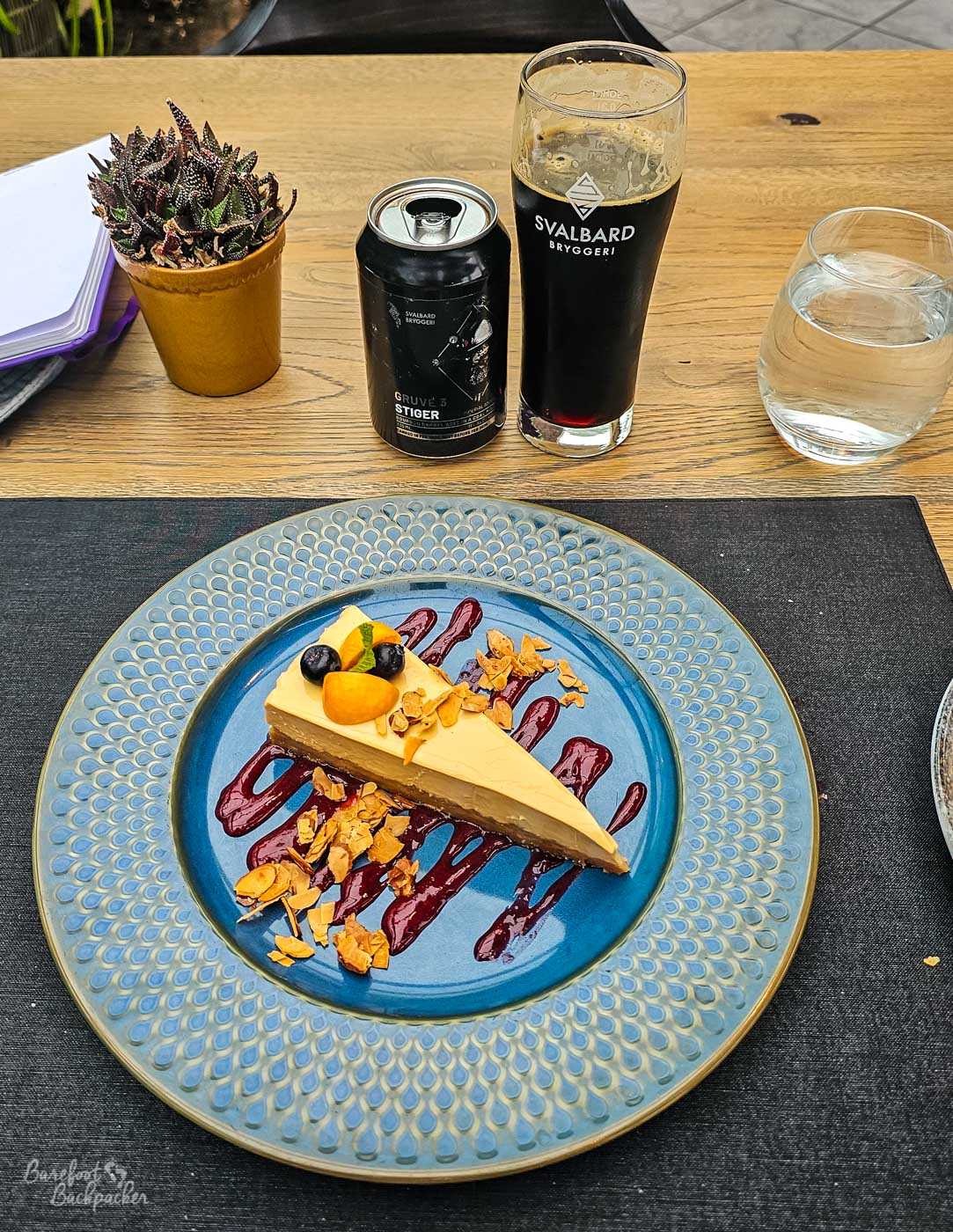
Cheesecake at Vinterhagen restaurant.
Then, while waiting for my bus back to the airport on my last day, I had a brownie and a hot chocolate in a large cafe called Fruene, which advertises itself as “The World’s Northernmost Cafe and Chocolate Shop”. It was created over twenty years previously as a woman-owned and women-led community and coffee centre, and now additionally sells wool and small interior décor.
Where to Stay on Svalbard
For a town as small as Longyearbyen, there are quite a few options to spend the night. The local tourist board say there’s 6 hotels, 3 guesthouses, and a variety of short-term lets, AirBnBs, and the like. You can even camp, and locals will often head out to cabins on the fjords for the weekend with a small boat, a crate of beer, and, of course, a very large gun.
Assuming the closest you want to get to a polar bear are the stuffed ones in the church, airport, and museum, all the accommodation options are in Longyearbyen, and most within a 10 minute walk of the Radisson Blu and the High Street. I stayed in an AirBnB, and it was in a long three-storey wooden block built on stilts on the side of a hill. It was very easy to get to, and it had an equipped kitchen-diner, bathroom, and one bedroom; it was simple but very comfortable.
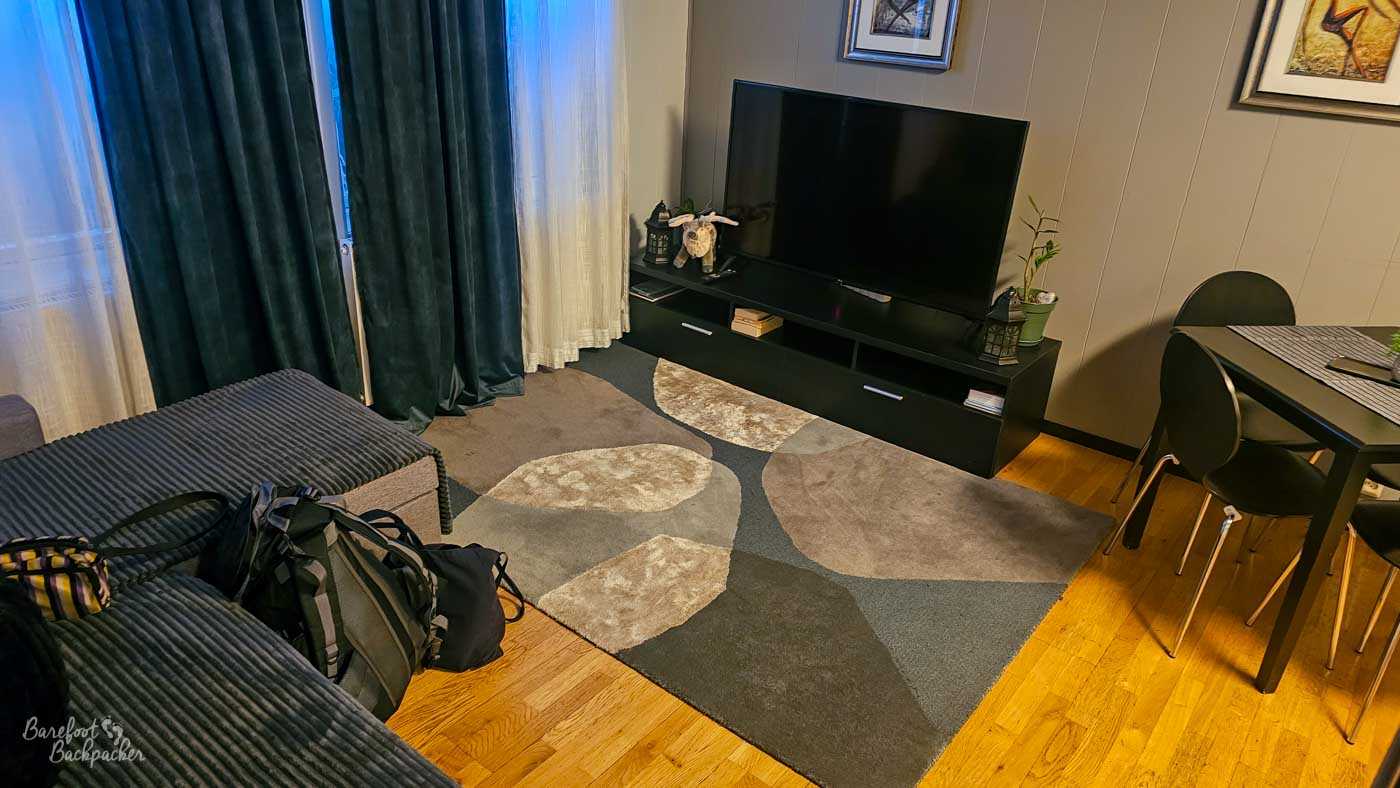
Inside my AirBnB in Longyearbyen
The only thing to be mindful of is even though there’s quite a few options, they do get booked up relatively quickly, and you don’t want to be left with the one hotel room in the centre that’s going for £300/night; at the time of my visit, rooms would have been available for around £130/night.
Barefoot in Svalbard
One interesting quirk of Svalbard culture is the ban on shoes. In some shops and restaurants, many buildings, and even in the Svalbard Museum, when you enter there’s a place where you can hang your coat up. But next to it there’s a bench or shelf where you also store your shoes, so you wander in in just your socks, or indeed barefoot if you’re wearing sandals, tho I never saw anyone do this – even*I* was wearing socks most of the time. Anyway it’s all perfectly normal and indeed expected.
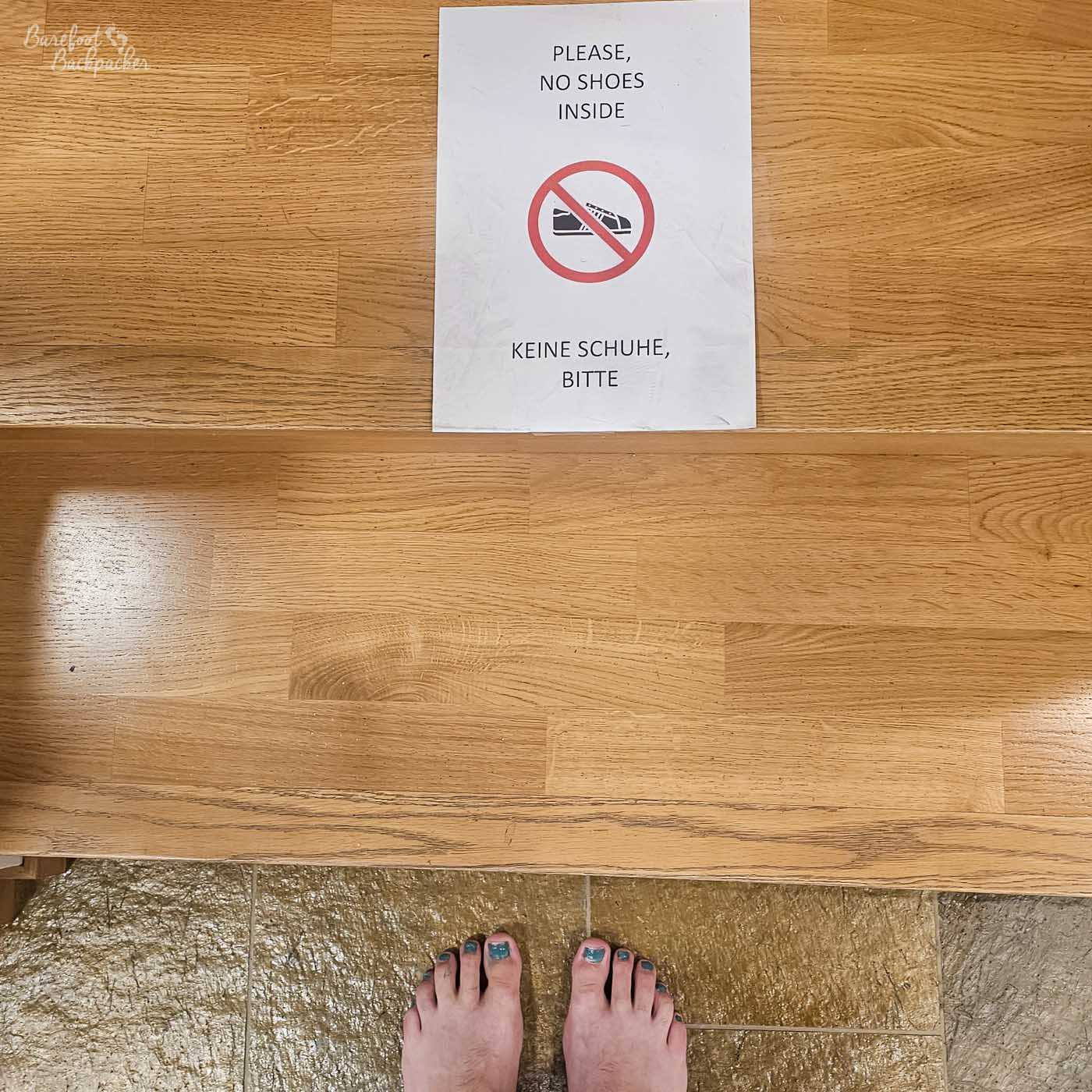
Sometimes I follow the rules. This is from inside the church.
The reason for this is because of the coal mining. As all the mines were close to the town centre, miners would traipse around the town after shifts on the way home. Obviously they would be covered in coal dust, especially their boots. So by ensuring every building was a shoes-off environment, it was much easier to keep their town buildings clean.
Tours in Svalbard
I need to say something about visiting Svalbard in general. It’s not an island that’s geared to independent travel – Longyearbyen has three roads and they all end not far outside town. In any case you’re not allowed past the ‘beware of polar bears’ signs on the roads at the edge of town and at the airport, well not on foot without a gun, a guide, or both. And as Longyearbyen is quite small, most of the experiences you’ll have on Svalbard will be, by necessity, on tours.
Tours in Svalbard obviously vary by season. There’s no real ‘bad’ season to visit, although of course you need to plan your visit to coincide with what you want to see and do; don’t expect to see aurora-lit skies in May, or go birdwatching in November. There’s of course all-year-round adventures to be had, including the mine tours and the fossil-hunting, plus explorations of Longyearbyen itself. Or just spend an evening in a traditional wooden hut in front of a fire and listen to local people talk about the life and history of the place.
Most of the tours will offer pick-up and drop-off at either your accommodation (if it’s a known hotel), at the Radisson Blue hotel which serves the centre of town where most other people will be, or at the airport, making it really convenient. Even the water-based trips which go from the port a little way west of town will provide pickups.