I was recently on a backpacking trip in the southern Caribbean with my friend Laura. Part of our plan involved crossing the border between Georgetown (Guyana) and Paramaribo (Suriname); in case you want to do the same thing, here’s our account of the journey and some information you’ll need to make the experience smooth. Or, smoother than the roads either side of the border, anyway.
Note that the border itself is at the Courantyne River, between the settlements of Moleson Creek and South Drain. There’s no bridge (yet), so the crossing itself has to be done on a ferry,
Costs and Practicalities of the Journey
When we were planning this trip, we didn’t find an awful lot of information about it online, and much of what we did was several years old. In particular, any mention of how you book the journey invariably led to bouncing e-mail addresses and random WhatsApp numbers without any context. However it’s such a common and popular route that it’s really not a hassle finding someone ‘on the ground’ as it were – the best place to ask is your hotel, and it’s almost certain that they know someone, if indeed they don’t have a side-hustle in it themselves.
The cost at the time of our journey was ‘roughly’ $50 USD per person – we gave them, if I recall, 20,000 Guyanese Dollars for two people which works out at about $47.80 USD each. This $50ish USD covers both legs of the journey; you pay the driver the full amount when you arrive at the ferryport in Guyana; he then takes a picture of you and sends it to the driver in Suriname so after you go through immigration, he can easily spot you and take you to the waiting van. On top of the van cost, you need to pay extra for the ferry itself, which you do at the ferryport when you go through emigration, The ferry cost roughly $20 USD per person.
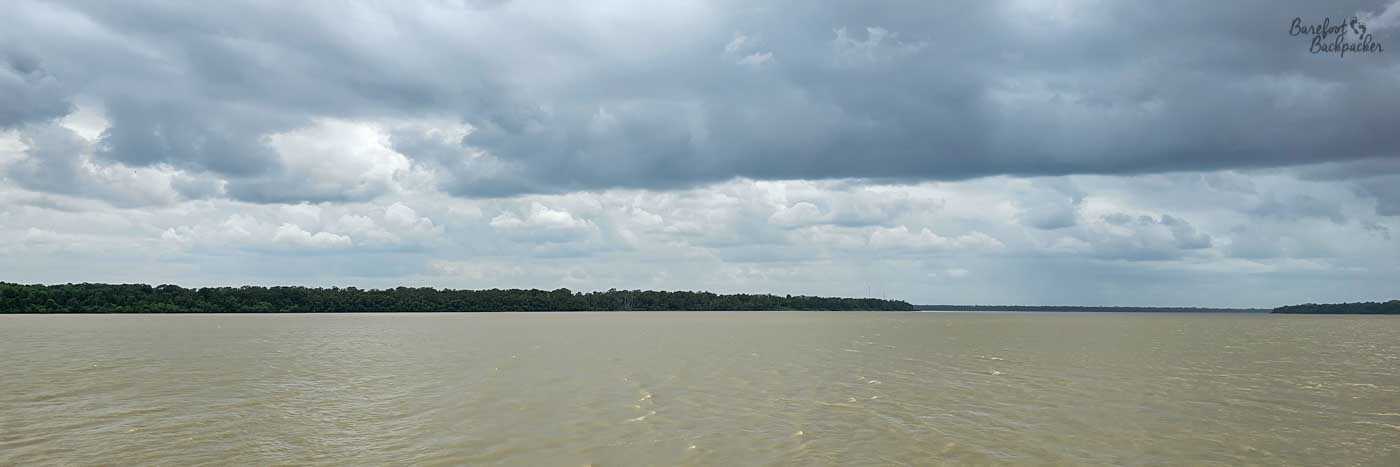
The Courantyne River as seen from the boat.
You may wonder why, if the ferry doesn’t leave until around 10.30-11am, and emigration procedures are quite quick, the vans depart so early to arrive at 7am. The reason is that there’s usually only one ferry a day, it’s not that big, and there’s only small villages near the ports on either side. Therefore the earlier you get to the port, the higher the likelihood it is that you’ll be allowed to board it, and if you’re not, well, there’s not much to do or go for the next 24 hours. In peak season sometimes it makes the journey twice or even thrice a day, but you can’t rely on this. Conversely it doesn’t run at all on public holidays. And you might want to check when those public holidays are as they can creep up on you without warning – for example, despite only being 5% Islamic, Eid is a public holiday in Suriname.
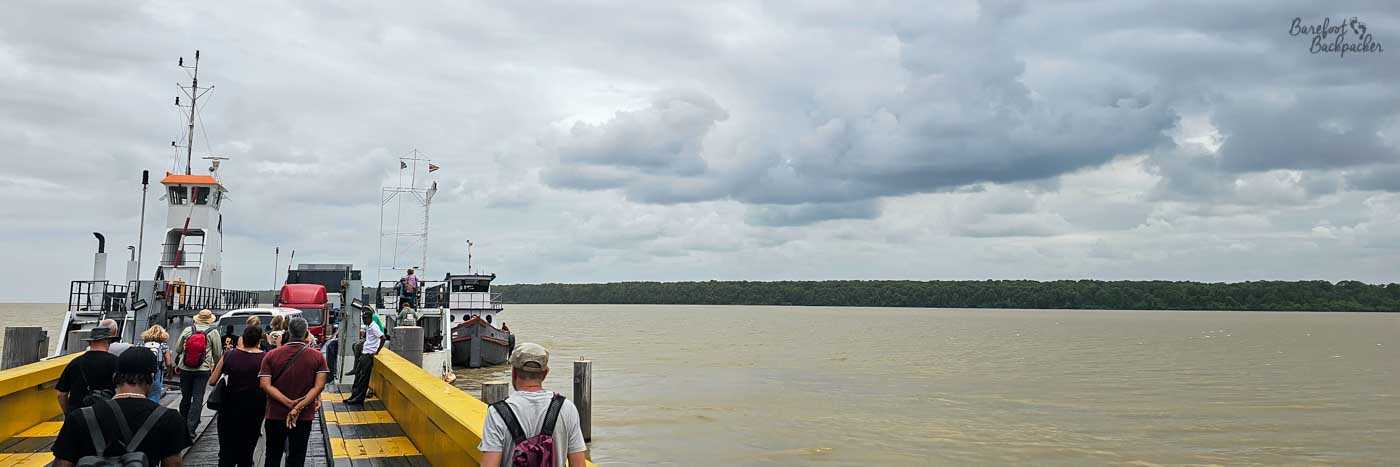
As we boarded the boat in Guyana.
The ferry (the MV Canawaima) has a capacity of around 24 cars and 200 passengers. It started in 1998 (with EU money, $20mil USD), and often breaks down – indeed in the week before we did the journey it had broken down with no estimate on when it was going to be repaired, much to the annoyance of the locals who’d been stuck on it at the time. Fortunately they managed to fix it before our arrival. Also, there’s literally nothing to do on the ferry. It’s not like a cross-channel ferry, it’s more like those that plough between Hebridean islands, or shuttle across bays connecting city suburbs in places like Seattle. It’s a car park that floats, with small seating areas high above along the sides.
Other Admin you’ll need to be aware of
Although we as Western Tourists didn’t need visas, there is still admin to do. You need to fill in a departure form online on leaving Guyana – if you haven’t done it by the time you reach the ferryport, it does have Wi-Fi – and fill in both an entry form and a customs declaration form, again online, before entering Suriname; all of these forms you need at least proof of completion, if not a copy of the form itself.
On entering Suriname, you also need proof of having had the Yellow Fever vaccination – certificates are checked on going through the emigration post at Guyana. If you don’t have a Yellow Fever vaccination and/or certificate, these can be obtained at the hospital in Georgetown, near the 1763 monument and the Botanical Gardens. It’s open roughly 8am to 4pm but closes at lunch from 12 to 1. Vaccinations are free, quick, and embarrassing. They’re also very common amongst both tourists and locals – on our visit there were two other couples, both Guyanese. And why did we need Yellow Fever vaccinations? Because we both forgot we needed to bring our certificates.
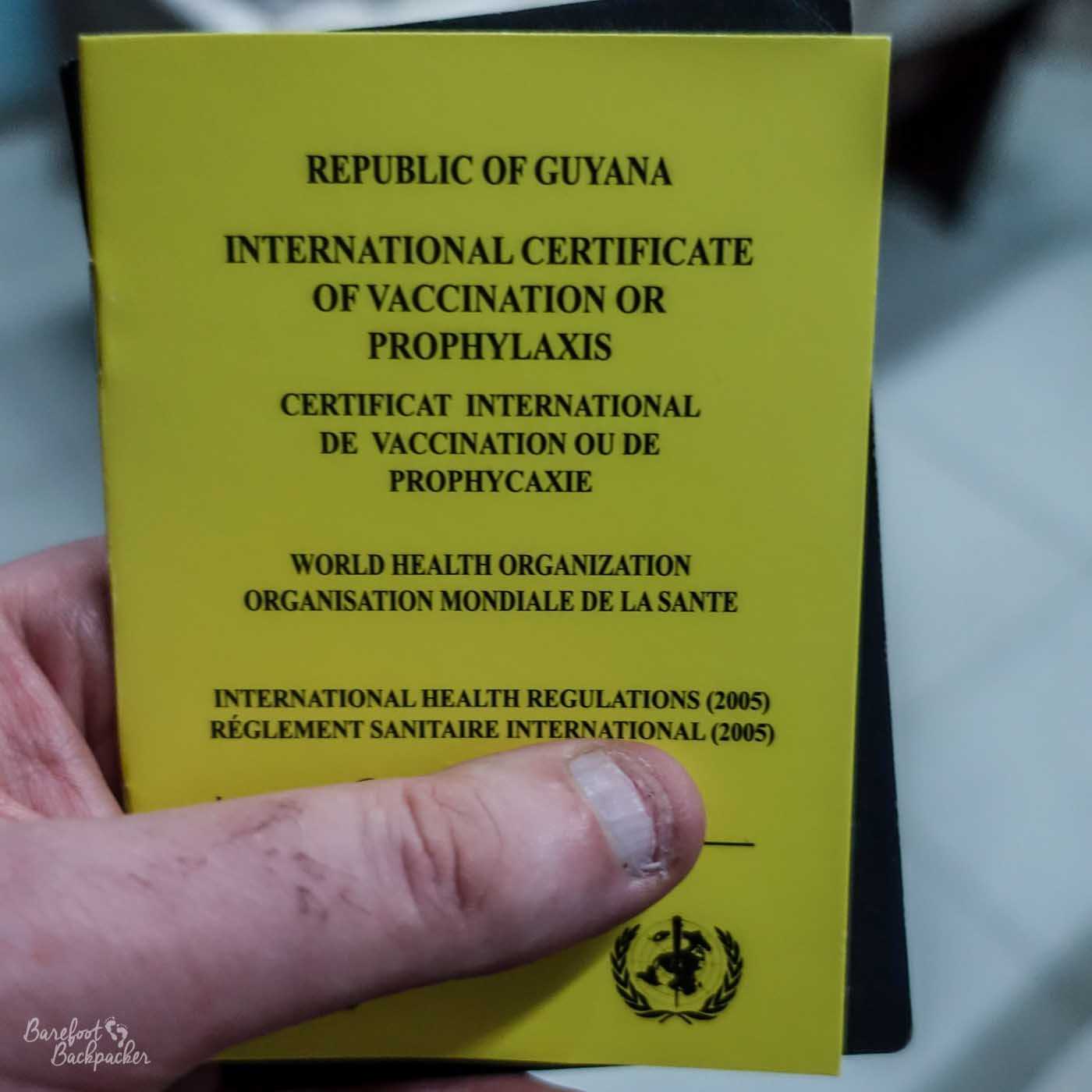
My new Yellow Fever certificate. The old one is still at home, yes.
But that’s another story.
Our experience of the route
We were told the van would come and pick us up from the hotel at 4am. Which is a ridiculously early start given we’d only arrived at the hotel around 4am the previous day. Imagine our surprise then when, having set the alarm for 3.15am, we had a knock on the door at 3.20am asking if we were ready. Grudgingly, we were on the move at 3.40am.
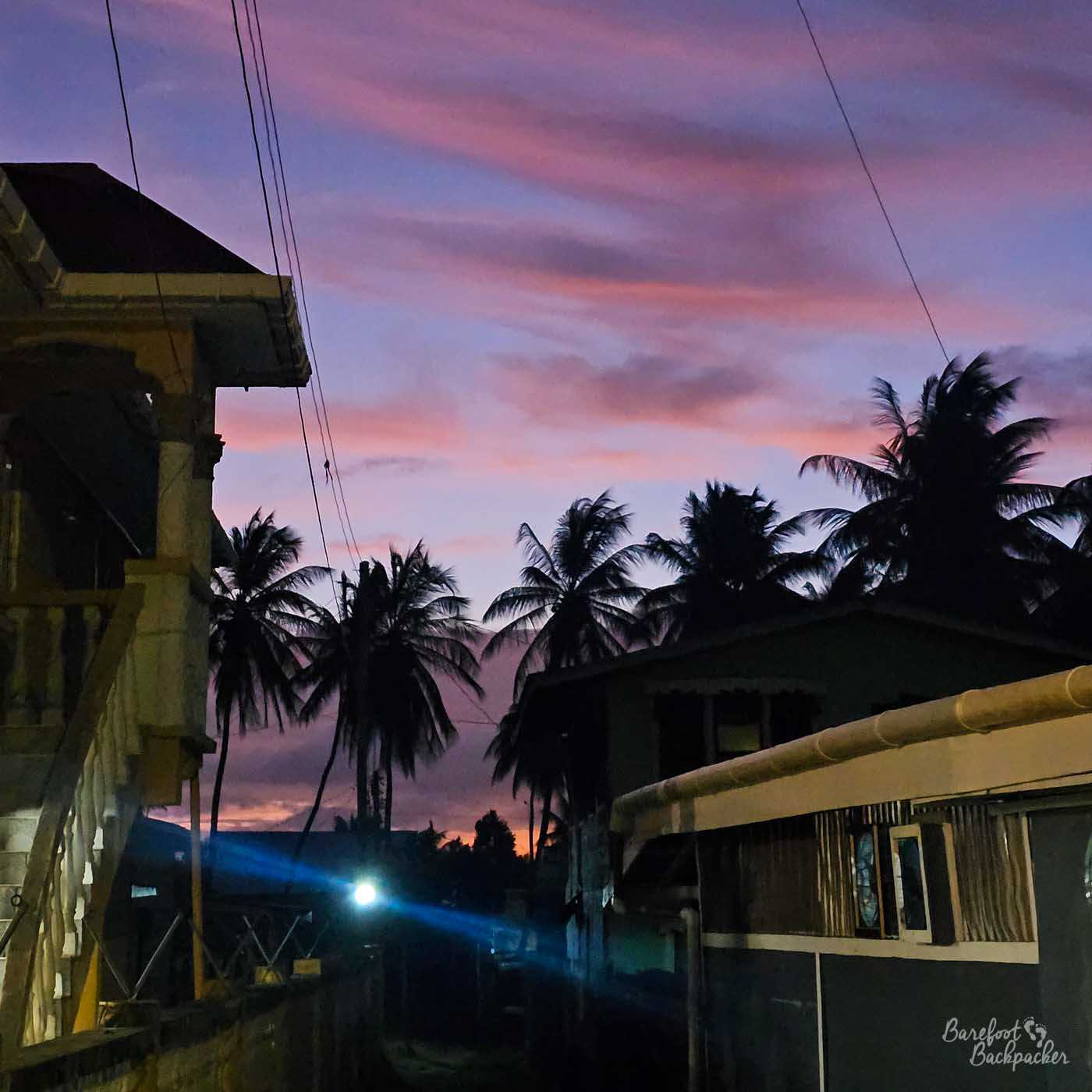
Our morning stop at a cafe partway through Guyana.
The journey through Guyana largely took place in the dark; this may have been a blessing as even when dawn came, the scenery was generally quite dull. A bit like eastern England, with flat fields and straight water channels. We stopped around halfway in a small town with a food shack where people could have breakfast.
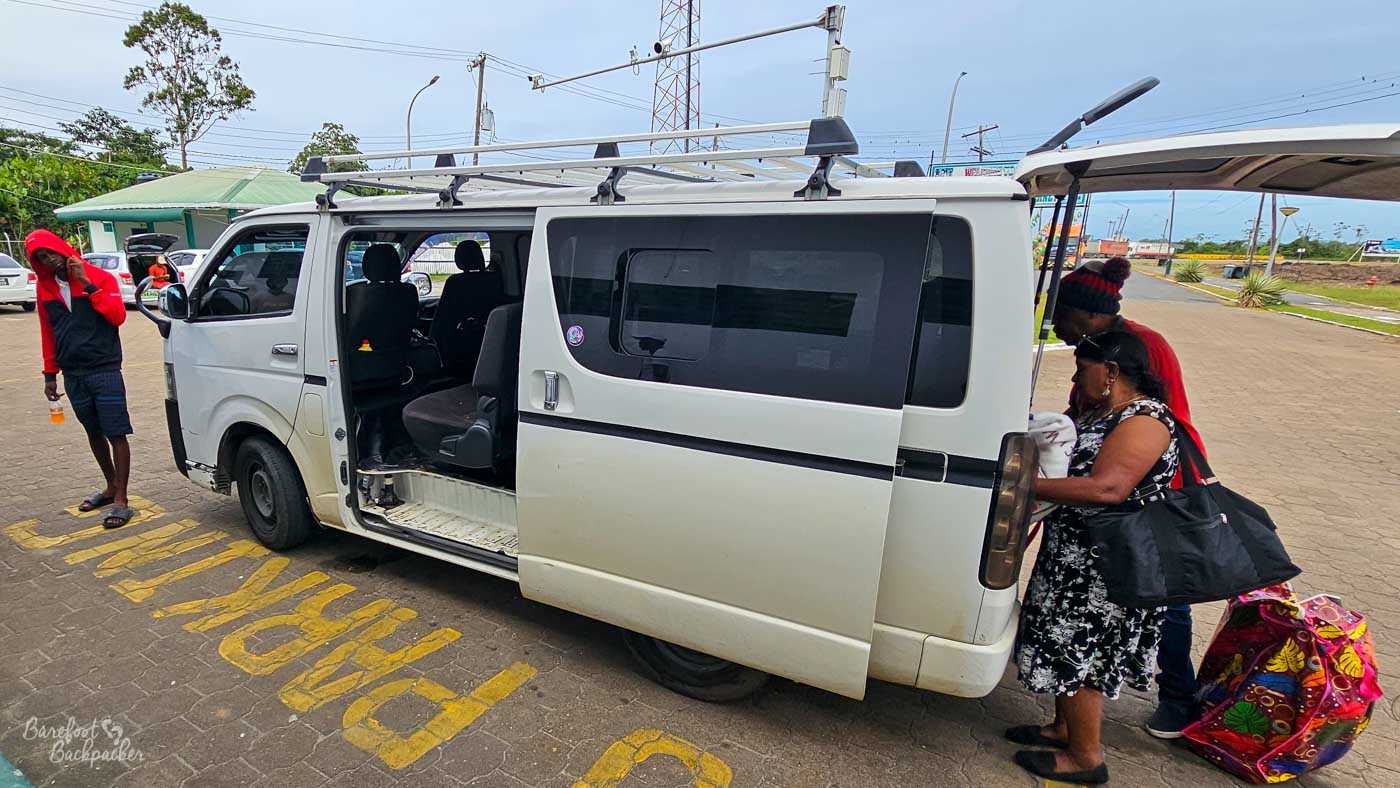
The minibus that took us from Georgetown to the border.
The van on the Guyana side was quite old and quite cramped; fortunately we didn’t have much luggage. I was also lucky in that I was seated near the door so could stretch myself out a little. We were the only obvious tourists in it.
The journey took 3hrs 20min; we arrived just after 7am. Going through exit formalities was pretty speedy and simple, and then we just sat around in the ferry terminal until the boat left. There’s not a lot to do in the ferry terminal – it’s one room with seating, a small food kiosk selling biscuits and fried chicken, and the toilets, with a long open corridor under an awning that led back to emigration. There’s also a small parking zone and two duty free shops, though I didn’t notice if they were open, let alone see anyone using them. Although not on our vans, we did see quite a lot of tourists also waiting for the ferry – the vast majority of them were Dutch.
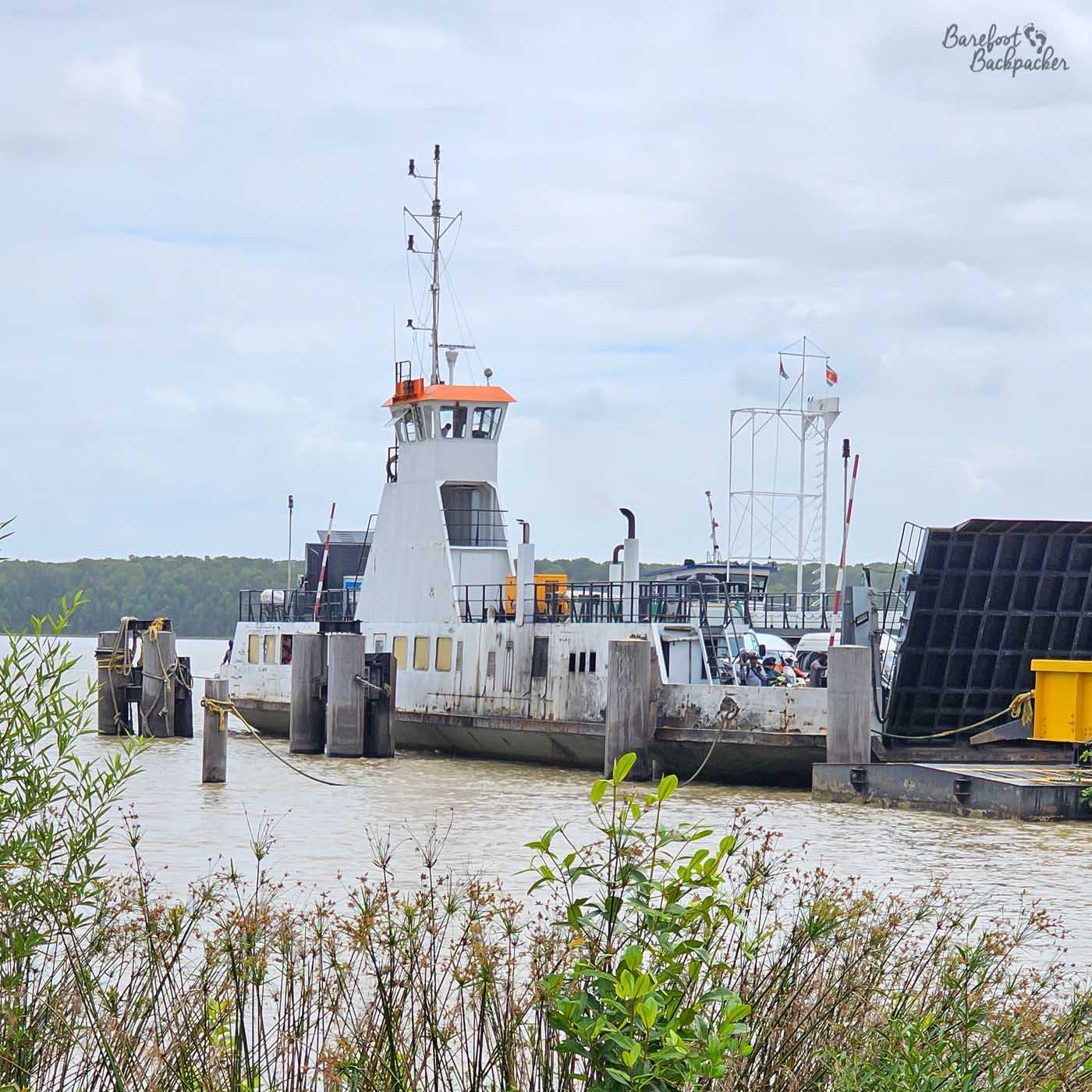
The ferry, while it was docking at the Guyana side of the river, taken through the fence from near the duty-free shops.
The ferry left about 10.40am and took roughly half an hour. It’s due to leave at 11am but evidently times are flexible (I guess if it’s full they just go when they’re ready). We did notice something very weird; the vehicles reverse on, which is an impressive achievement on such a narrow roadway. Given the ferry had a ramp at both ends, we don’t know why they do this, and the Internet didn’t help.
Immigration into Suriname was pretty quick too; I guess there weren’t that many people on the ferry, even if you include all the vehicles.
We left the ferry terminal about 1pm and arrived in Paramaribo about 5pm – the last hour was spent slowly inching through traffic in the outskirts of the city. In world terms it’s not a very big city – population around 260,000 – but that’s half the population of the country and there’s pretty much only three roads in, so the traffic kind of clogs up.
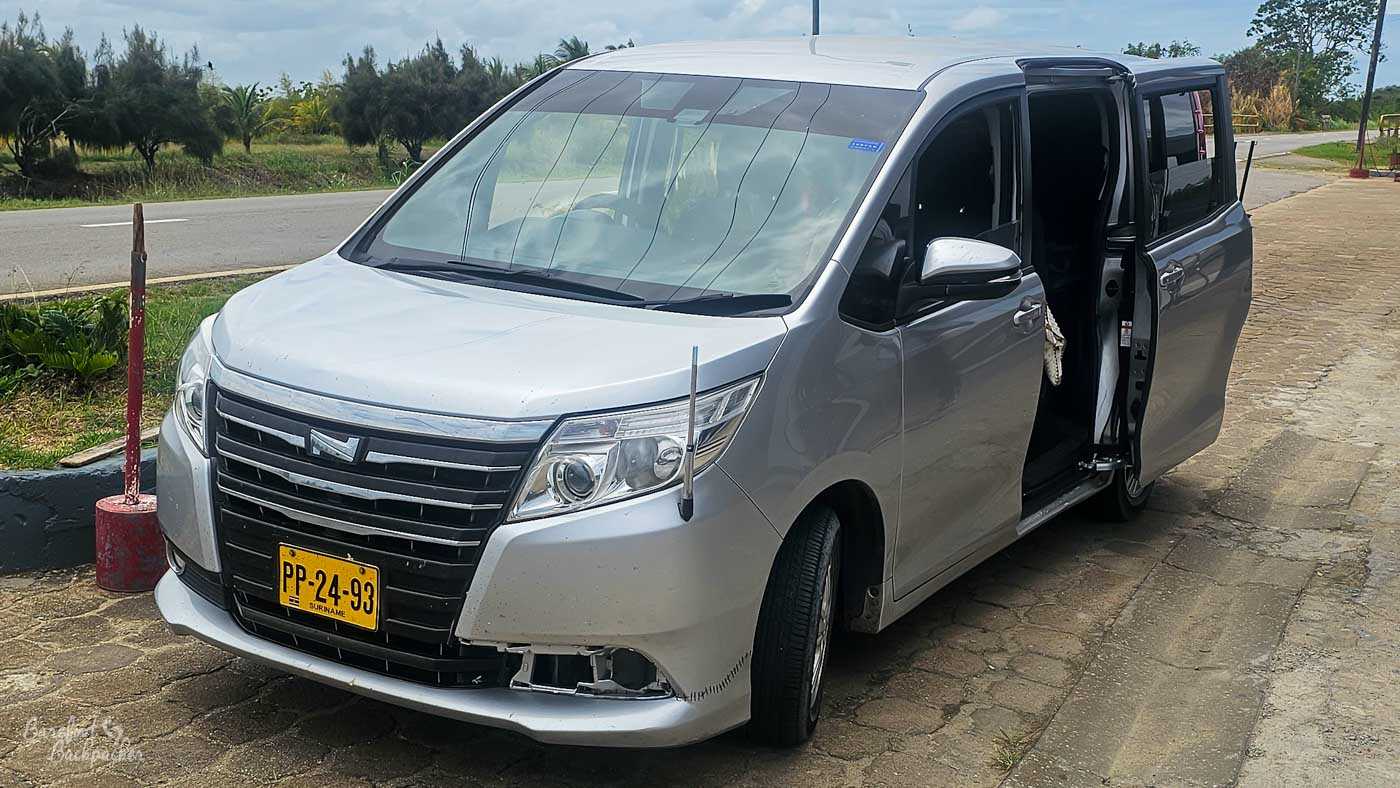
Our van that took us through Suriname.
The van on the Suriname side was newer, sleeker, and much less comfortable. I didn’t have as much legroom and the seats, which initially felt softer, soon grated on me, Again, we were the only obvious tourists, though it was clear it was a very multicultural journey – we heard four languages spoken (English, Dutch, French, and one of the local languages). In front of us for the whole trip was a baby who made virtually no noise for all 12 hours. Kudos.