Wuthering Heights is a novel published in 1847, and written by Emily Brontë. It tells the tale of the families that lived in two houses on the moorlands – the eponymous Wuthering Heights and the larger nearby Thrushcross Grange – and ever since, the location and the mood have been popular with a certain aesthetic. I lived within hiking distance of Haworth, the town where the Brontë sisters lived, so it seemed obligatory for me to wander out onto the moors and find the places she wrote about.
Top Withens
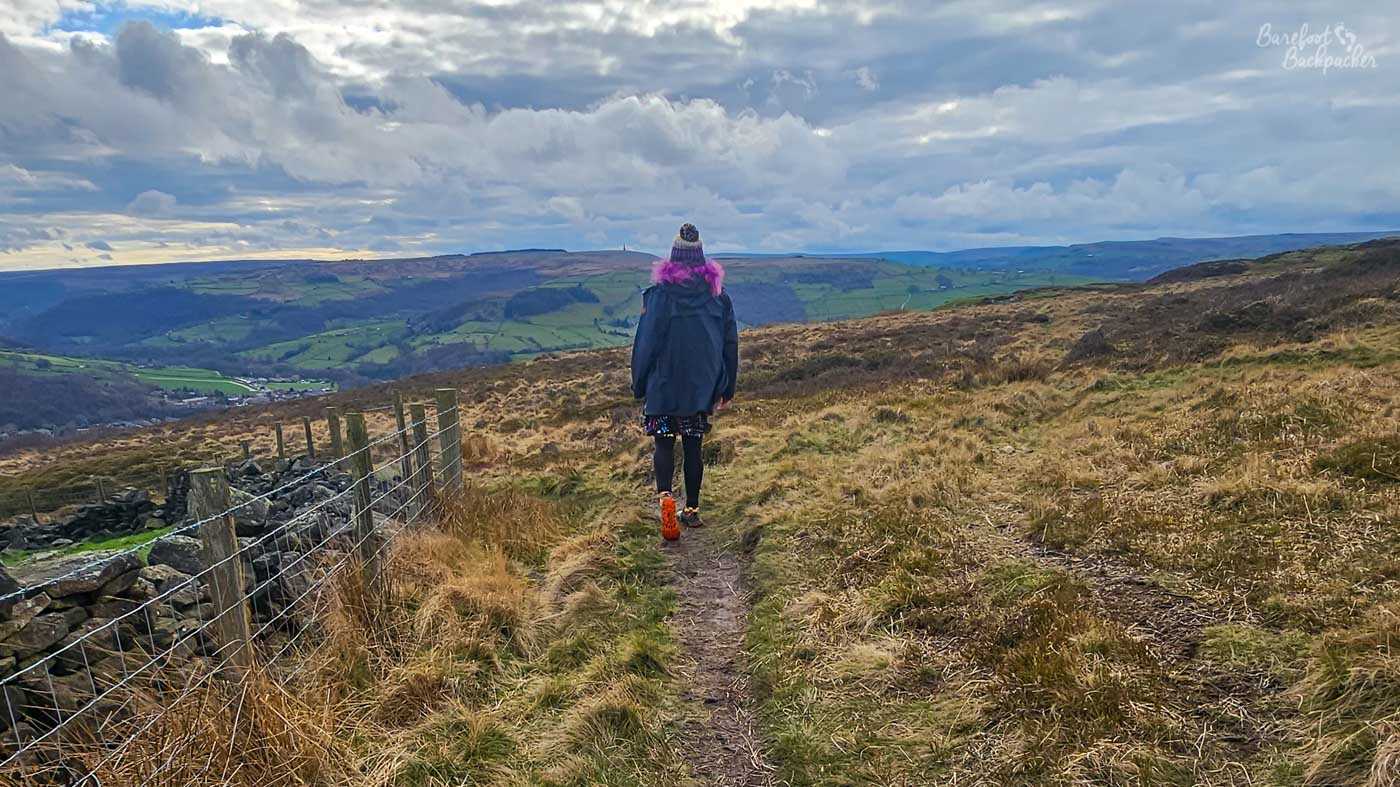
The site that’s most associated with Wuthering Heights is known as Top Withens, a ruined farmhouse on the edge of Haworth Moor and Wadworth Moor, 423m up and just over 5km from Haworth town. Some maps refer to it specifically as Withens Moor. “Withens” is a Yorkshire dialectal word for ‘willows’, which are these days in short supply.
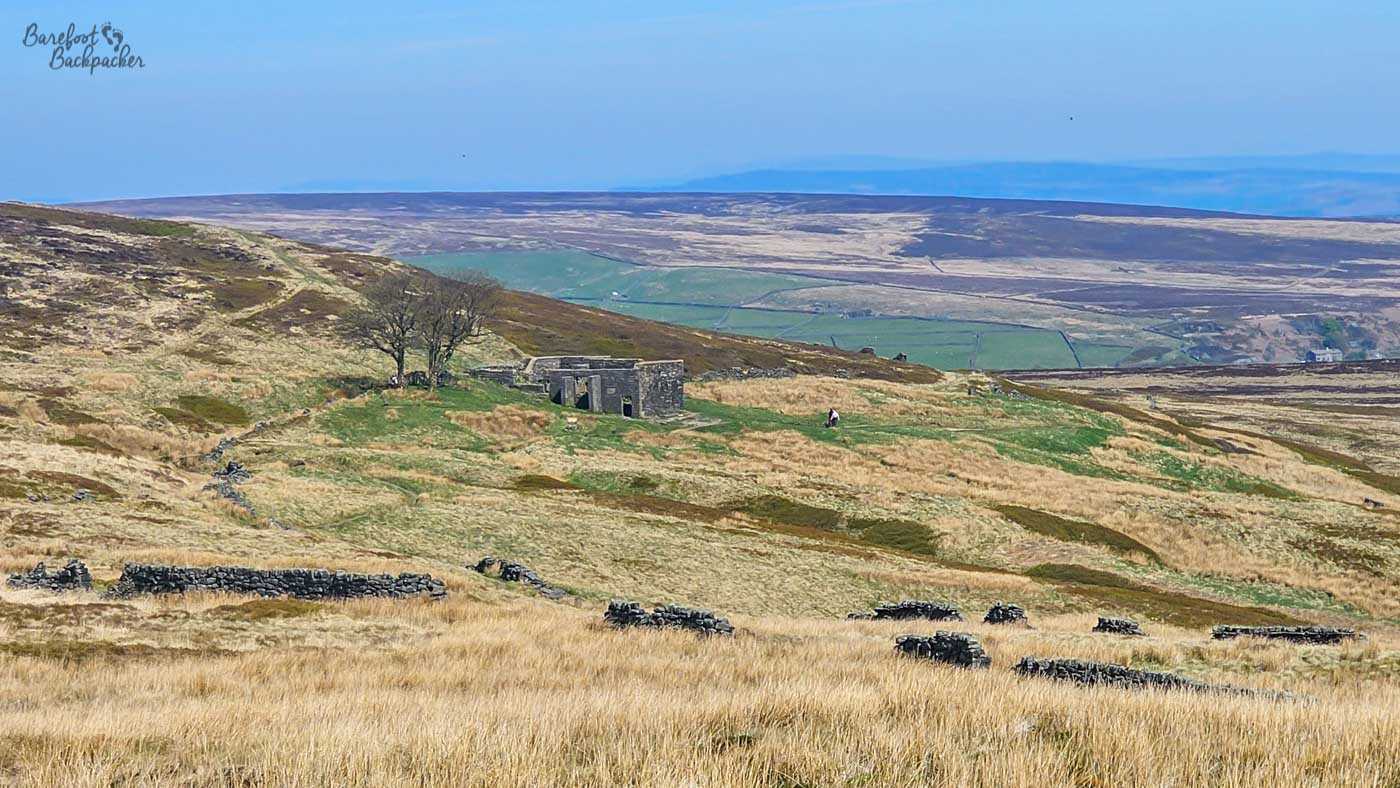
The landscape that Top Withens is situated in.
Approaching Top Withens from the south, along the Pennine Way from the Calder Valley, is slightly anti-climactic. You know it’s there, and it’s a good waypoint for tracking how far you’ve gone, but when you first see it you think ‘is that it?’. And to be truly honest, that’s pretty much what you think when you get there. Ruined farmhouses and barns are ten-a-penny on the moors, and in this particular case there’s not even that much left – there’s many more substantial ruins elsewhere on the moors.
The site isn’t on the moor top; rather it’s set a few metres below it, and set quite snugly into the hillside. To the southeast there’s a small plain before it rises again; the cottage is almost in a kind of hollow. All that remains are the framework of what seem to be two buildings; the main complex and, slightly up the hill, the barest shape of a smaller block, maybe a barn. You can cross the threshold and look inside but they’re nothing more than overgrown stone boxes – high walls, no ceilings, not much in the way of detail. As you approach, the main building looks like it’s a small place with maybe two rooms; as you get closer you can see it goes back a bit, and from the north side you can see what amounts to a lean-to.
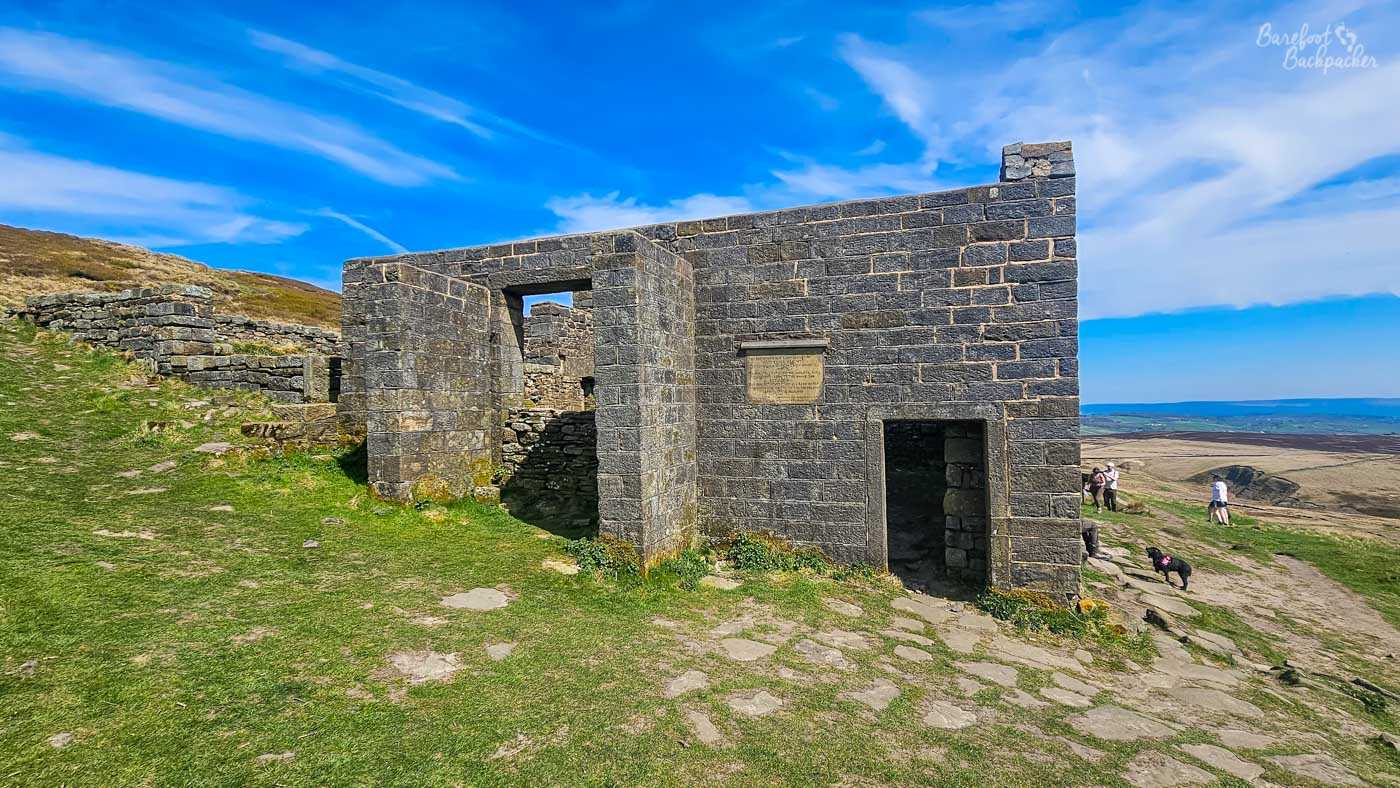
The ruins of Top Withens closer up.
It’s also not even Wuthering Heights.
That is to say, while the ruins of Top Withens have seeped into hiking folklore as being ‘the inspiration for the novel’, and while Emily Brontë herself would very likely have known of these buildings, and while the location matches some of the scenery-painting she does in the novel, the chances of Top Within itself *being* Wuthering Heights, or at least the direct inspiration thereof, is quite low. Indeed there’s a plaque on the wall that reads: “This farmhouse has been associated with “Wuthering Heights”, the Earnshaw home in Emily Brontë’s novel. The buildings, even when complete, bore no resemblance to the house she described, but the situation may have been in her mind when she wrote of the moorland setting of the Heights.”
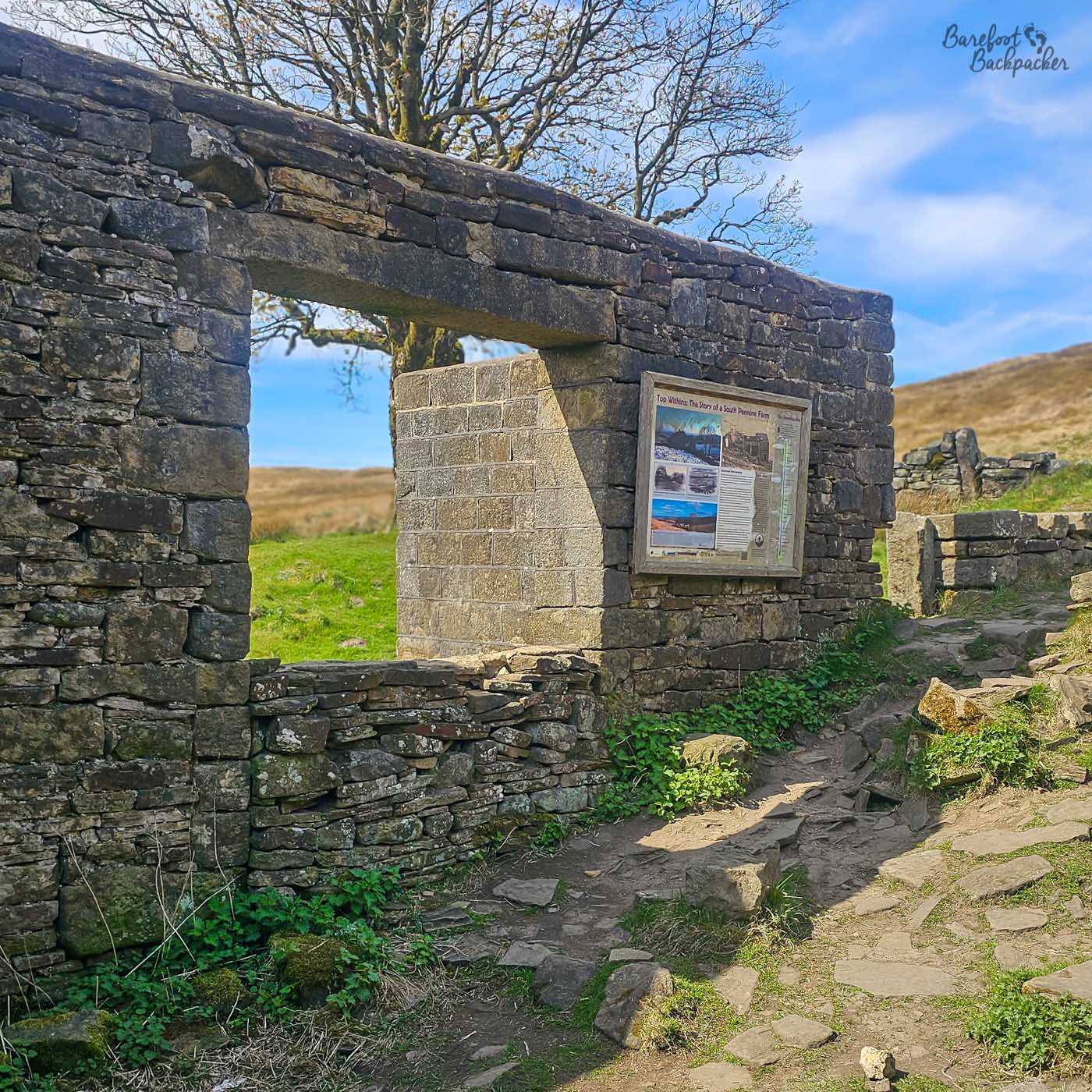
Inside the ruins of Top Withens. You can start to see how big it isn’t.
The main reason for this is it’s far too small. Top Withens is only two small buildings. While Wuthering Heights isn’t large, and certainly not in comparison with Thrushcross Grange, if you get close to Top Withens you can clearly see that the descriptions in the novel portray a complex much bigger than the ruins of Top Withens would have been, even when complete.
The association comes primarily from Ellen Nussey, a long-time friend of Charlotte Brontë, who suggested to the artist Edward Wimperis it would make a good illustration for his cover for the 1872 edition of the book.
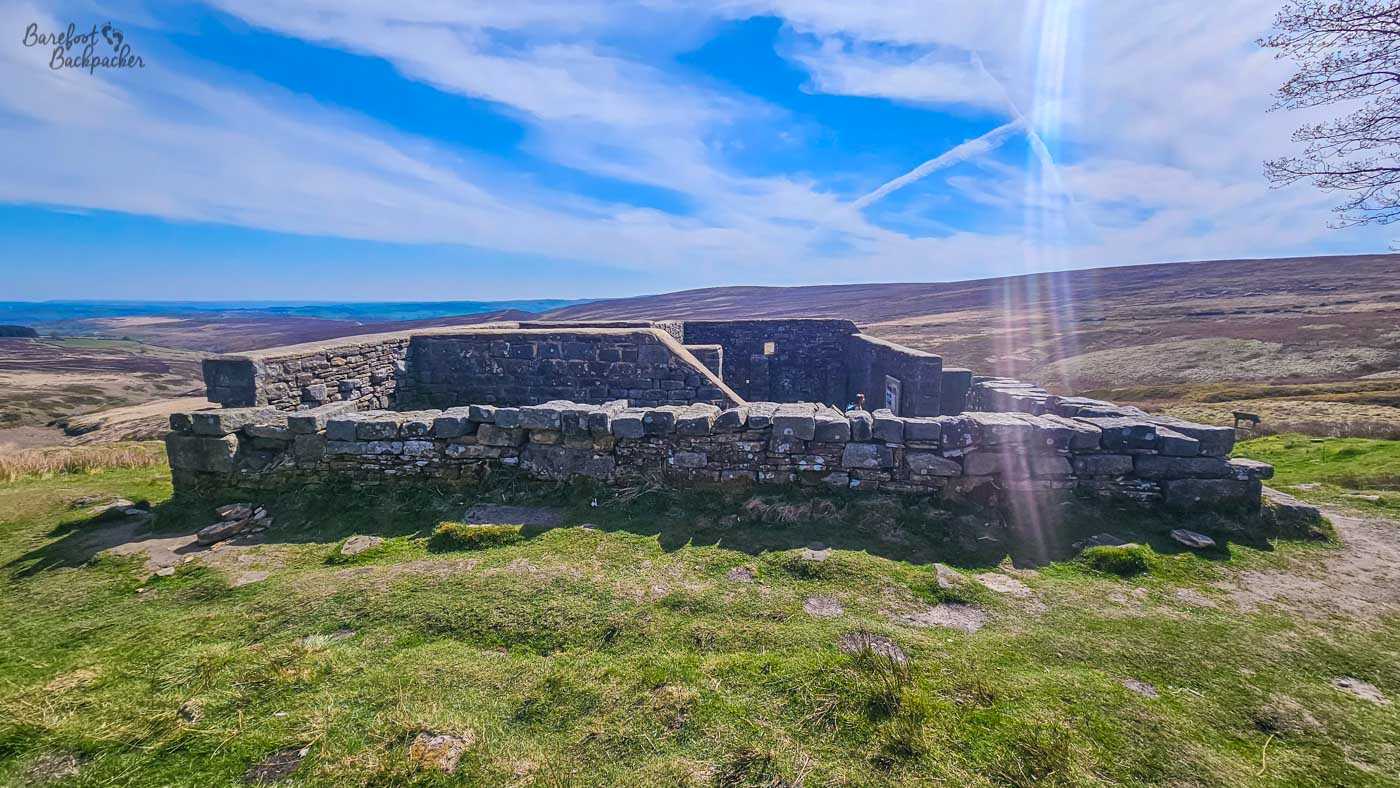
Above the ruins of Top Withens. Apologies for the sun flare; it was uncharacteristically sunny that day.
Top Withens was likely built in the late 1500s, and abandoned probably in the 1930s; being isolated farm buildings on the moors some distance from the nearest road, and unable to be cheaply connected to mains water, gas, or electricity, meant it just became impractical to live out here. John Lock published “The Souvenir Guide to Haworth: Home of the Brontës” in 1956 and described a visit to Top Withens thus (at this point it had been uninhabited for thirty years): “Entering through the narrow porch, you come into a large raftered room with a stone fireplace. A second, smaller room lies through the door opposite, containing also a stone fireplace and from the window of which there is a fine view over the moors towards Haworth. Through a door to your left you pass into a narrow vaulted cellar. On entering this there is an opening on your left, a small compartment with a square shaft in the roof. Putting one’s head through this one finds oneself looking through the floor of a large barn which was formerly the peat house.”. Not exactly screaming “big house”, is it?
So if not here, where was Wuthering Heights? If indeed it existed at all?
Ponden Hall
The main suggestion is Ponden Hall, not far to the north. Both Top Withens and Ponden Hall stand on the Pennine Way, the UK’s most famous and treacherous long-distance footpath. But while Top Withens is very much on the moors, Ponden Hall is on a small country lane, just above a reservoir, and close to the only road heading west out of Haworth, towards Colne in Lancashire. Interestingly, the Wuthering Heights lore is that, if Top Withens was Wuthering Heights, Ponden Hall was Thrushcross Grange. However, Ponden Hall has far more going for it as the novel centre. For one thing, it’s the right size and setting for the depiction in the novel – it’s nowhere near as large as Thrushcross Grange was described as being, and the latter is specifically noted as being located in a park, which Ponden Hall is not. It was bigger before the reservoir came, but it was never a huge manor house like Thrushcross Grange.
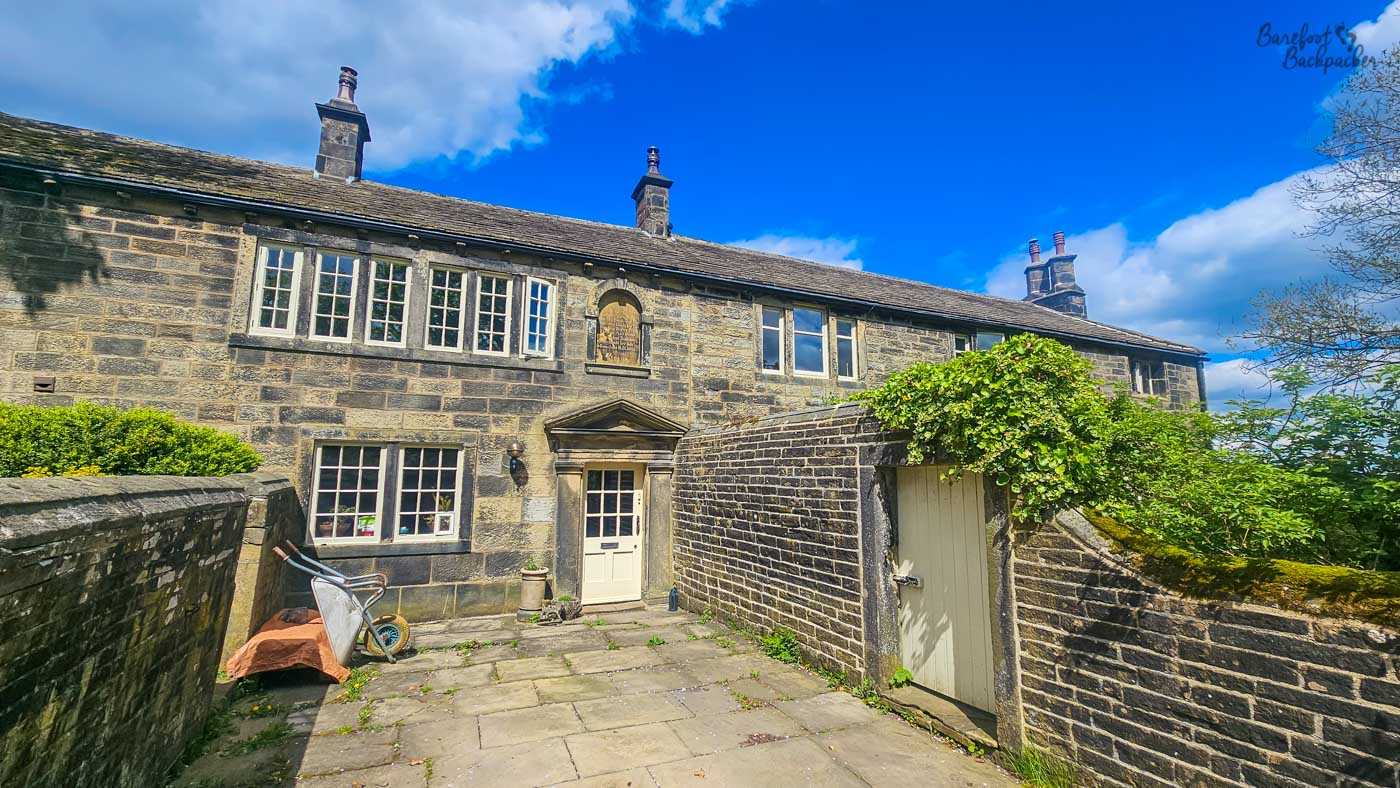
View of what remains of Ponden Hall from the road.
It’s known that the Brontës visited Ponden Hall on a semi-regular basis, and Emily used the library quite often (it included an original Shakespeare First Folio, and was ‘the finest in the West Riding’, an area covering much of Yorkshire), so would have been fully comfortable using it as an inspiration for something in her novel. Interestingly her sister Anne is believed to have used it as the base for her novel “The Tenant of Wildfell Hall”. The owners of Ponden Hall in their times were the Heaton family, one of the more notable families in the area, who often served as the local magistrates and wardens of Haworth Church. Furthermore, in 1896, a travel blogger called William Davies published an account of a visit to Haworth in 1858, where he met Patrick Brontë (presumably the father of the Brontë sisters), who took him on a little tour of the area. He wrote: “On leaving the house we were taken across the moors to visit a waterfall which was a favourite haunt of the sisters … We then went on to an old manorial farm called ‘Heaton’s of Ponden’, which we were told was the original model of Wuthering Heights, which indeed corresponded in some measure to the description given in Emily Brontë’s romance.”.
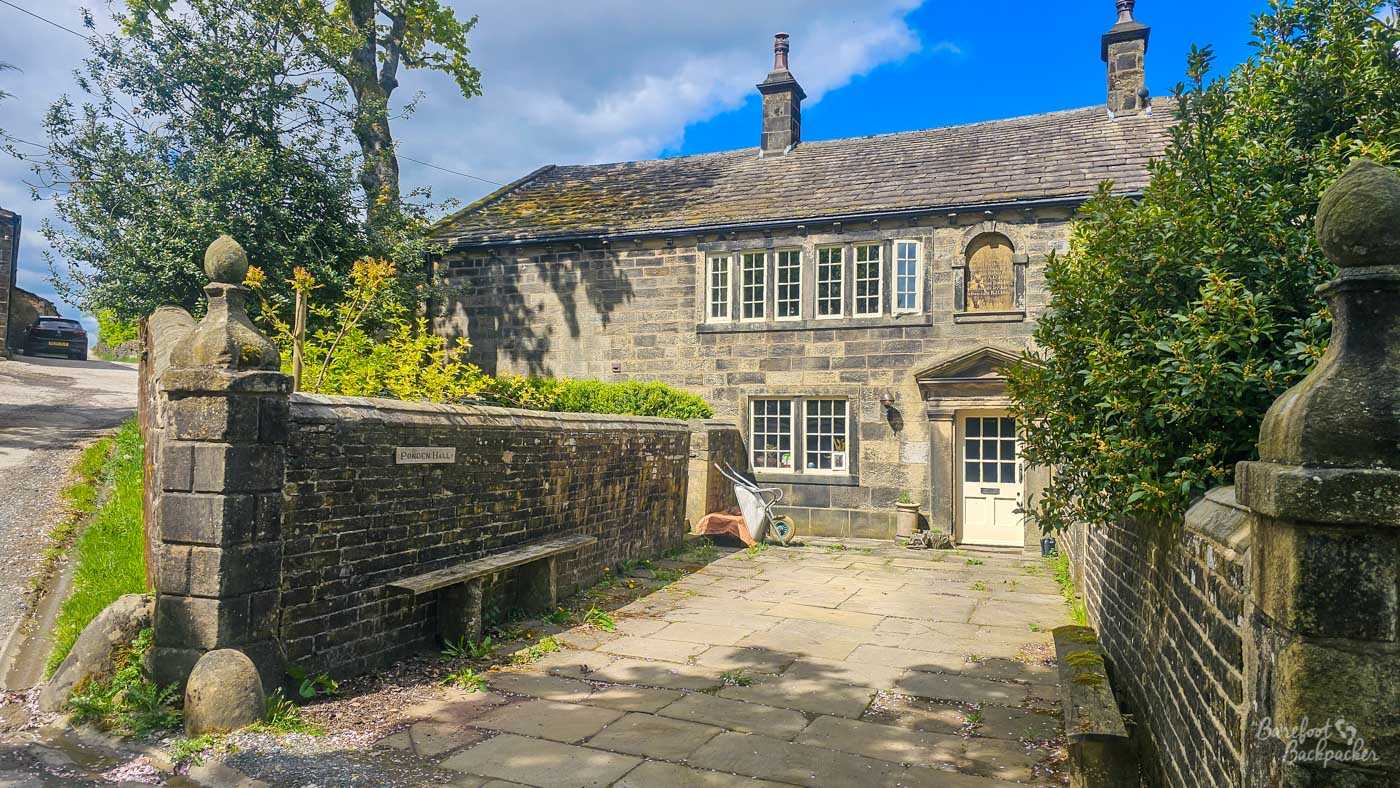
Another view of what remains of Ponden Hall. It’s not the easiest of buildings to photograph.
The Hall itself was built in the mid-1600s, expanding on a site that had been inhabited for a hundred years by that point. A separate ‘Peat Loft’ was constructed in 1680 – a two-story building designed to dry peat (on the upper floor) by using the lower floor as a cowshed and allowing the cows’ natural body heat to rise. The Hall was refurbished and modernised in 1801, curiously the year the framing storyline of Mr Lockwood is set, when the Peat Loft was connected to the main hall and converted into a living area with a courtyard and a library. Due to the expansion and additions to the Hall over the years, it’s a little unclear as to what still survives. Certainly the Peat Loft does, but the farmstead over the road was demolished in the 1950s, and there’s apparently little remaining of the original Hall itself, though it’s on private property and behind the Peat Loft so it’s a little hard
to judge. What remains is a Grade II* Listed building though. The Peat Loft is, now, a lovely stone cottage, quite long (giving the impression of a small row of old terraced houses), hidden slightly from the road by an array of trees. It’s predominantly grey, in a ‘quaint village stone cottage’ way, with small rectangular windows and a portico door. It’s not a big driveway any more but you could easily fit two cars in it end-to-end. It’d be a great place for a weary traveller from London to reach, settle in, sleep, and listen to tales of its history over breakfast. And indeed, until recently, you could; it was operated as a B&B with rooms with names like “The Earnshaw Room”, but it closed and was sold off around 2020, and it’s unclear what it’s used for now, or even if it’s just a normal family home.
High Sunderland Hall
The other site suggested as being an inspiration for Wuthering Heights itself, in look and style rather than location, is High Sunderland Hall, which is just north of Halifax. Or was; it was demolished in 1951 as it had fallen quite into disrepair. The site is now a small farm, in the rolling hills, and there’s seemingly nothing left of the original buildings. Originally it was another 16th Century manor house, probably along the same size as Ponden Hall at its height, and it was noted for its elaborate wooden carvings, indeed many contemporary visitors describe them as ‘grotesque’. This matches some of the descriptions in the novel of the décor of Wuthering Heights itself. While this hall was some 12½km SSE of Haworth, note that Emily Brontë spent a few years as a schoolmistress in a village called Bank Top, only a few km further to the south, and almost certainly would have passed by it regularly as she went to and from home. In addition, several of the Sunderland family who owned it moved to Haworth and were baptised by Patrick Brontë, so it’s very likely she would have been quite familiar with both them and their home.
The other thing to note is, and while this is almost certainly going to have been true of Ponden Hall, and indeed pretty much any significant manorial house of the time, High Sunderland Hall is specifically noted to have had ghosts, in particular the severed hand of a woman (not the woman, to be clear, just the hand) knocking at windows and trying to open doors. It’s said the hand was cut off in a fit of jealousy by her husband; not that jealousy is a theme in the novel, not at all. The general suggestion is that she took the outside of High Sunderland Hall, stuck it on the front of Ponden Hall, and placed it more-or-less where Top Withens is. Which makes for an odd building all round, really.
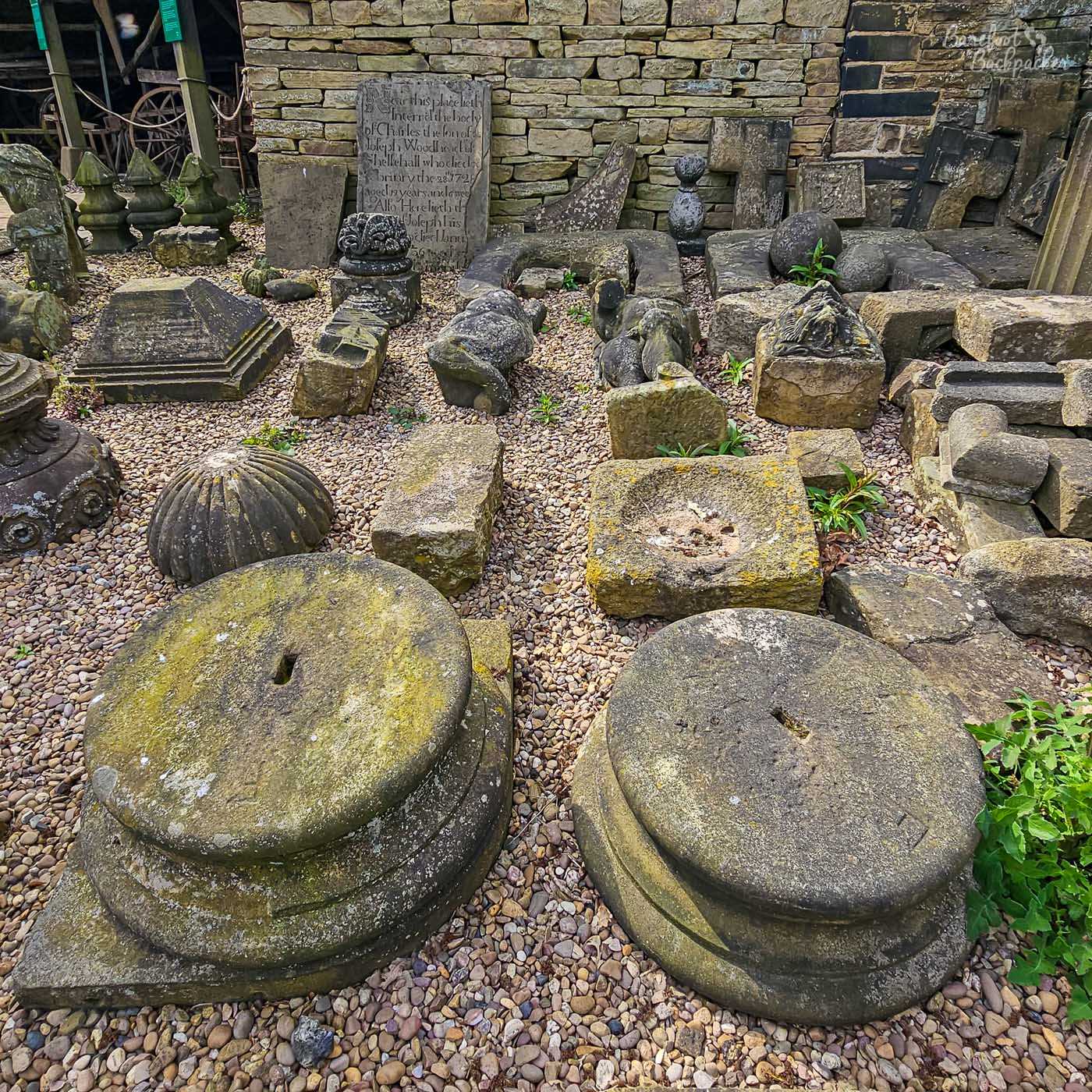
Detritus from High Sunderland Hall, on display at Shibden Hall. Some of it matches the descriptions of Wuthering Heights.
Although long demolished, there are some surviving remnants of High Sunderland Hall. But for that we have to go in search of the other manor house in the novel, Thrushcross Grange,
Shibden Hall
In the novel, it’s noted that you can’t see Thrushcross Grange from Wuthering Heights because the moors are in the way, which would be true if the original theory held and Top Withens was Wuthering Heights. However, the location of High Sunderland Hall gives us a strong alternative contender. Between it and Bank Top is Shibden Hall, a Grade II* Listed manor house dating from 1420 and still with a very definite Tudor aesthetic.
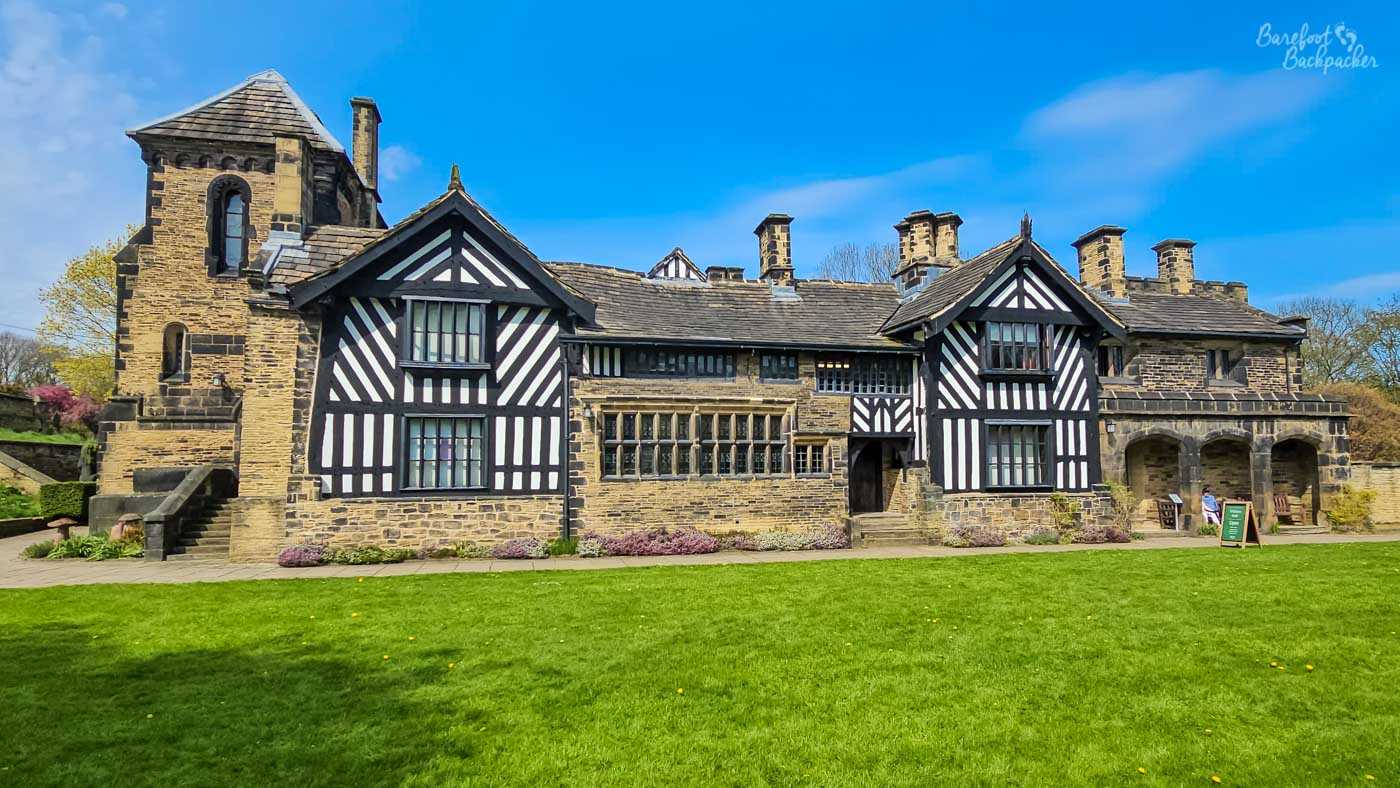
The frontage of Shibden Hall.
During the Brontë era it was owned by the Lister family, rich cloth merchants and mill owners and, interestingly, they were contemporary with one Anne Lister, probably the most famous Lesbian Travel Blogger to have ever lived, and the subject of recent TV series ‘Gentleman Jack’. There’s no evidence Anne Lister ever met any of the Brontë sisters – they moved in very different circles – but it’s nice to imagine they could have passed each other on the streets of Halifax. Though probably not in any of the pubs there.
Thrushcross Grange isn’t described in anywhere near as much detail as Wuthering Heights so matches are as fuzzy as the average Google search, but Shibden Hall does tick off some boxes. It’s in the right place (being a little distance south of Wuthering Heights, albeit twice as far from Haworth as it should be), it’s the largest building around by some distance (although some might say it’s *too* big; the Listers were notably richer than the Lintons are said to be), and it’s set in 36 hectares of parkland, which, while smaller than the novel’s description of Thrushcross Grange (which make it seem closer in size to Chatsworth House, some 60km away on the other side of the Peak District, and more aligned to Pride & Prejudice), makes it still the largest and most impressive building around.
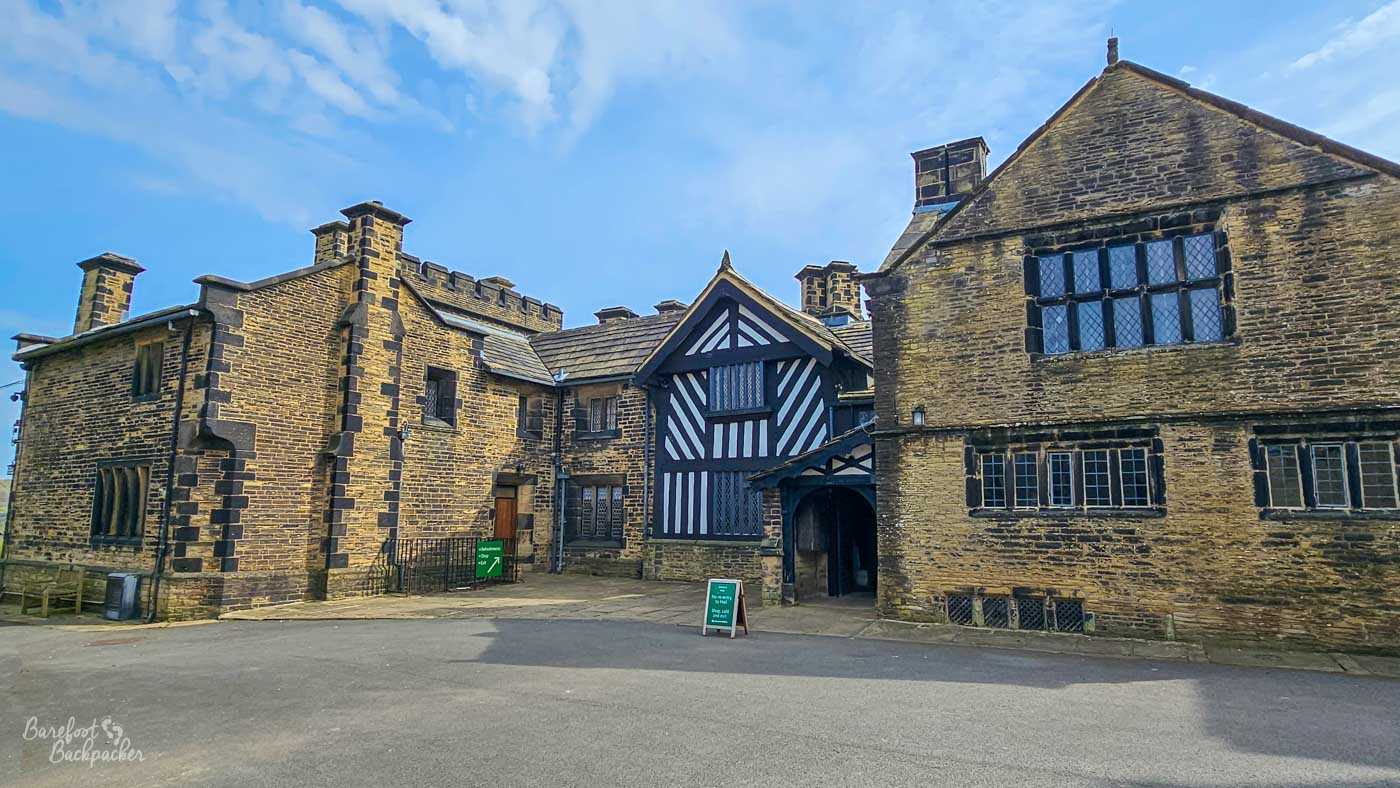
The back side of Shibden Hall.
As you might expect, the Hall has been expanded over the centuries, and as such it’s a bit of a mishmash. The Tudor panelling has contrasting beams and light-coloured infill, and shares the front space with what the internet tells me is a more Gothic influence, with stone construction, arches, and robust chimneys, and even ‘witch posts’ – spikes on the roof to stop witches from landing. Apparently it was the rage in the 17th Century to replace timber structures with stone ones, but here they seem to have only gone partway. The inside of the Hall is what you’d expect; downstairs is full of wooden-panelled corridors with flagstone floors leading to rug-covered rooms with laminate flooring and high ceilings, filled with antique wooden furniture and iron fireplaces, while the upstairs has more evidence of the Tudor elements on the stripe-painted walls and the (much lower) ceilings. Some of the rooms in the Hall, notably the Study, have been finely painted to make the walls look like oak, while others, like the dining room, have images painted directly on the walls to resemble paintings or wall-hangings – while known as ‘poor mans tapestries’ they would still have been very expensive to commission. In the grounds, a barn was added in the 17th Century; internally this is made of small white brick and has a huge ceiling with exposed wooden beams and rafters in quite an intricate pattern.
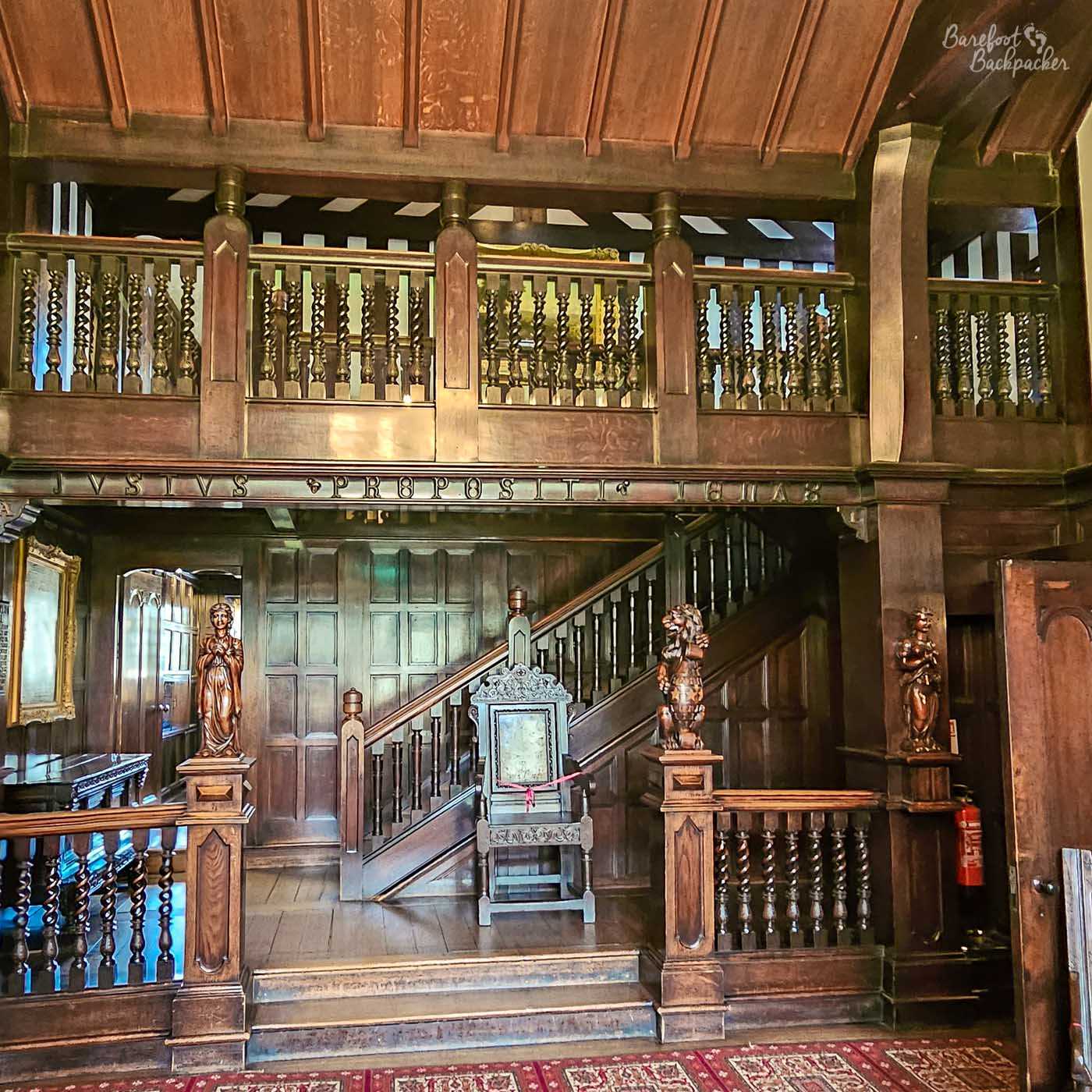
Inside Shibden Hall.
The whole site is now a museum, operated by Calderdale Council, having been donated in the 1920s by the last owner, John Lister The main building has an overview of the life and times of the people who’ve lived in it, while the barn contains exhibits about artisinal crafts, including blacksmithery, barrel-making, and leather-working, as well a collection of period carriages, including those of the type that would have been used by Lockwood to get to Wuthering Heights in the first place, By the barn is also a small collection of remnants of the stone décor from outside High Sunderland Hall, including gargoyles, that very closely match descriptions of the outside of Wuthering Heights.
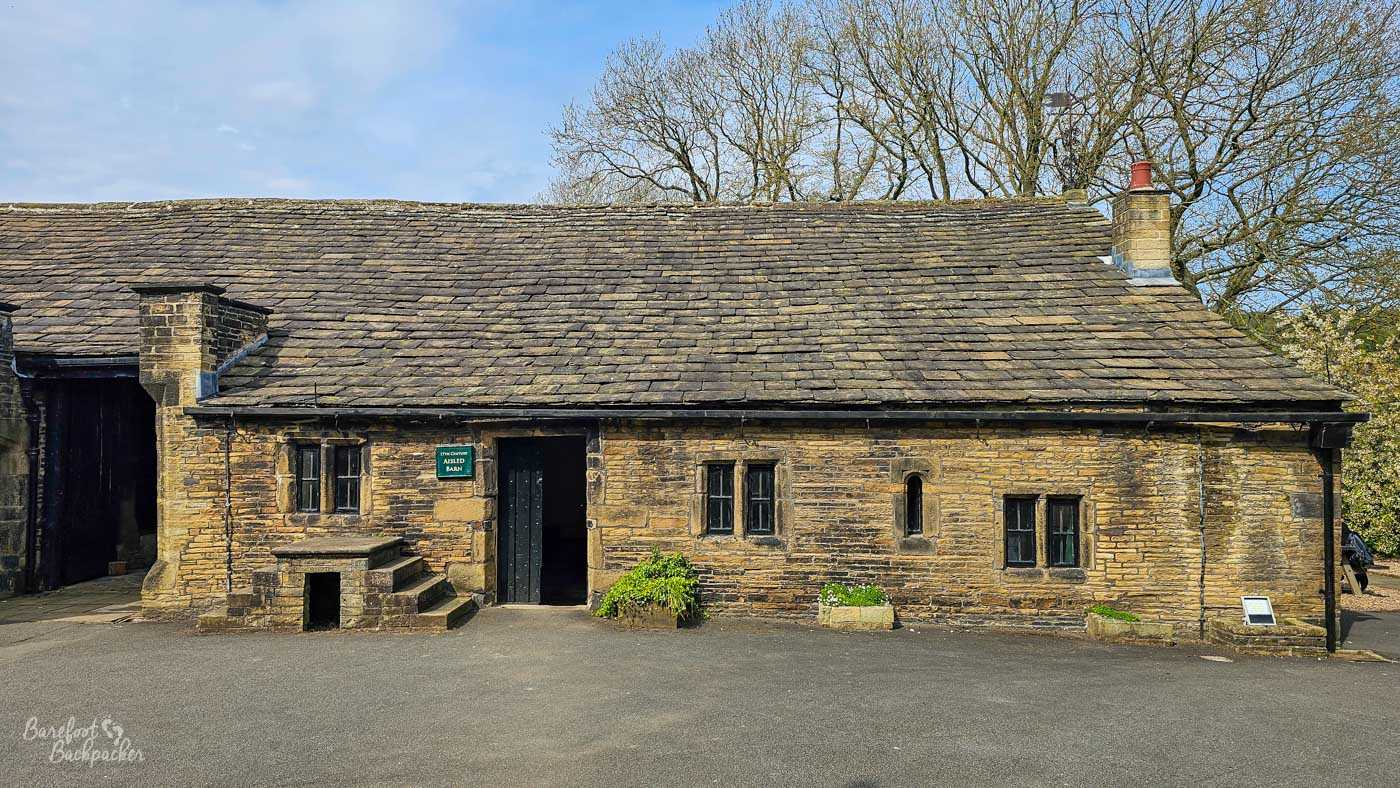
The barn to the rear of Shibden Hall.
The parkland, Shibden Park, contains a café, miniature railway, boating like, and even an orienteering course through woodland. While definitely not a dead ringer for Thrushcross Grange, it’s certainly going to have been in Emily’s mind when fleshing out the idea of “a big manor house”.