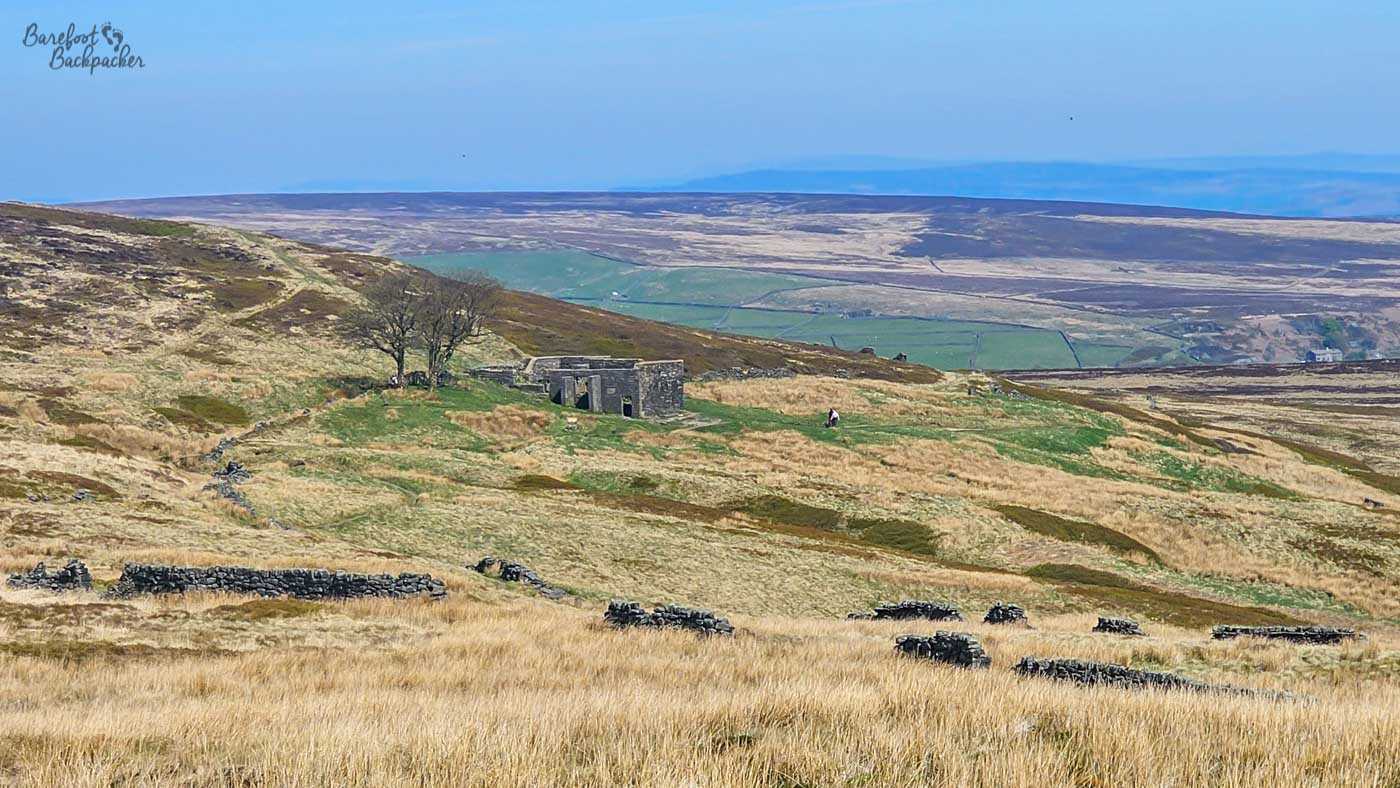
I was not expecting the day to go quite the way it did. I was taking a long weekend on the island of Jersey, to meet a friend, and my flight back to Manchester was cancelled. I took the opportunity of this extra day to visit the Jersey War Tunnels museum, and doing so kicked off a whole series of events and learnings that lead directly to me telling this story. If you want more context, I made a podcast about the background to the War Tunnels a couple of months ago.
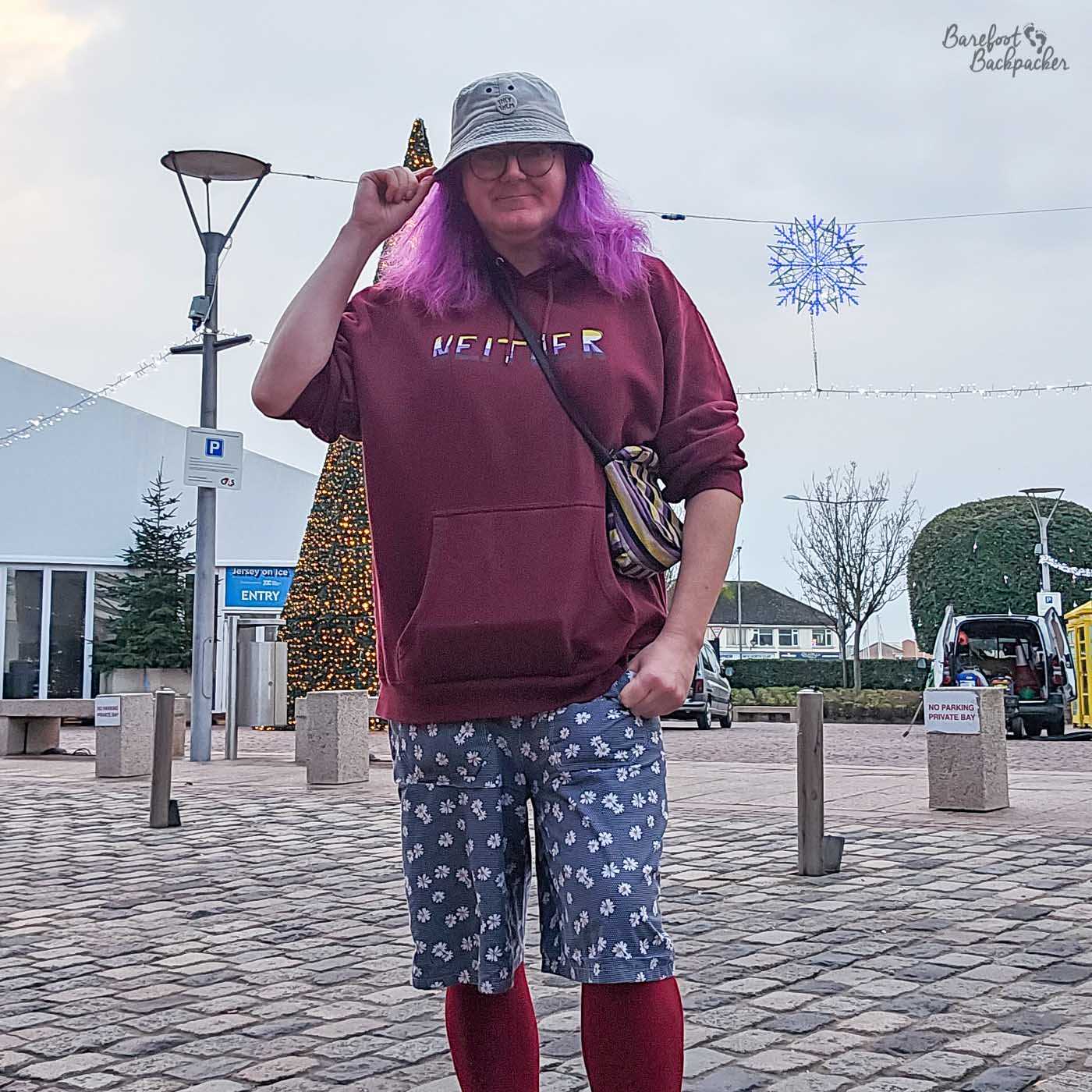
How I dressed when I visited the museums in Jersey; pic taken near the Jersey Museum in the centre of St Helier
My attire that day unexpectedly became important. A maroon baggy hoodie, with the word ‘neither’ written on the front, in the colours of the non-binary flag. Baggy dungaree shorts, blue with a floral pattern. Maroon leggings, and sandals, because it’s December. My hair is a vibrant purple, I have a stone-blue hat with a they/them badge pinned to the front, and I’m carrying a shoulder bag also in non-binary flag coloured stripes.
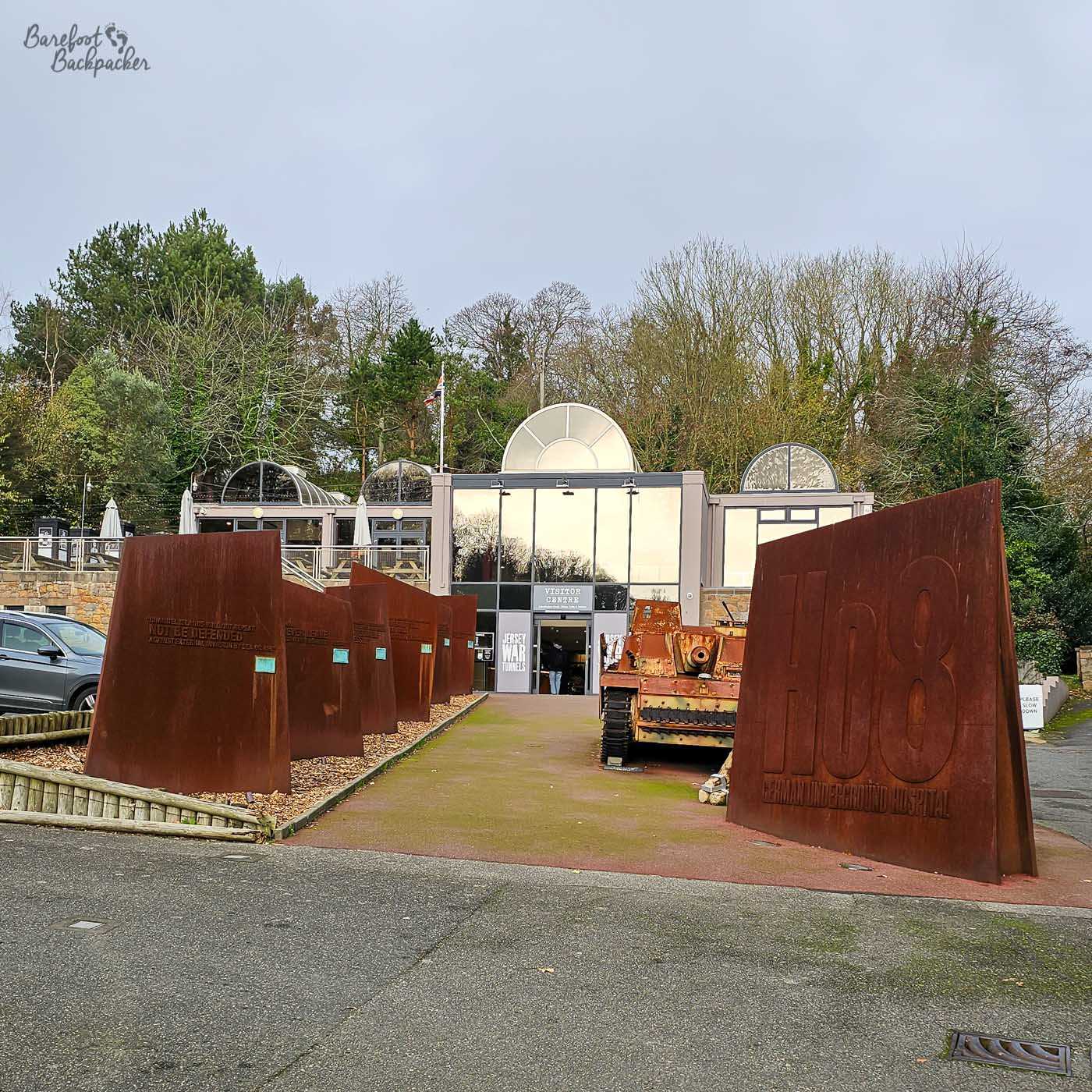
Entranceway to the Jersey War Tunnels Museum information centre.
The Jersey War Museum is one of those museums where you get given an item related to someone you can follow the progress of as you go round. In this case it’s copies of genuine identity documents issued by the occupying government to keep track of its citizens. Potentially completely at odds with who you are – it’s just a way to keep you engaged. I walked into the museum on a quiet day and I was the only person there. In principle the lady behind the desk could have spent time thinking more about giving me the details of someone she thought I’d connect with. Reader, she did not. Instead she immediately went to her box, pulled out a card without any apparent thought, and went ‘Have you ever heard of Lucie Schwob? I think you’ll find her interesting; she has a backstory, she’s not who she says she was, and she uses a false name’. I was intrigued from the start.
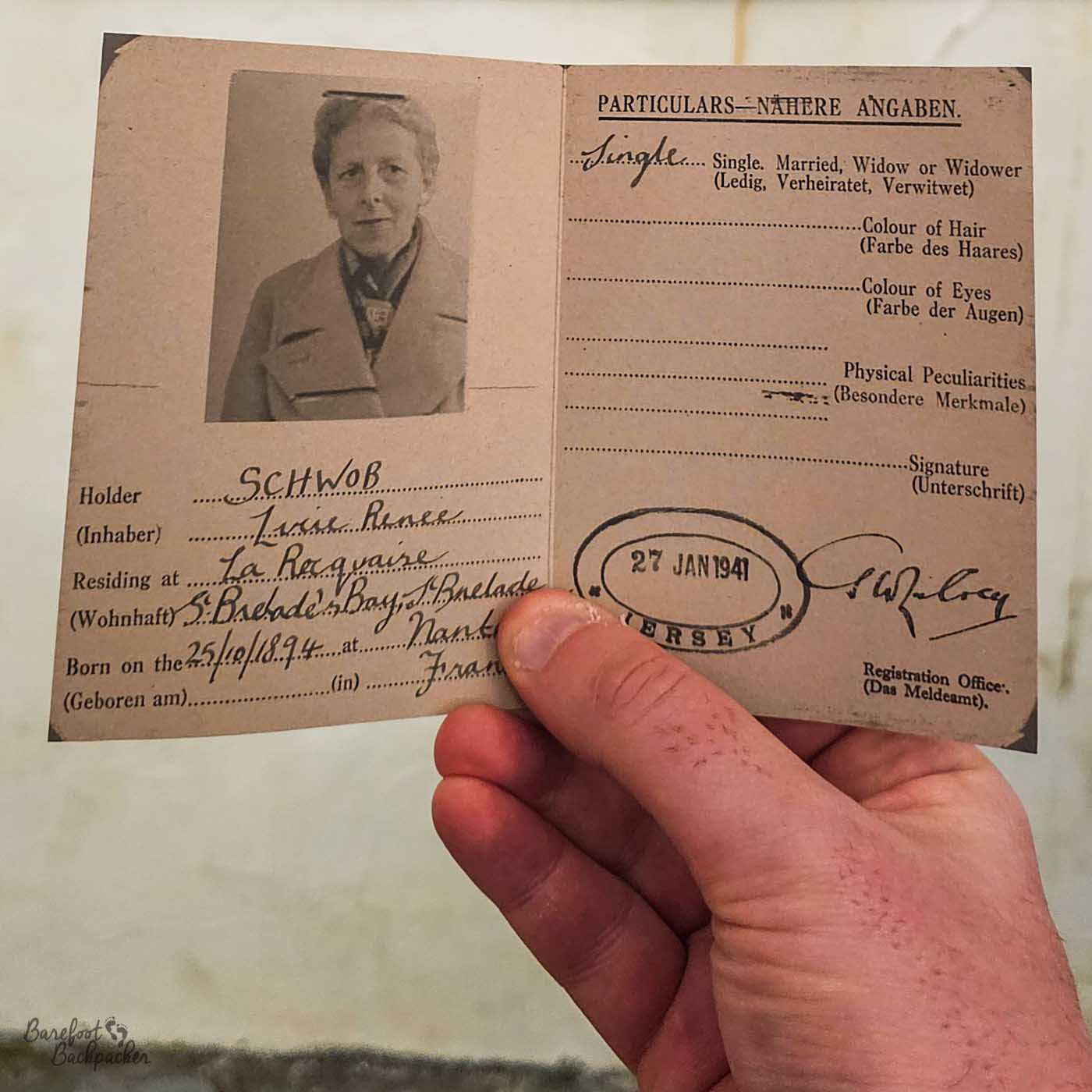
Lucie Schwob’s identity card, as given to me by the museum.
The identity card said her name was Lucie Renee Schwob, she was single, she lived in St Brelade, and she was born in Nantes in France on 25 October 1894, which at the time of the invasion would have made her 45 years old. Slightly younger than me, but similar enough.
I saw her first in the section about resistance, where an information board revealed what she did during the occupation. She, with sister Suzanne Malherbe, were arrested for sabotage, in this case “possession of a wireless and distribution of anti-German news sheets”, as well as sheltering someone described as “a young forced Ukrainian worker” at their home in St Brelade’s Bay. They were sentenced to death in November 1944 but the Bailiff managed to commute their sentences to Life Imprisonment – they were released upon liberation six months later. It also tells us that Lucie died, quote, “in her beloved Island of Jersey” on 8 December 1954.
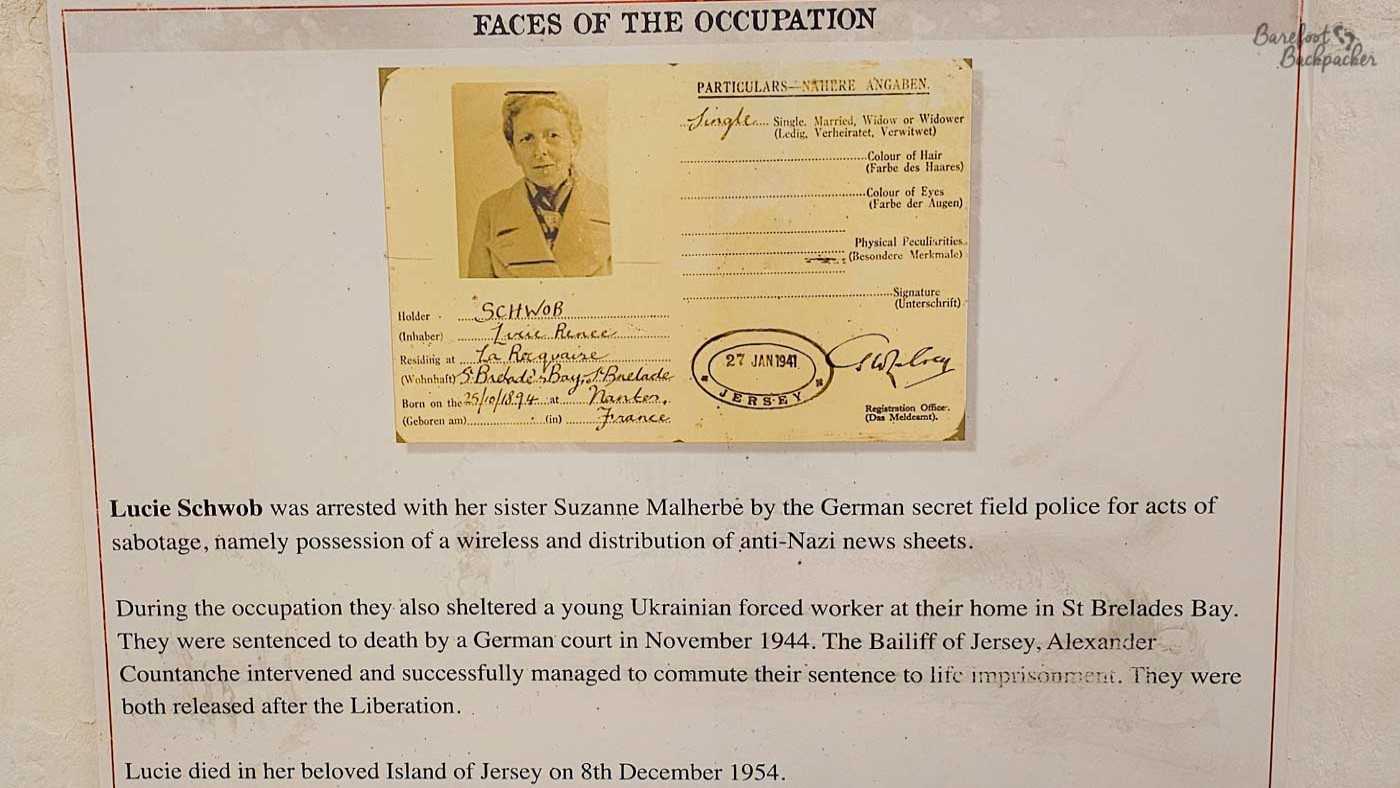
Bigger reprint of Lucie’s identity card, on the Jersey War Museum wall.
So, she shared a house with her sister. This got me thinking the obvious; given Lucie was described as single, was Suzanne really her sister, or is this all code for ‘lesbian’. Did the lady at the front desk code me as being Queer-Friendly? There was nothing in the museum about anything to do with a false name, or a secret identity, only that she was actively resisting the occupation. When I returned to the front desk, the lady asked me what I’d discovered, then told me to go to the Jersey Museum in the centre of town, to find out the rest of her story.
So, I headed over. And after a while I found her referenced, on another board with an identity card on. This one listed her occupation as “independent”. So, a single middle-aged woman living with her sister who didn’t have a standard or typical job, and seemed to be affluent enough to live that kind of lifestyle. The mystery deepens.
Nearby in the museum was a a wall with a series of sketches and extracts from poems and manuscripts on it. They were representations from two French artists in the 1930s who’d moved to Jersey in 1937 after spending many a childhood holiday there. Their names were Claude Cahun and Marcel Moore. At first I wasn’t sure of their relevance to the occupation; it seemed a bit of a jarring topic change. But then I read on. And I quote:
“Born Lucie Schwob and Suzanne Malherbe, they were romantic partners, creative collaborators, and stepsisters.”
I see.
The description continued:
“They lived together in 1920s Paris as Cahun and Moore, defining and exploring their identities. They invented characters for Cahun, often GenderFluid, enigmatic, and playful. But in 1937, as anti-Semitism and fascism were on the rise, they moved to St Brelade’s Bay, a place of calm, familiarity, and privacy.”
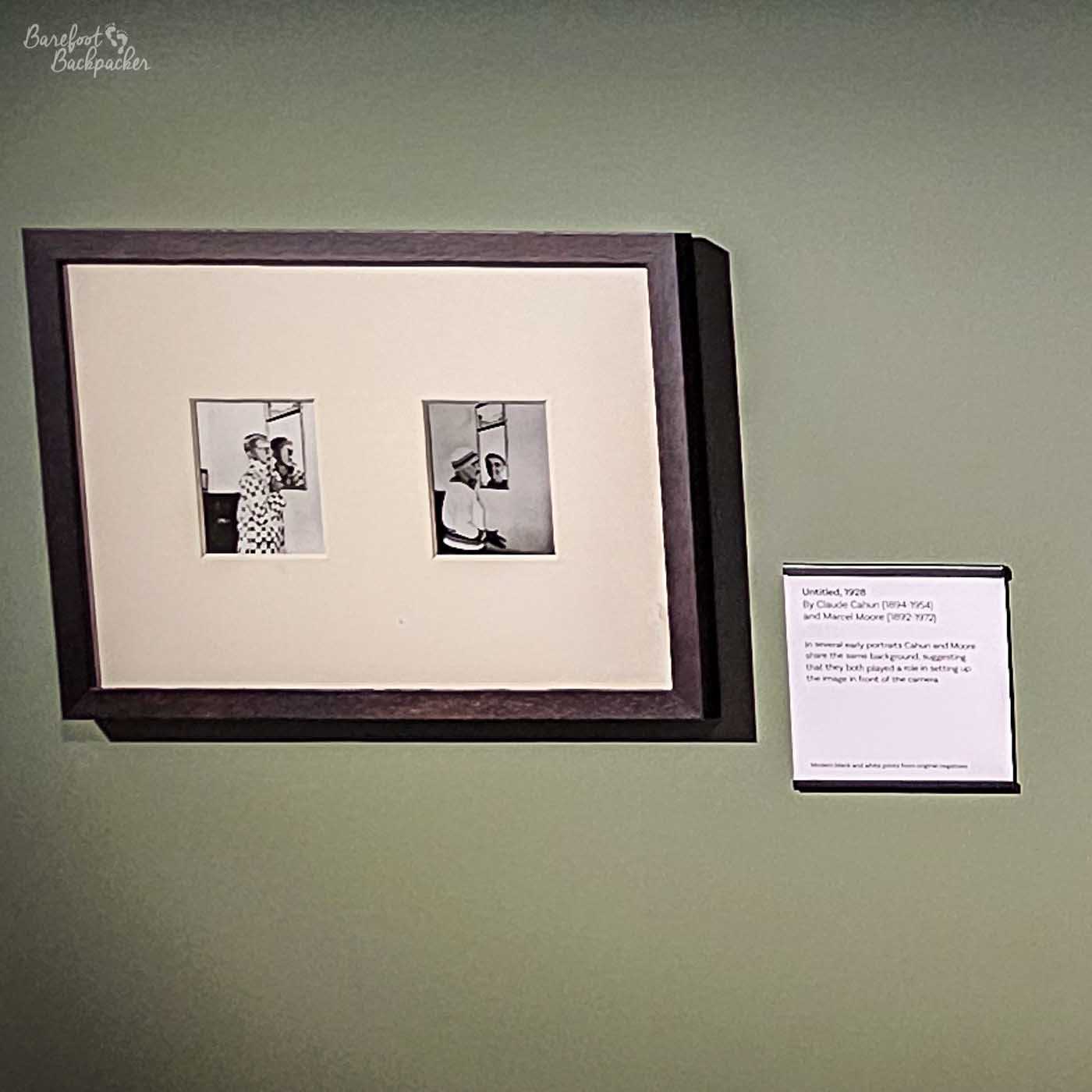
A print of an image made by the couple showing them both in shot.
So. Let me recap, and get this queer.
The lady at the Jersey War Tunnels saw me approach, and immediately thought: ‘this person is giving off very Queer, no, more specific, very gender-non-conforming vibes, let’s give them a story to follow that matches their identity’. Maybe she recognised the non-binary flags, maybe she just felt I too was ‘exploring my identity’. And then sent me on a journey of discovery to find out for myself, without telling me what she was doing. It’s an amazing bit of museum-work.
There’s a couple of questions that both museums left unanswered, but they were easy enough to find out afterwards. Lucie and Suzanne were stepsisters, but only because their parents married each other long after Lucie and Suzanne had met; they were lovers first. They were artists in the 1920s, and Lucie herself came from a very creative family – her uncle Marcel was a symbolist and surrealist who was friends was the likes of Oscar Wilde and Marcel Proust. Under the guise of Claude Cahun, Lucie specialised in what we’d now refer to as selfies, but that underplays it – what he created was self-portraits of himself in multiple guises and personalities, taken from a huge variety of angles and made substantial use of mirrors and cutting-edge photo effects. They would have absolutely rocked Instagram and TikTok. Suzanne, under the name of Marcel Moore, was more of the ‘Instagram Husband’, but again, that underplays his role; he was a fashion designer and photographer, and they worked very closely together to produce the art.
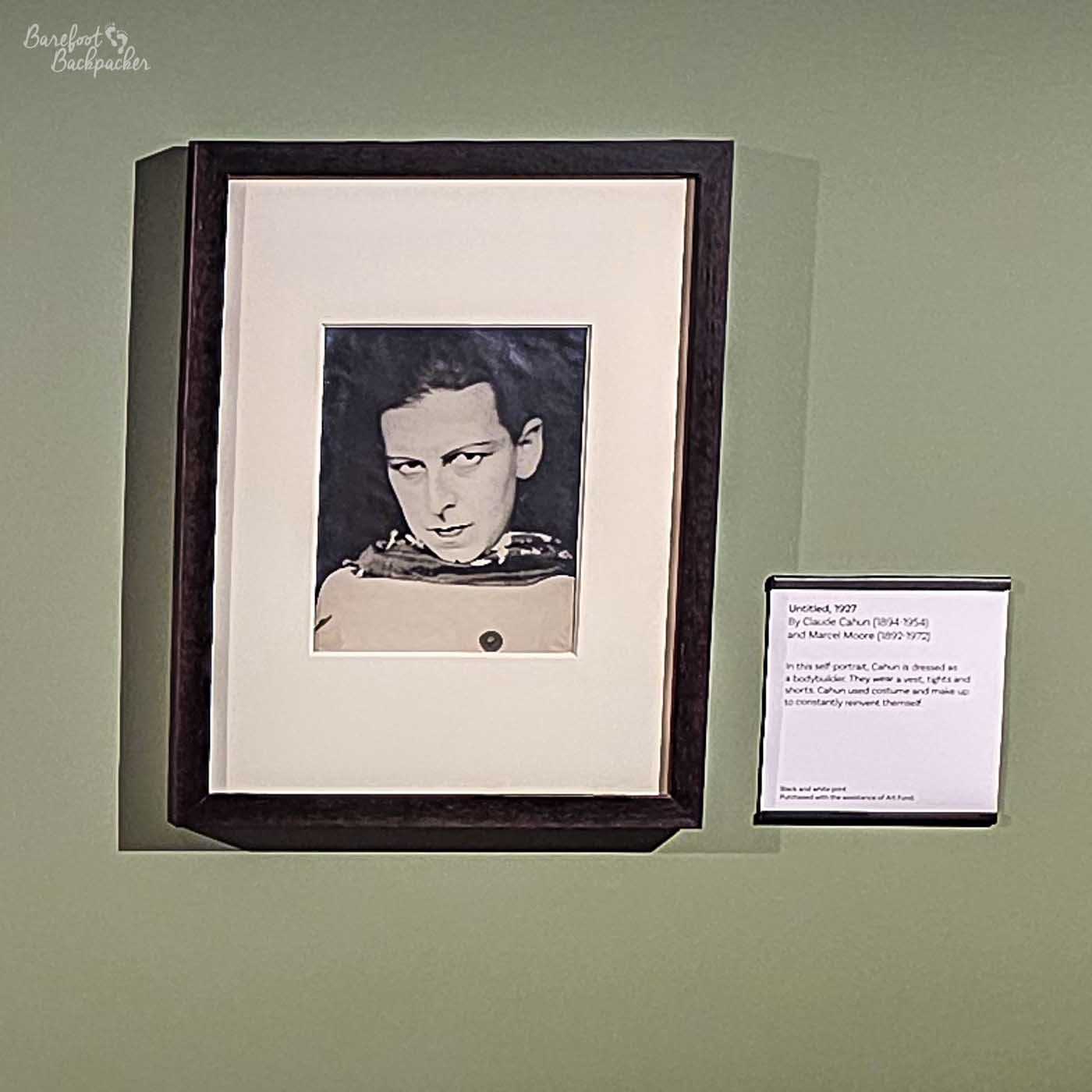
A print of an image made by the couple showing Claude cosplaying as a bodybuilder. They often used costumes in their photographs to play a role.
Much of their work together in the resistance to German rule directly used their artistic flair. Suzanne was fluent in German, so was able to use that to created the suspicion the resistance was ingrained in the occupying forces not just the Jersey public. Resistance came naturally to both of them – even in the quite liberal pre-war France they were seen as outsiders because of their genderfluidity and non-standard lifestyle; in addition Lucie was Jewish, or at least of Jewish heritage – so much of their life and artistic work had always been a challenge to the prevailing society and culture. They even tried to set up a gay magazine, where they wrote that everyone had the right to be what they wanted to be, but it was forced to closed after 4 editions due to societal pressure.
Note they both reverted to their birth names and gender when the German occupation came, and gave a front of being ‘normal’ citizens, as much as unmarried sisters living together in the 1940s could be. They did what they needed to to survive, and be able to resist without suspicion. It’s interesting to muse that I’m around their age and could, if necessary, mask as more ordinary than I am. But, most importantly, while they left France when the clouds of war were gathering, when war came to them, they stayed, regardless of how they stayed, and they fought.
Sadly their story doesn’t really end well. Though both survived the war, much of their art was destroyed while they were imprisoned, and whatever happened in those six months took their toll on Lucie specifically, who never recovered her health and died a few years later. Suzanne outlived her by 18 years before dying by her own hand at the age of 79. They’re buried together in St Brelade’s Church, in a grave engraved with their birth names.
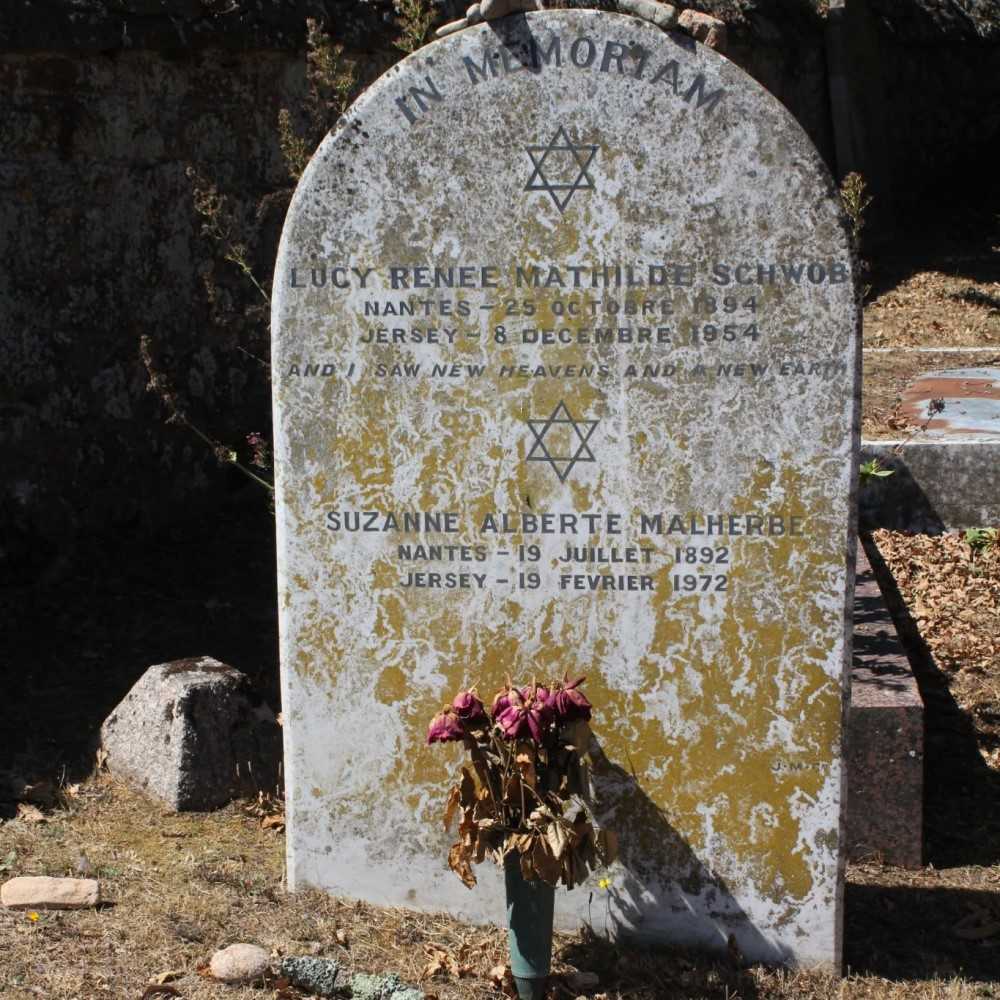
The grave of Lucie Schwob and Suzanne Malherbe.
As for their genderfluidity, it’s hard to define exactly since they lived before words truly existed to describe that; plus they were native French speakers and French is a very gendered language. After the revelation, I thought of them as Trans Men, however Lucie herself actively wrote “Masculine? Feminine? It depends on the situation. Neuter is the only gender that always suits me.”, and even as a woman tended to present quite strongly androgynous, and seemed comfortable using both he and she pronouns; it’s not unlikely she might have used non-binary or even neo-pronouns had they been available to her, but we can’t say that for certain.
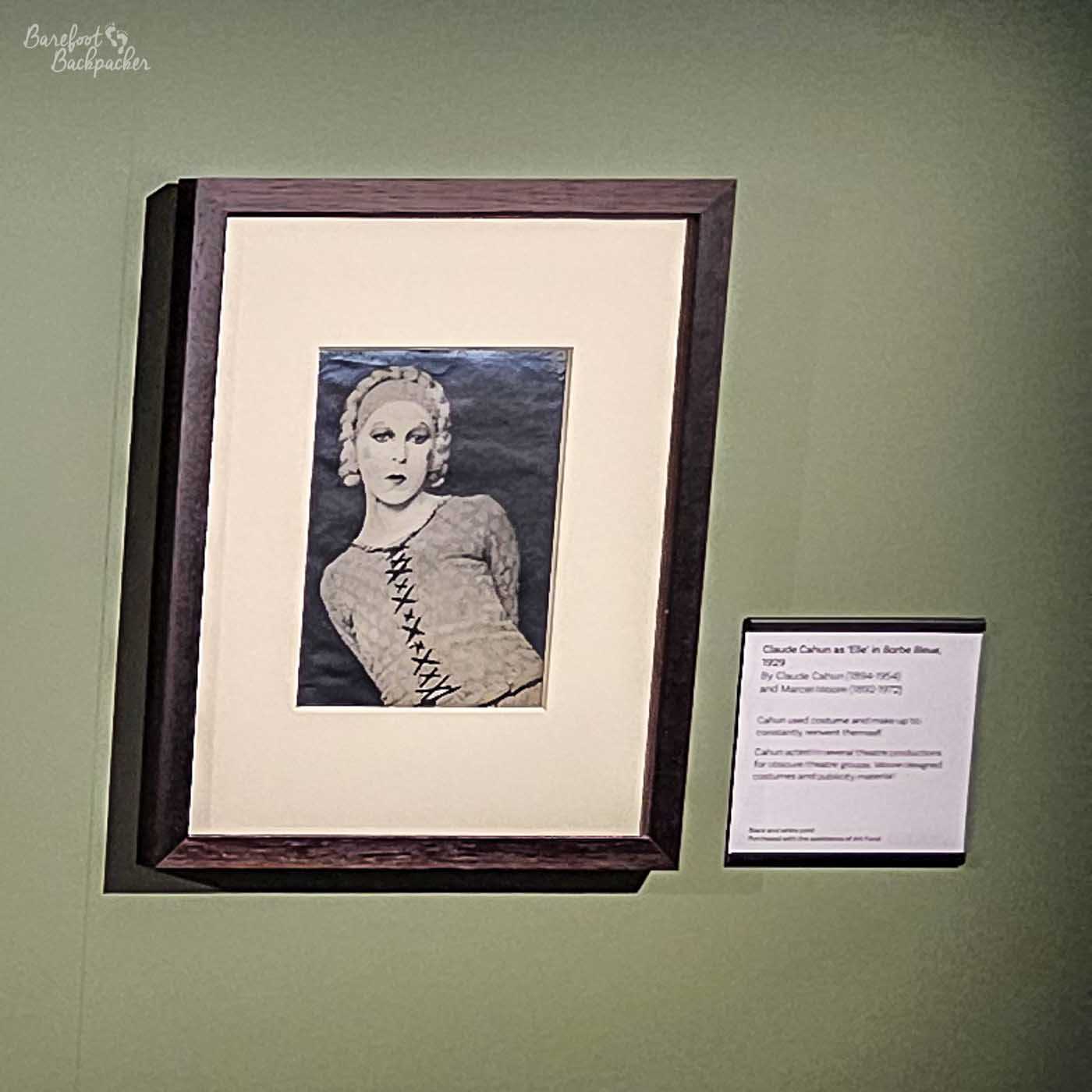
A print of an image made by the couple showing Claude acting in a more feminine presentation; a shot from a self-made movie.
So, I had never heard of Lucie Schwob, but it feels like I should have done. And while we lived in different times, different backgrounds, and had different life goals, it’s a strong reminder that people like them, people like me, have always existed. People who aren’t comfortable in the identity and culture we were assigned and brought up as, and who spent their lives exploring and discovering who they really were. We’re not a new phenomenon created by the likes of Tumblr; the only thing the internet, that forums and sites like that, have done is to make it easier for us to find each other, and, more importantly, find ourselves, to be able to answer the questions we didn’t even know we could ask, that help to make us realise why we never felt as happy or comfortable in our lives as those around us.
It’s also a reminder that society and culture has always found people like Lucie, people like me, difficult to categorise, and therefore scary and need to be removed. In this age of creeping authoritarianism and an apparent desire to return to traditional family values and structures, remember, it’s people like them, people like me, who’ll be near the front of the action, alongside other minorities and bad influences. When they kill one of us, they kill all of us; there is more strength in union than individualism, and we need to stand together to stop it – especially in a society like mine that feels more naturally prone to right-wing thought than most.
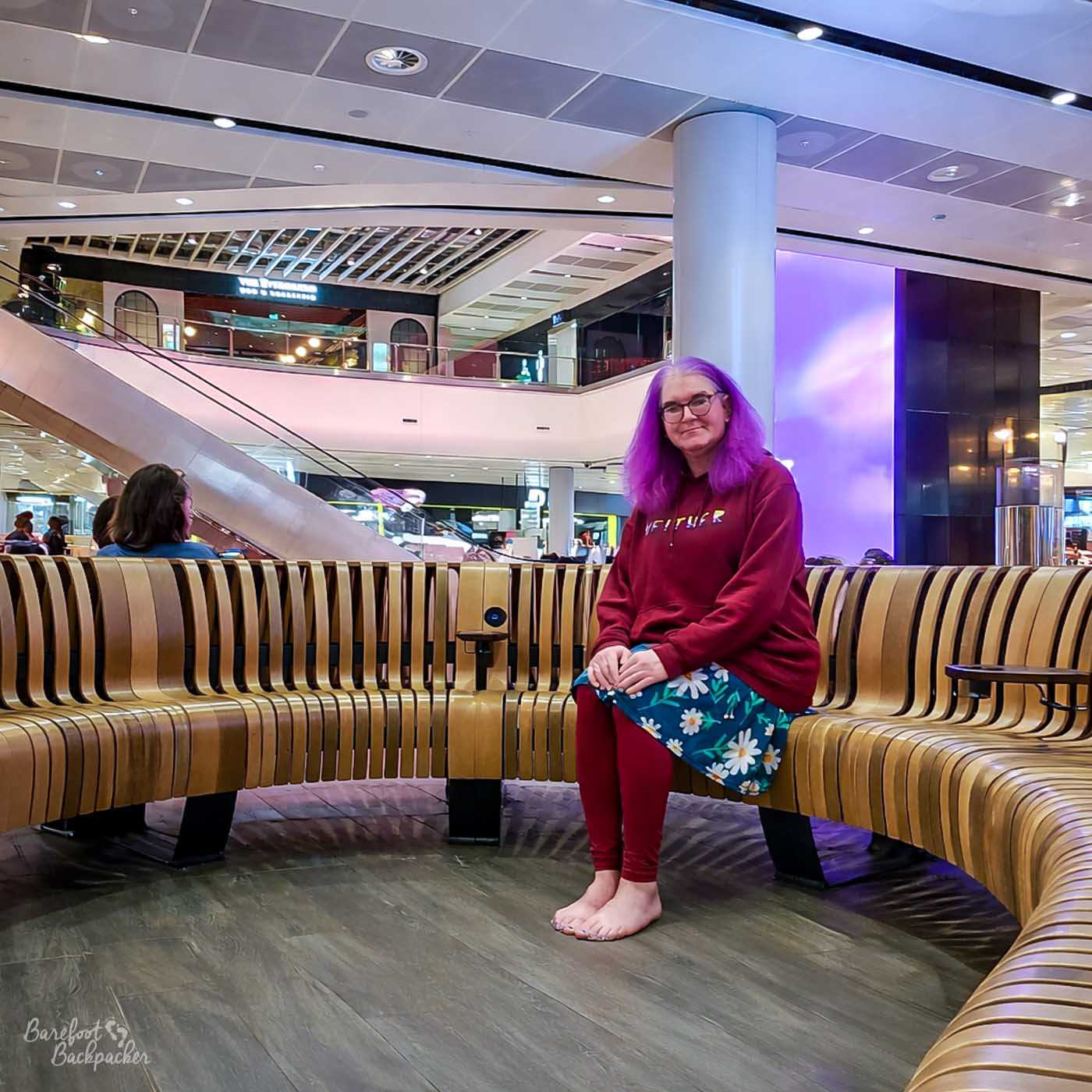
Me sitting in an empty Manchester Airport about 4am on my way to Jersey, looking cute and Queer, but with absolutely no expectations as to what I’d discover about myself.
I wonder what people will say about us, about you, about me, in 80 years time. I hope no-one writes a presentation called “The Ballad of Nel Scroggie”. I hope they don’t need to.