In July 2026, me and Laura were sent on another of the Jet2citybreaks; we’ve done one before to Vienna to sample the Christmas Markets, but this time we were off on a summer trip, to the Polish city of Krakow.
Jet2Holidays offer city breaks to Krakow from several cities in the UK; we caught one of the flights from Manchester Airport as it was the most convenient airport for us; we left on the Sunday late afternoon too so it was a pretty chill experience. I would say we got a large free checked luggage allowance, but you know us, we travel hand-luggage only! If you’re interested, by the way, you can check out other flights Jet2 make to Krakow here.
After a comfortable flight, arriving into Krakow was a breeze. As non-EU citizens, we were worried about long queues on entry, but in fact everything went pretty smoothly and quick. Catching the train from the airport into the city centre was similarly easy – the railway station is close to the airport and well-signposted, with regular trains through the evening. We bought the tickets on the platform using one of the ticket machines, it was in English and very clear. At the time of our visit, the train to/from the airport was 20 zloty each (£3.85) and takes 17 minutes to Krakow Główny railway station, just north of the old town.
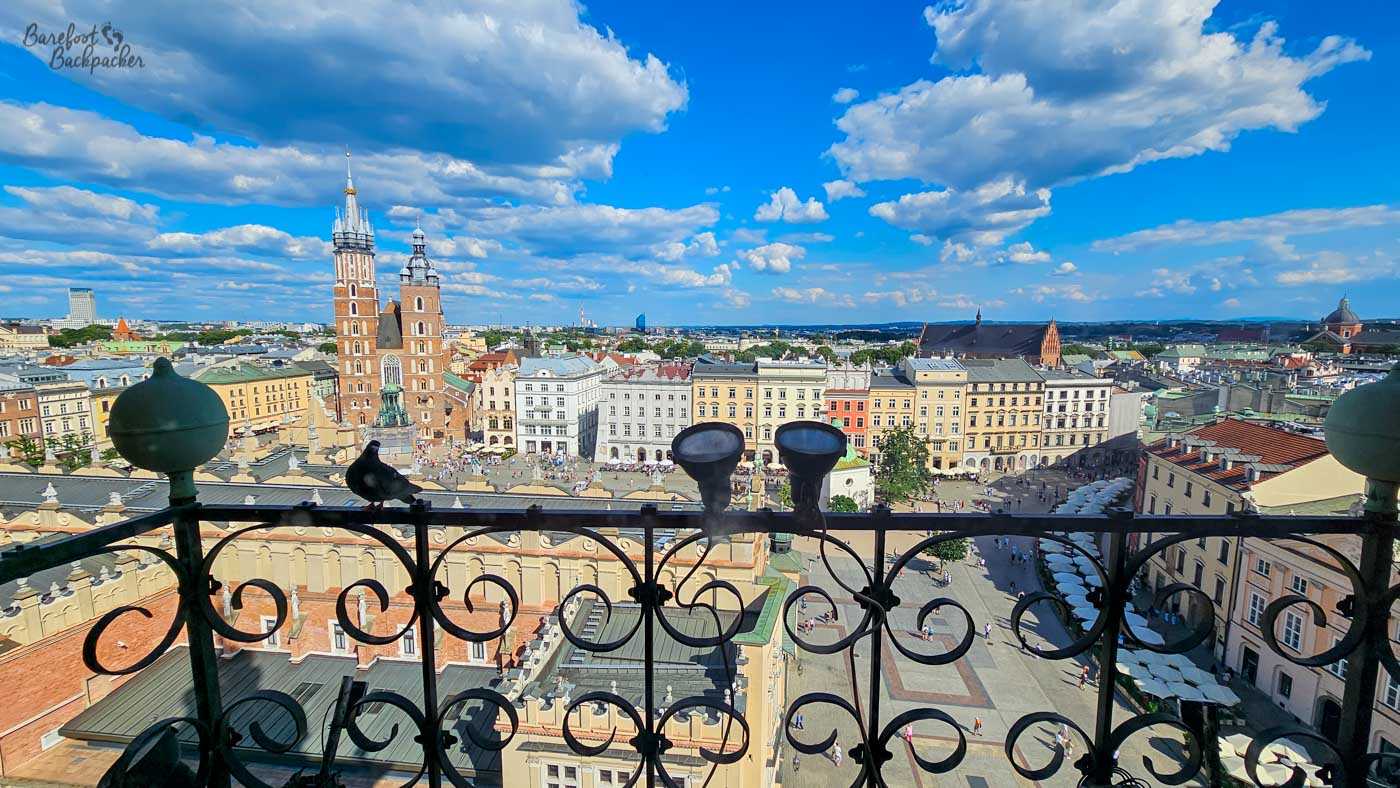
Overview of Krakow as taken from the top of the Town Hall Tower.
Our flight arrived late in the evening, so by the time we arrived in Krakow itself it was heading towards midnight. Our hotel was in the south of the city centre, a short walk from Krakow Grzegórzki railway station, which fortunately is also on the direct line from the airport, one stop beyond Krakow Główny. We were worried that nothing much would be open, but very close to the station we passed by a pizza restaurant called “!ncredible” (yes the exclamation mark is part of its name); it’s part of the Loft Hotel and open 24 hours, so very convenient. And while the pizza wasn’t truly Incredible (we’ve been to Italy!), it was definitely far better than midnight pizza would be back in the UK. They were 33cm/13”; a mortadella/pistachio and a capricciosa, with a couple of beers, the whole thing came to 176zl (£34).
I must also say that our visit took place during some damp weather in the middle of summer 2026. It was the first rain we’d seen for about two months, and it was incredibly welcomed.
The Old Town
Krakow is most noted for its old town which, like many others in Poland, is very charming and cute, and unlike many other Polish cities, was not needed to be rebuilt after World War Two. It’s centred on the main square (Rynek Główny, or ‘Main Market’), which is about 3.8 hectares in size, or slightly more than three Trafalgar Squares. It’s a UNESCO World Heritage Site, and lined with old large buildings with strongly-coloured frontages and big windows.
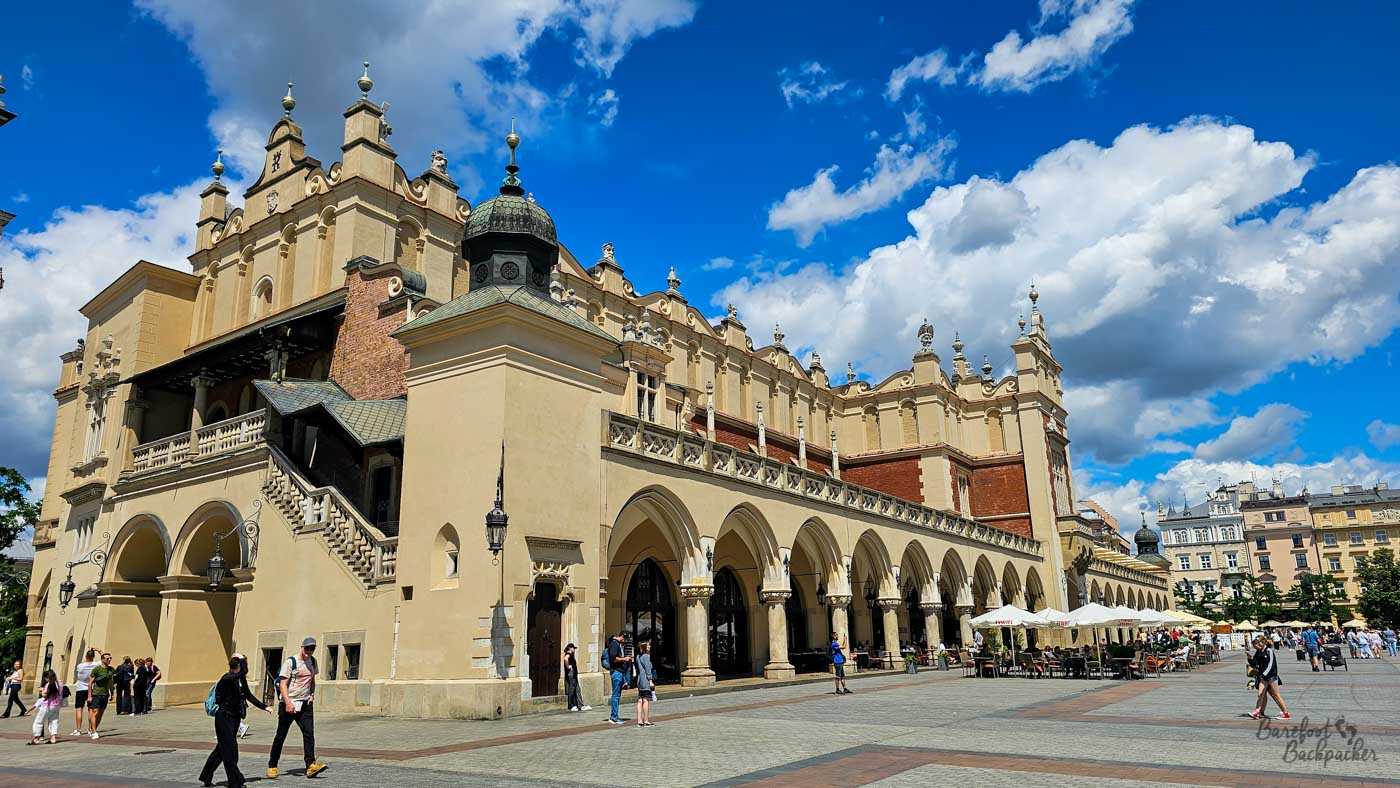
The Cloth Hall in the main square.
In the centre of the main square is the large Cloth Hall. This is the old market hall from Mediaeval times, and when Krakow was the capital of Poland it was the main centre for trade for the entire country. In later centuries it was used more as an administrative building and a place to hold exclusive balls and parties hosted by royalty, leading politicians, and other high-ranking dignitaries. Today there are still market stalls on the ground floor, mainly selling things like amber jewellery.
The main square is very busy, full of tourists and people serving tourists – if you want a guide, an old town tour, or a ride on a horse-drawn carriage, this is the place to go. There are, however, a whole series of quiet streets coming off and around the square, with old buildings, churches, and squares. One of the larger ones is Plac Szczepański, with public art sculptures and a dancing fountain which stands in front of the grand Art Palace.
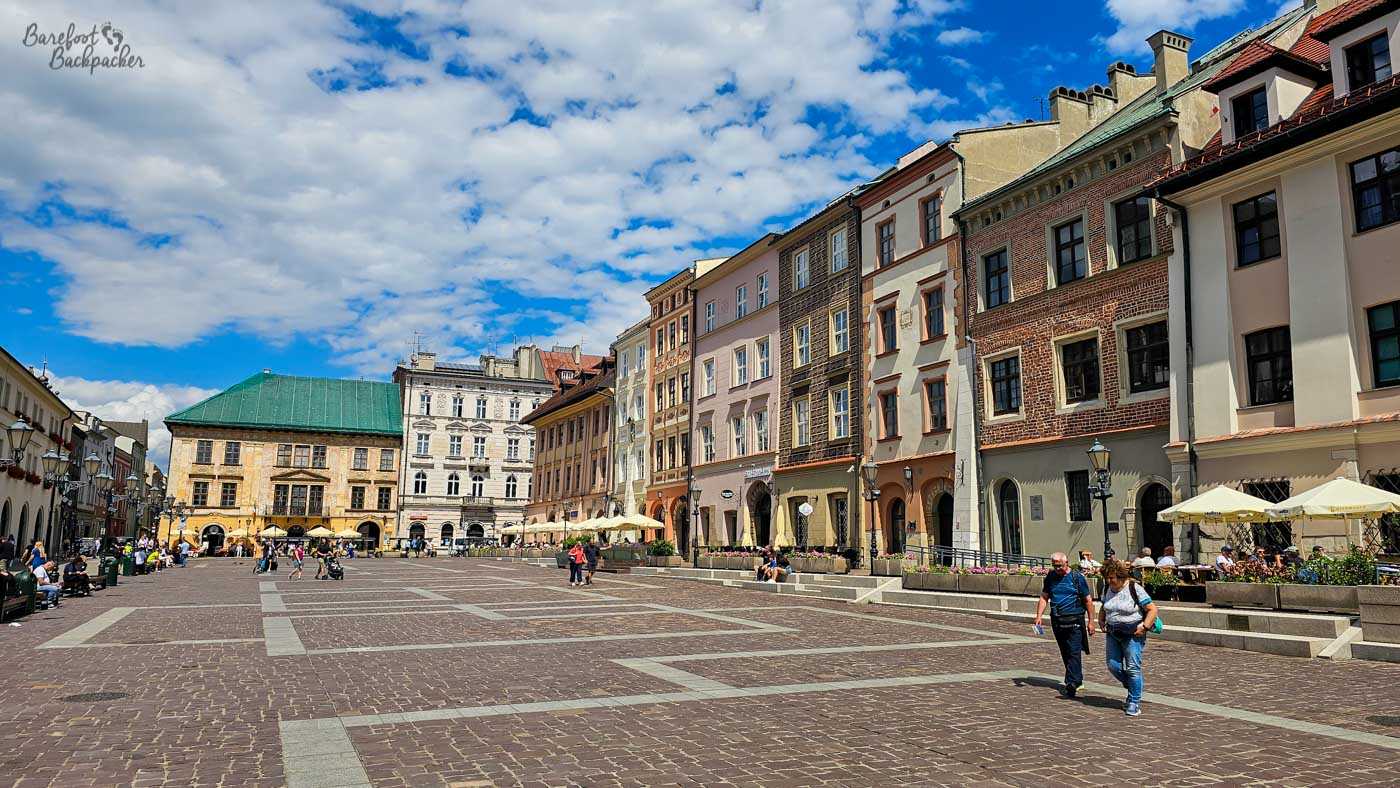
Another of the cute squares in Krakow old town.
Encircling almost the entire old town is the Planty. This is a linear parkland, with a wide path and a thick layer of trees and gardens either side. We saw many people cycling and jogging along it, and with benches at frequent intervals it’s a very pleasant and serene place to just sit and watch the world go by, in the shade so it never gets too hot.
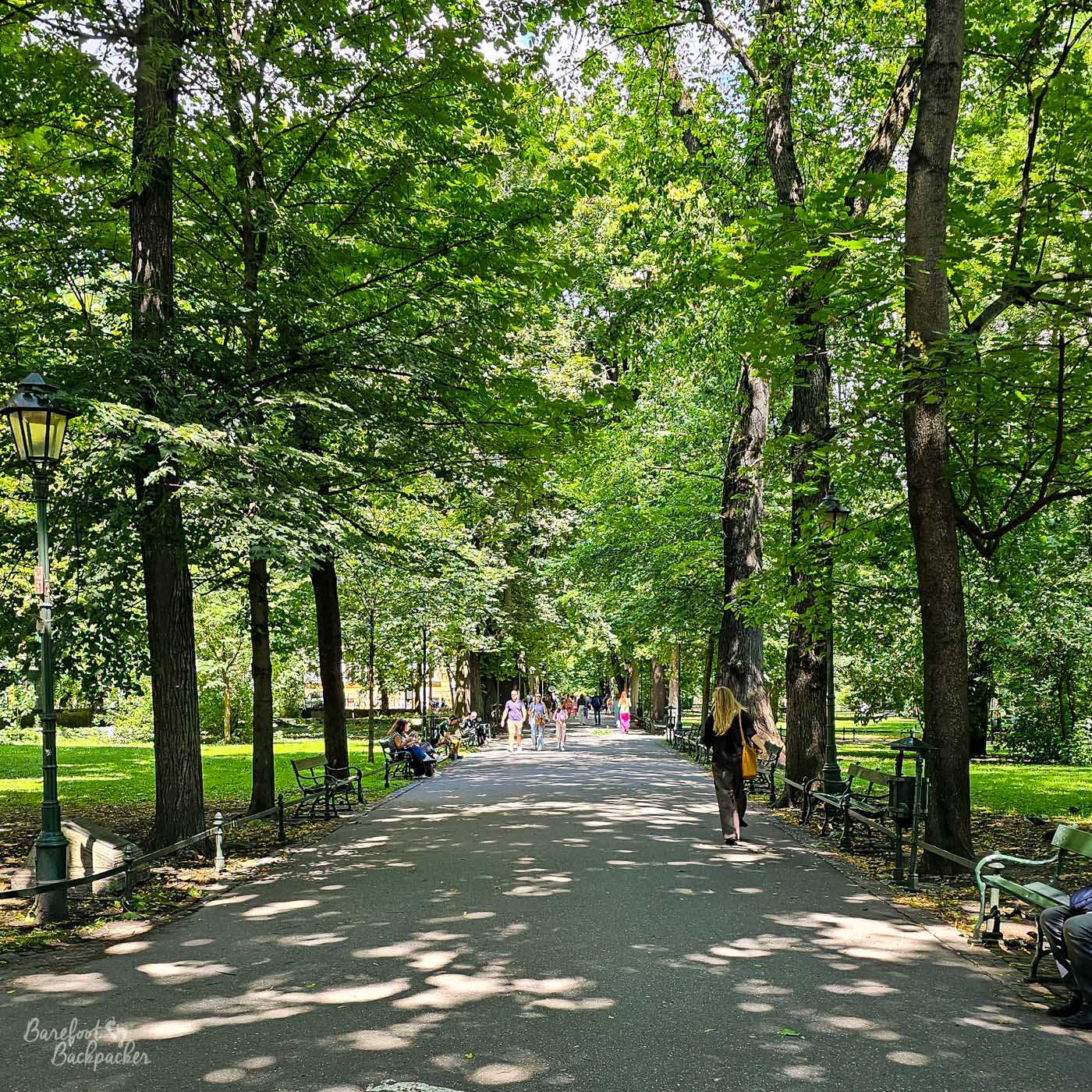
View of part of the Planty; it was like that all the way round.
The Planty is actually the path of the old city walls, which were mostly pulled down by 1830, and to the north of the Old Town it runs alongside what remains of them. Although they now stand alone, both the Barbican and the Florian Gate are still quite impressive and imposing buildings, and you can get a feel for how the city would have looked in its heyday. Outside them you’ll often find musicians casually playing, which draw a crowd. They both contain small museums.
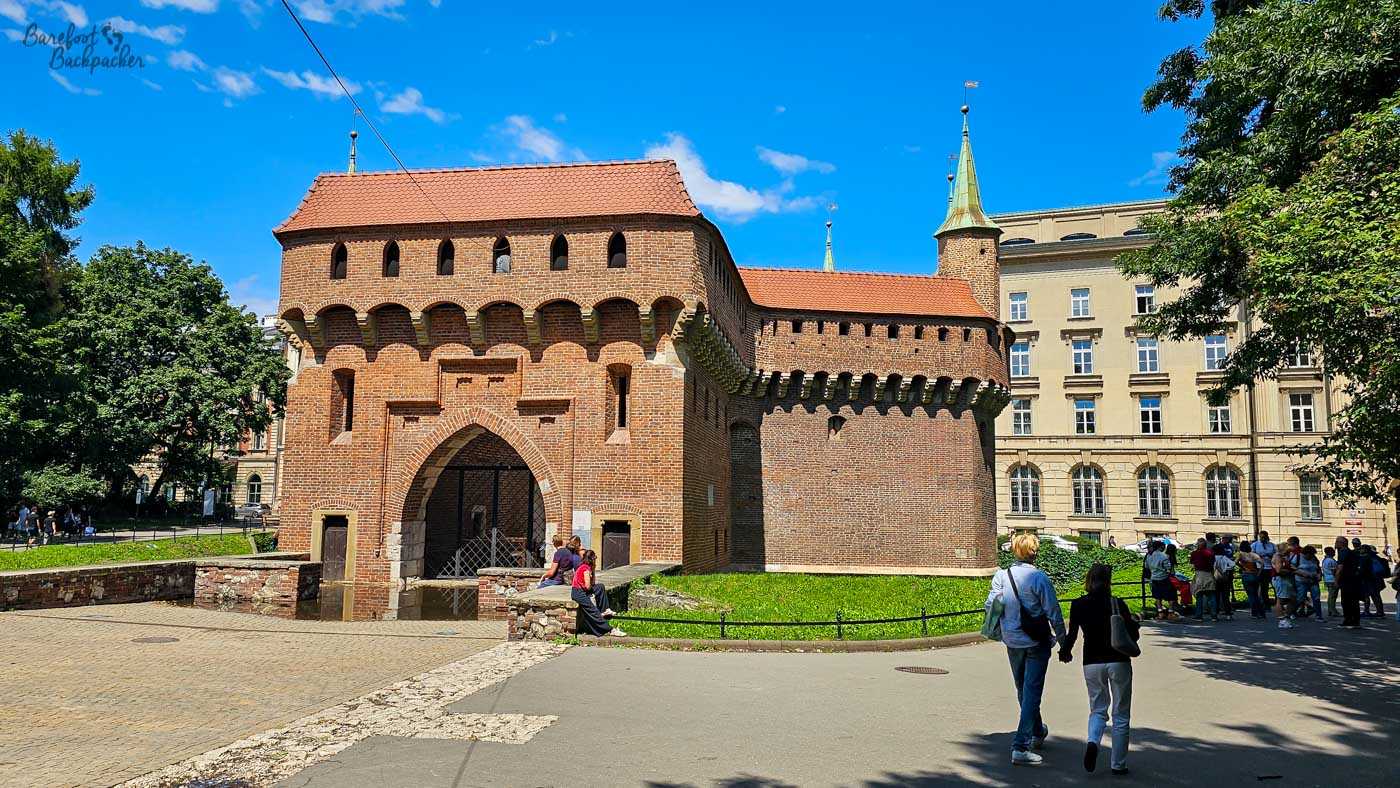
The Barbican in Krakow.
The high point of the Old Town is the Town Hall Tower. This costs 16zl to enter, is 75m high, accessed by 110 steps, and is all that remains of the old town hall and granary that were demolished in 1820. I mean it *says* it’s 110 steps, but what it doesn’t tell you is that this is a mix-and-match of all manner of styles, from plain wooden stairs to tight spiral stone stairs, and everything in between. It’s definitely a place that’s been refurbished and reconstructed a bit.
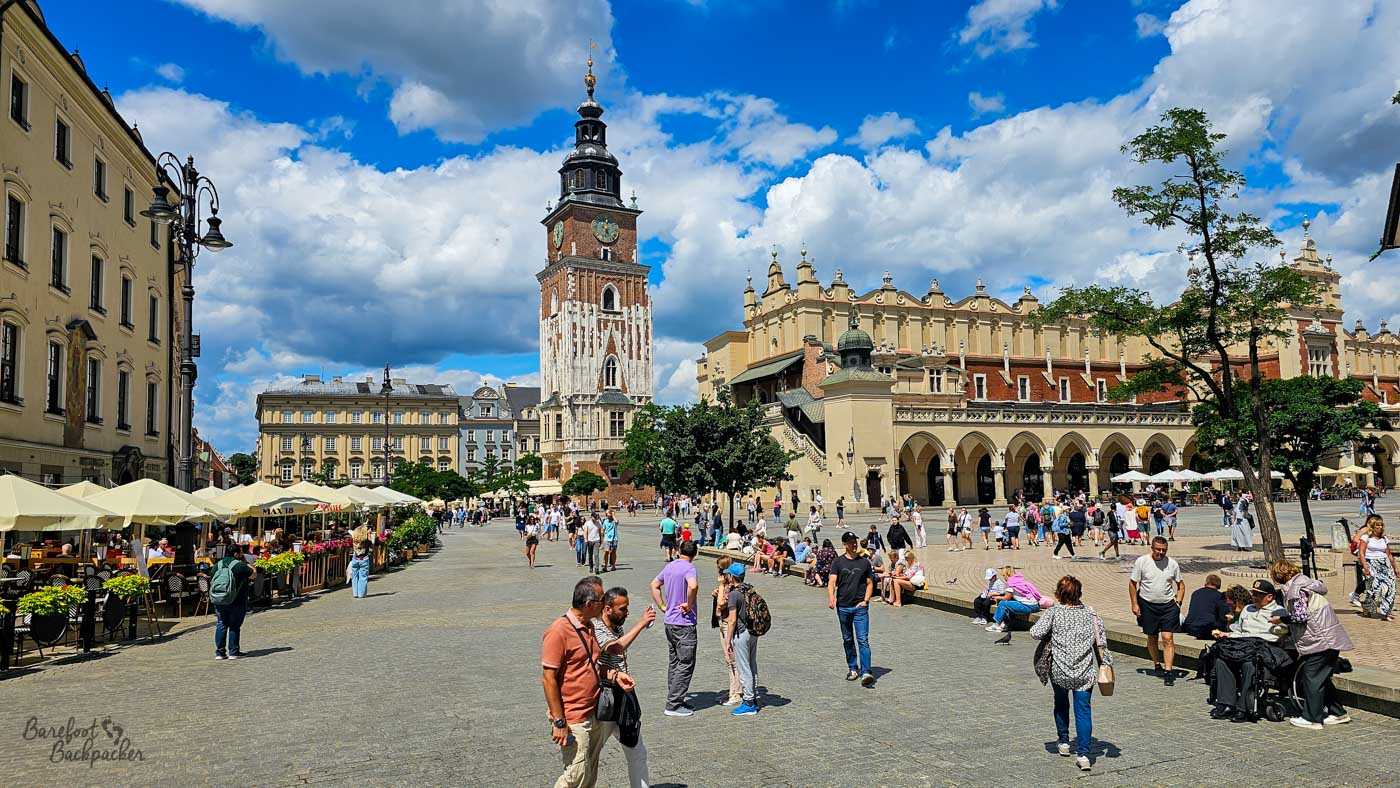
The Town Hall Tower seen in the context of the main square.
It consists of five different floors; the ground level having the entranceway and a small shop, while the next three have small dioramas about the history of the city and the tower, in both Polish and English. The top floor contains the bells, and small balconies from which you get a great view of the city below you. Or would if they hadn’t locked and fenced them off for health & safety reasons. You can still see through the mesh gaps, but it’s not the same.
Another of the most iconic spots in the old town is St Marys Basilica. The first impression you have when you walk inside is that Catholics absolutely know how to decorate a cathedral. It looks so vibrant in fact that it’s hard to believe that it was originally built as long ago as 1347, although it’s been added to and renovated several times in the intervening centuries.
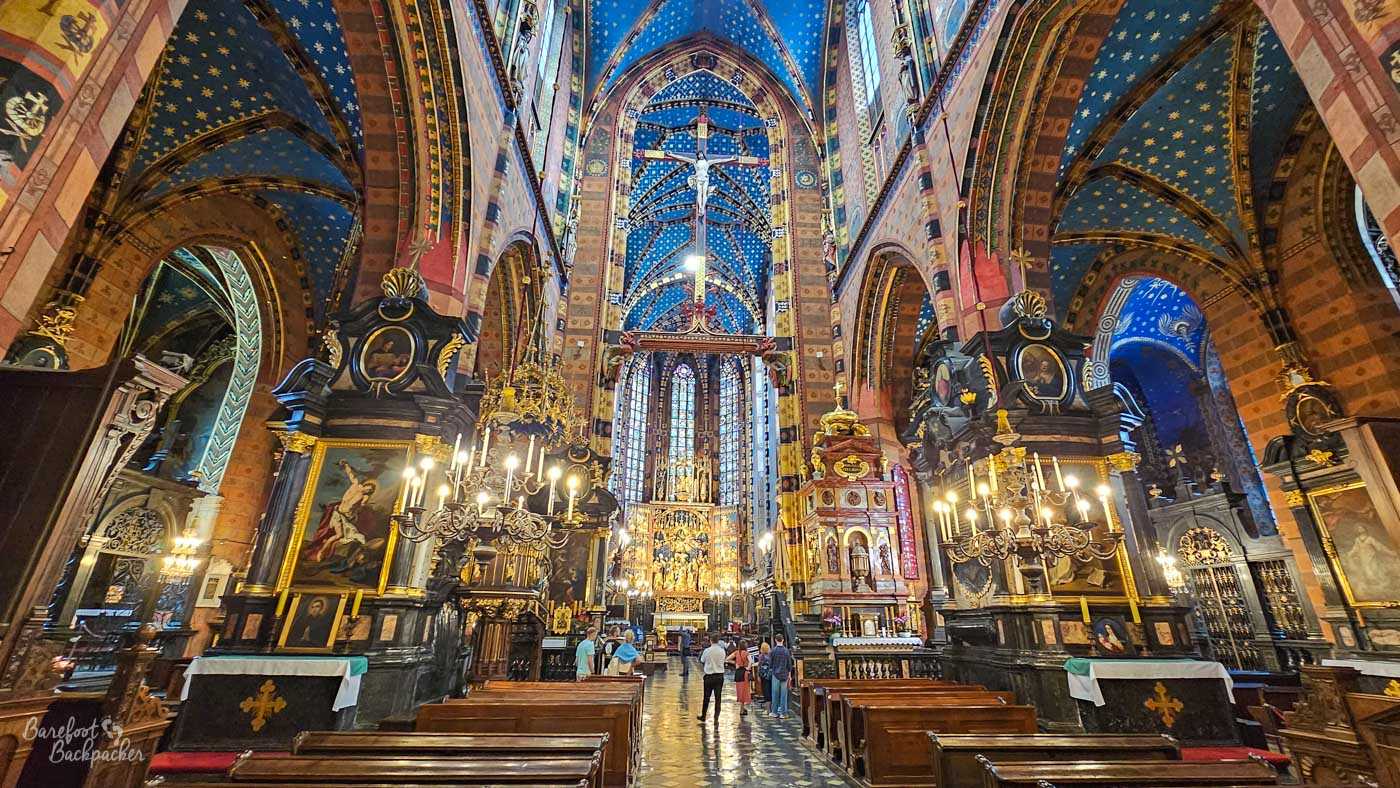
Inside the basilica; lots of gold, as you might expect.
The area you can visit isn’t actually that big inside, but there’s enough to see to make it worth your while. The ceiling is vast, and the walls are sublimely decorated and covered with gold effects. There’s also a large shrine inside to Pope John Paul II who came from here – indeed the airport is also named after him. Tickets are 20zl each, but for an additional 20zl you can also climb up one of the towers (54m). We didn’t do this because we’d just been up the Town Hall Tower, but it might be a better, or at least a more convenient, view.
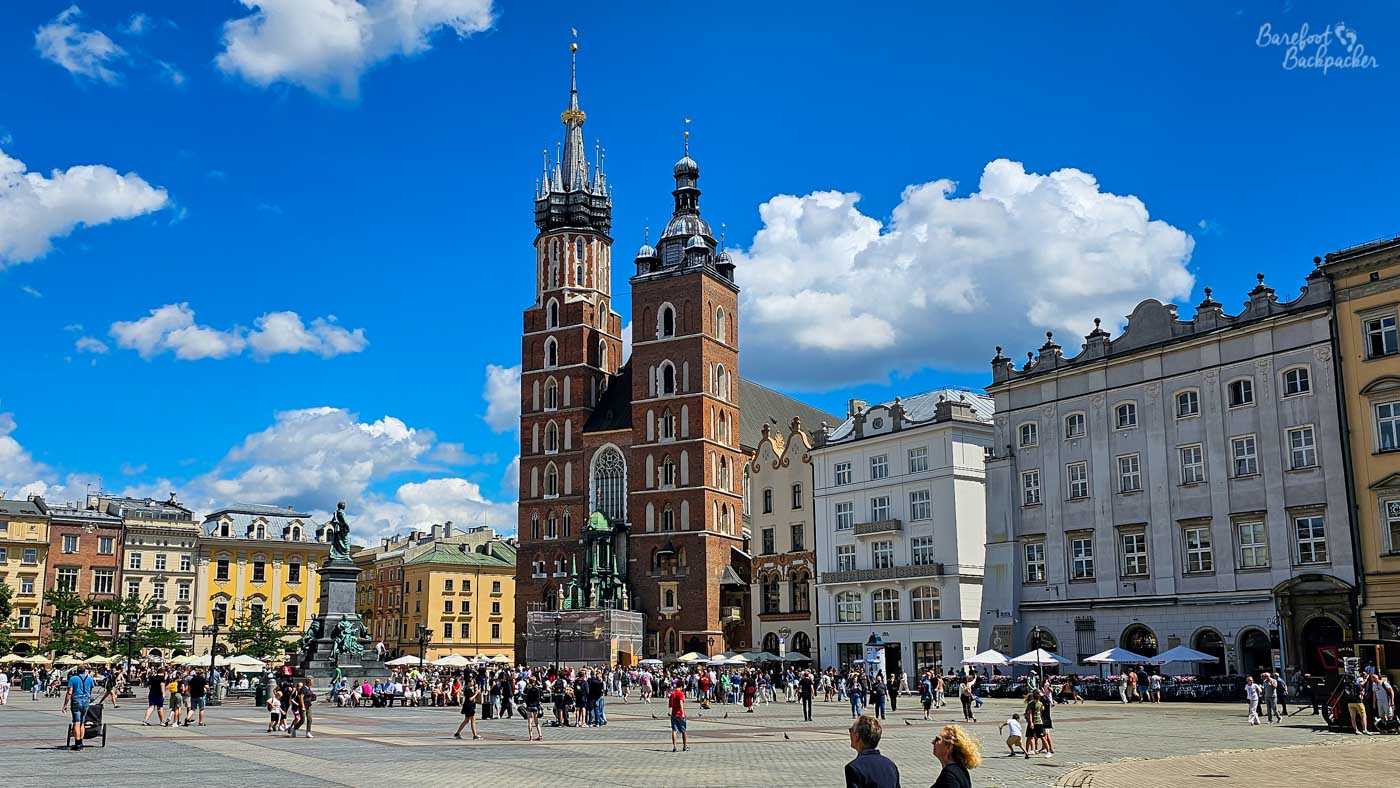
The Basilica, as seen in the context of the main square.
The final notable thing about the Basilica is that at the start of every hour, a trumpet is heard playing a tune (hejnał mariacki) from the battlements at the top of one of its towers. It’s played by the fire brigade, of all people, and it’s not just a handful of notes either – the tune lasts close to a minute, before cutting off abruptly for modern folklore reasons, and the whole thing is repeated three more times – traditionally the whole tune is played once in each of the cardinal directions. It’s loud enough that you can hear it over the hubbub at the Viva La Pinta pub, one block north.
Museums
The main museum, indeed the main sight, in Krakow is Wawel Castle. It’s built on a hill about 230m high that overlooks a bend in the nearby Vistula River – the hill itself is quite small in area so from the castle you can also see the whole of Krakow laid out below. It also makes for a steep climb up.
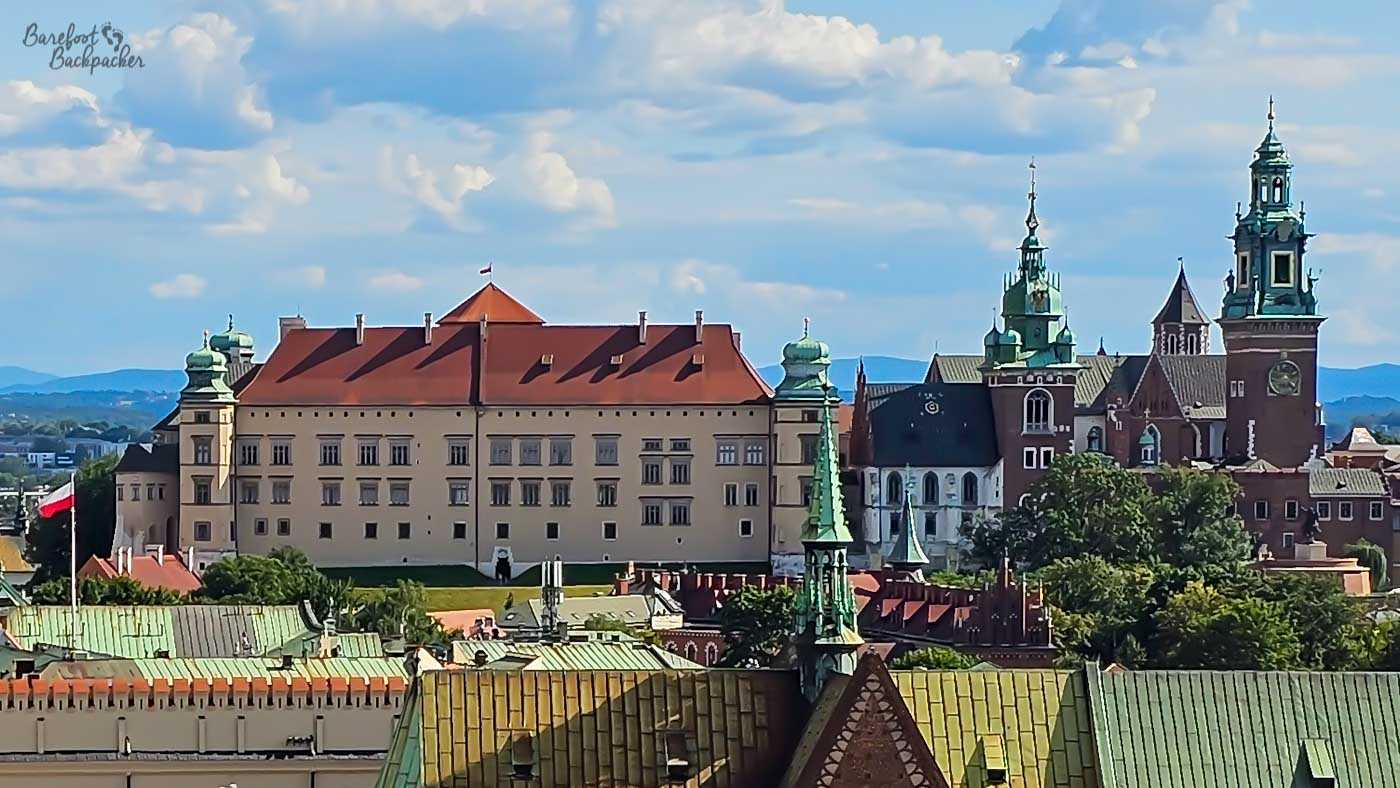
Wawel Castle as seen from the Town Hall Tower.
The Castle itself was built in the 1300s, though there’s been some kind of fortification here for millennia, and was, until 1609, the home of the King of Poland – Sigismund III Vasa moved everything to Warsaw during his reign as it more centrally-located within his newly-expanded Commonwealth. It fell into disrepair over the years afterwards, but upon Polish re-independence after WW1, the authorities deemed it to be a symbol of Polish history and power, and refurbished it.
However, the most important thing to note about Wawel Castle if you visit it is that, in effect, you’re not visiting a castle, as you might know them from the likes of the UK and France. Rather, Wawel Castle is one of the foremost art galleries in the world, that just happens to be located inside a castle. This makes a difference as to what and how you might want to see it.
One thing that I also need to mention is that the ticketing arrangements are … complex. Each of the different parts of the castle, like the Armoury, the underground caves, and the Treasury, that have different things to view, all require separate tickets. Even the two levels of the Castle itself can be booked and visited separately. In addition, the cathedral that’s within the complex is treated as an entirely different entity altogether, paid for there rather than at the main desk. This means that rather than having one ticket that covers everything, you can pick and choose which bits of it you want to see, and pay accordingly. It also means you have to plan, since the tickets are generally sold on a time-specific basis, or at least, there’ll be situations where the next available ticket for a certain part of the complex won’t be for another three hours. You can get round this by booking ahead, though I did find the online process of doing this to be a little slow. We ended up getting just tickets for the two floors of the main castle, which cost 95zl each.
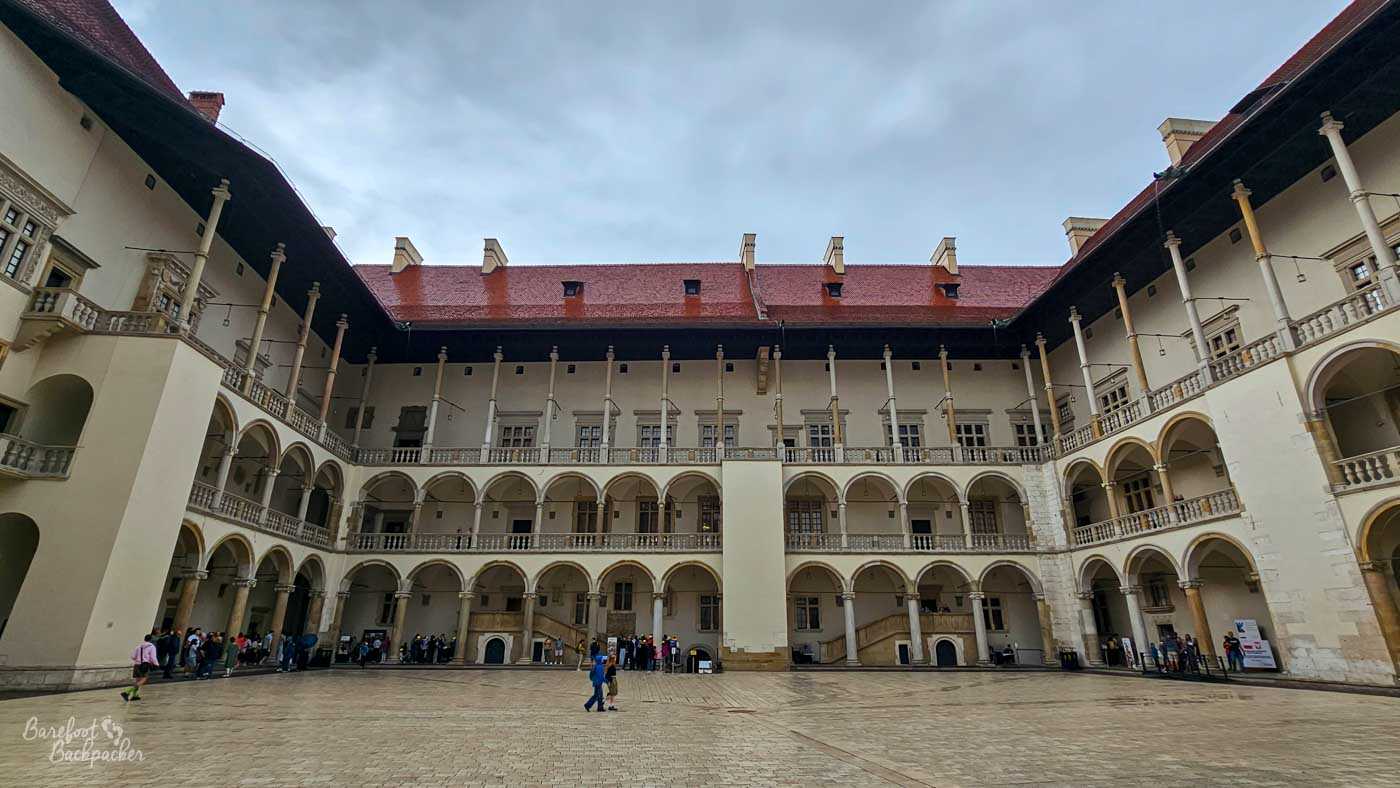
Inside the inner courtyard of Wawel Castle.
The castle has two courtyards; a larger one just past the entrance hall, and a smaller and more impressive one once you get inside the main body of the castle. It’s from the inner courtyard that most of the entrances to the separate parts of the castle are; just note they’re labelled with code letters rather than what they are, and even then not very visibly.
Wandering around inside the castle felt more like exploring a stately home. The main focus of the exhibits is the artwork; this consists of framed paintings on the walls, but also murals, or possibly frescos (one room has a depiction of the zodiac running for 360° just below the ceiling), and painted ceilings depicting Greek myths or biblical tales. There’s also an array of period furniture, carpeting, and sculptures. Many of these rooms were originally State Rooms where important things happened, or bedrooms for members of the royal family, so the décor reflects their importance. The whole thing is definitely artistically impressive and worth seeing if you’re into, well, what people with money spend it on to make their place look good.
The one thing you don’t find much about though is the history of the castle itself. That might not be important to you, but I’m noting it here in case it is.
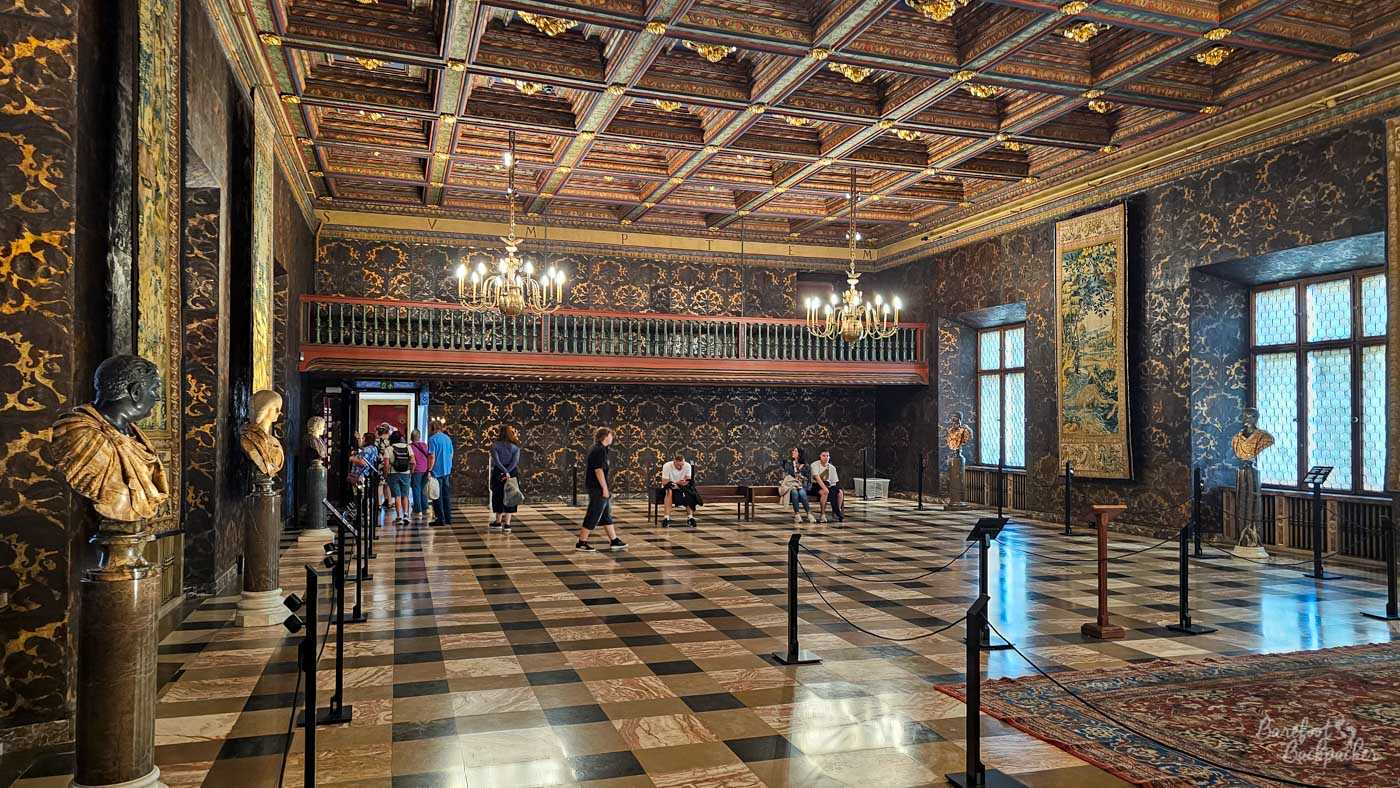
One of the grand state rooms in Wawel Castle.
All tickets, regardless of which rooms/sections they’re for, include access to the Royal Gardens. These are laid out at the exit of the castle, and provide views across Krakow. There’s not a lot to them though, and they’re quickly viewed, but that doesn’t make them unimpressive.
Two other museums we went to are in the district of Kazimierz, just south of the castle and north of the river. This is the old Jewish Quarter, and a lot of the architecture and history reflects that. One such museum is the Galicia Jewish History Museum; this takes you through the (recent) history of Jews in Poland mainly through the medium of photographs. It’s quite a simple yet powerful way to tell a story.
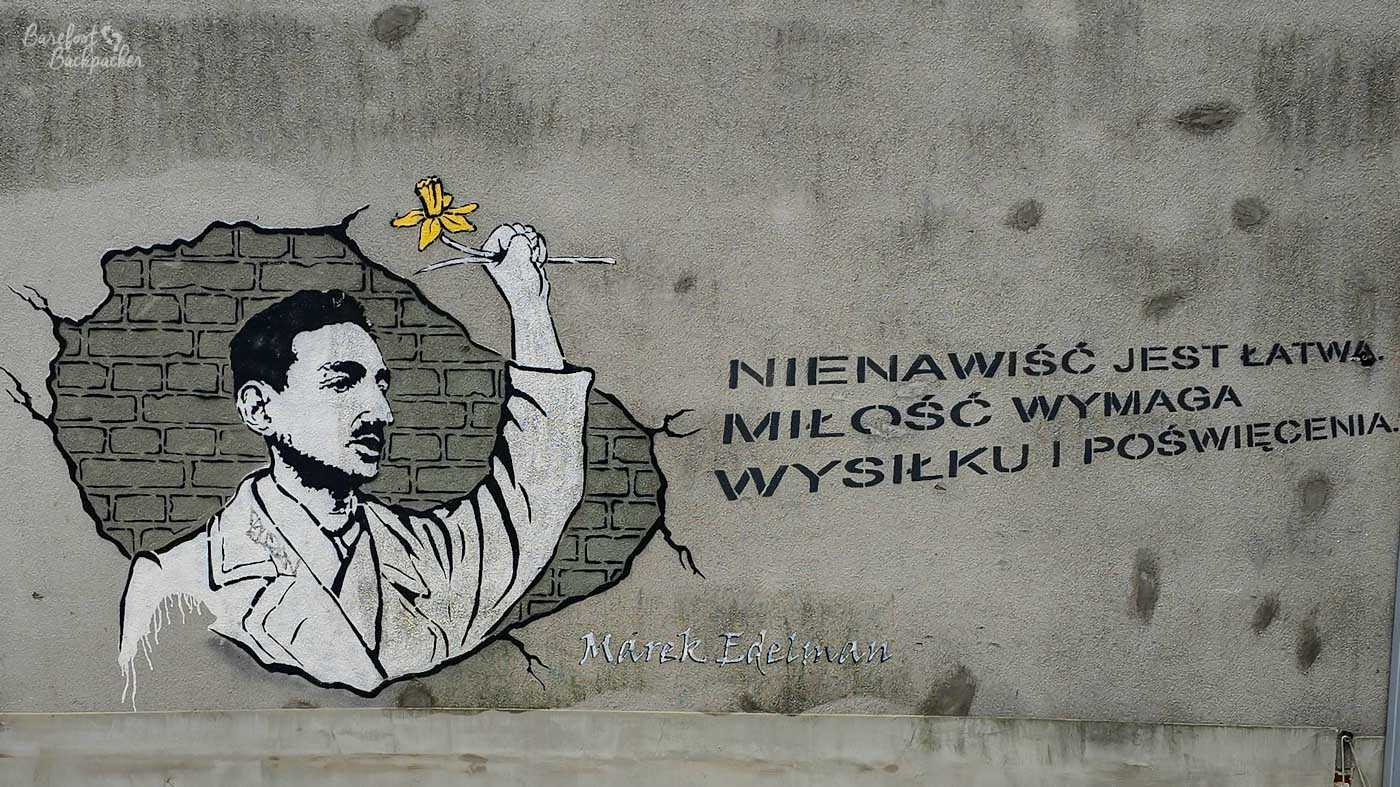
A mural in the Jewish Museum. The caption translates as: Hatred is easy. Love requires effort and sacrifice.
It’s not a big museum, and the photography is divided into five sections, but each of those sections is going to keep you focussed for more time than you might expect. The five sections are ‘current ruins’ (pictures of what partially-destroyed Jewish places look like now), ‘what they used to be (pictures of what those places looked like pre-WW2)’, ‘the process of destruction’ (pictures of those sites being destroyed), ‘places that have been repurposed or eradicated entirely’ (an interesting section with a mix of either surviving Jewish buildings now being used as shops or houses, or of places of Jewish history that have been wiped clean entirely so you’d never know anything related was there), and ‘people and culture’ (purposely, this is the only section with photographs of people).
At the back there’s a small room with stories of ten different people from the Krakow area who survived World War Two, where they went, what they did, and how they rebuilt their lives. Some of them stayed in the Krakow area, some of them stayed where the war took them, and some of them emigrated to places like the USA.
The museum cost 35zl each to enter, and is definitely worth it, if you want to be moved.
Nearby is the Ethnographic Museum. We went on the Tuesday, when it was free, though we didn’t know this until we got there. It’s located on Plac Wolnica and it used to the old town hall of Kazimierz. It’s a couple of floors that give an overview of Poland and Polish culture, with such things as displays of traditional dress from each region, models of various styles of building from different parts of the country, and a series of rooms highlighting different aspects of life, including an old schoolroom.
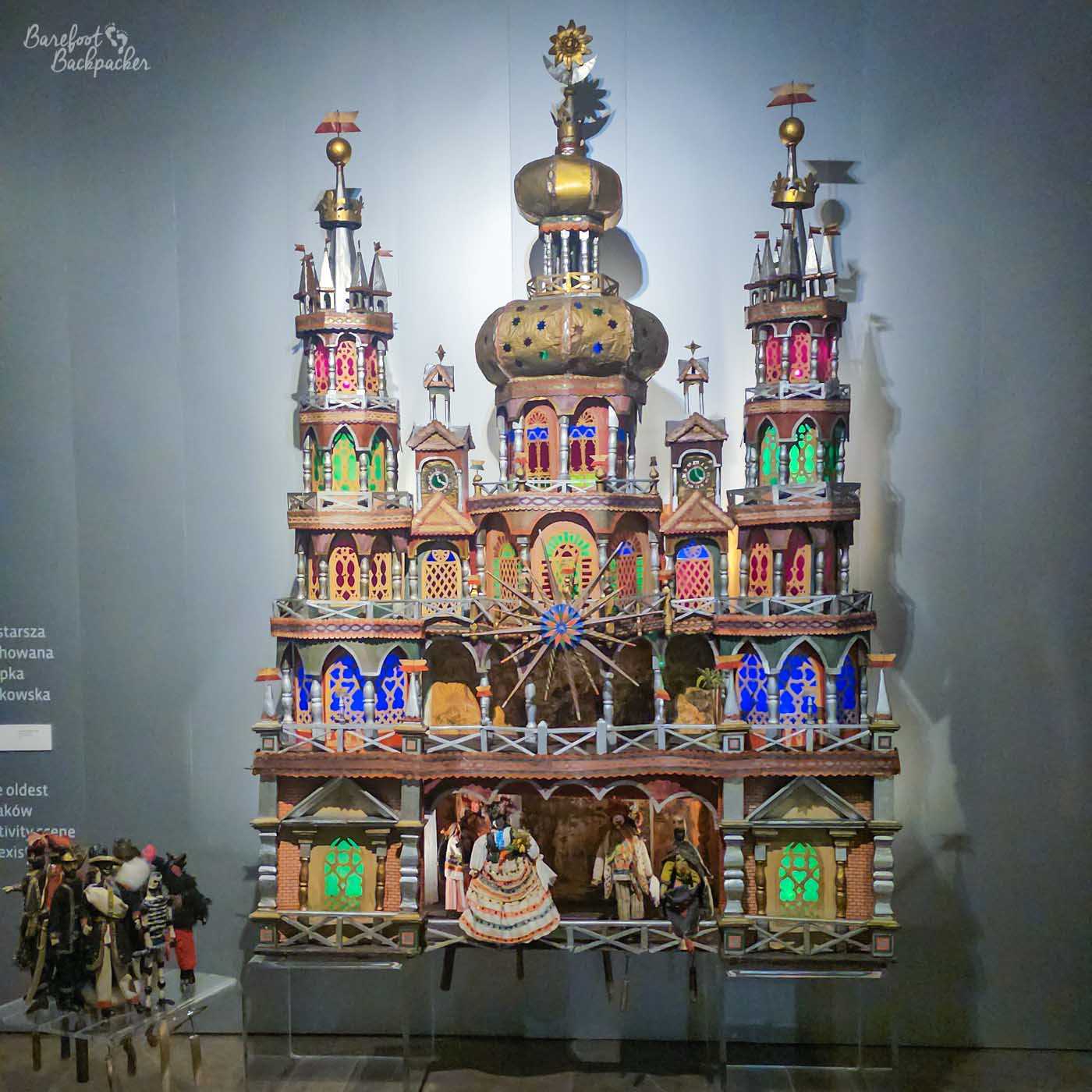
The oldest nativity scene in Krakow. Quite impressive, too; better than my primary school managed.
There’s also a lot of information around everyday life, including childhood, hobbies, types of work, food, and marriage, with exhibits and displays, including some that are interactive. There’s farming equipment like wooden cabbage shredders, and musical instruments like wedding bagpipes, as well as what’s described as the oldest Krakow nativity scene in existence – which is also large, colourful, and has Orthodoxy stylistic vibes. I must also mention the top floor with an art display of some very … alternative representations of Jesus. I’m not sure it should have amused us, but it did.
There’s a couple of other museums in this area that we didn’t get to, the most notable of which would be the Museum of City Engineering. It’s located in an old tram depot and is dedicated to the everyday-industrial history of Krakow and Poland, including transport, television, and household appliances.
While not a museum, it’s worthwhile noting that as Kazimierz was the Jewish Quarter, and just on the other side of the river is Podgórze, where the Jewish Ghetto in WW2 was located, it’s an interesting, if sobering, walk around both districts looking out for relevant historical sites, including old synagogues, the New Jewish Cemetery, and the remains of the Ghetto wall, which is bigger than you might hope it would be. There are also memorials and monuments to look out for, including a memorial close to Limanowskiego tram stop that commemorates the site of the Jewish orphanage in the Ghetto. The Jewish Ghetto Memorial itself is in Plac Bohaterów Getta, an open-plan paved square just south of the river whose name translates as ‘Place of the Heroes of the Ghetto’. It’s a series of 70 large chairs, representing how houses were emptied once the Ghetto had been ‘cleared’ of people, and all the contents dumped in the square.
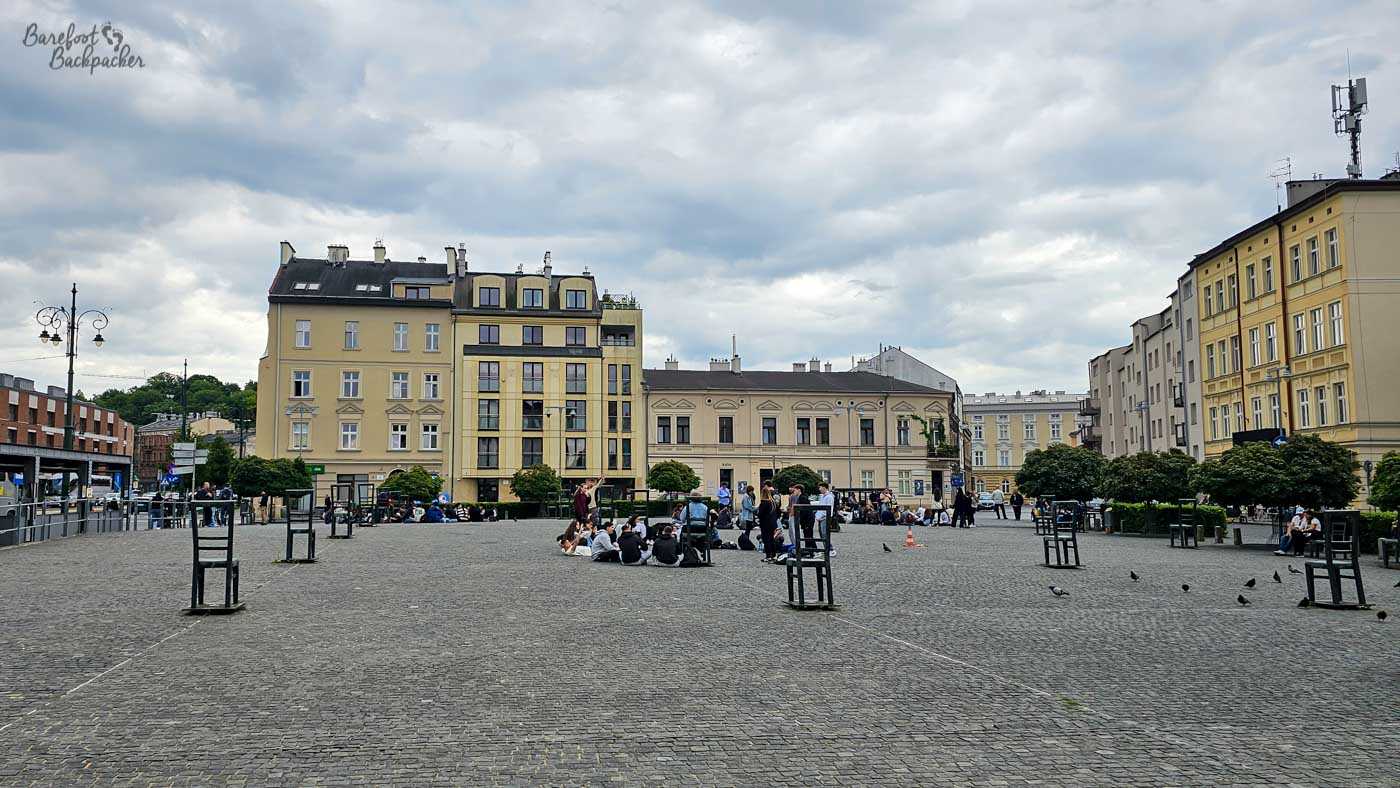
The chairs in Plac Bohaterów Getta.
We did not go to the Schindler Enamel Factory, a museum that looks in detail at Krakow under the occupation in WW2 and set in the factory run by Oscar Schindler, because it said there were no tickets available to be booked for the entire week we were there. Little tip, what with this and the hassle we had at both Wawel Castle and Auschwitz; in high season, book your tickets in advance.
Food and Drink
Restaurants
In the main, we wanted to eat traditional Polish food; while Laura is a lot more attuned to Central European cuisine than I am, we did feel it would make sense to try food that was more likely to be authentic than back home.
Polish food is … they’re very fond of heavy foodstuffs – stews, potatoes, and the like, plus they share with the Germans a love for cabbage and pickled vegetables. Of course they’re also very noted for pierogi – boiled dough dumplings filled with a variety of things, from cheese and potato, to any kind of minced meat, to fruit and chocolate. A very versatile foodstuff.
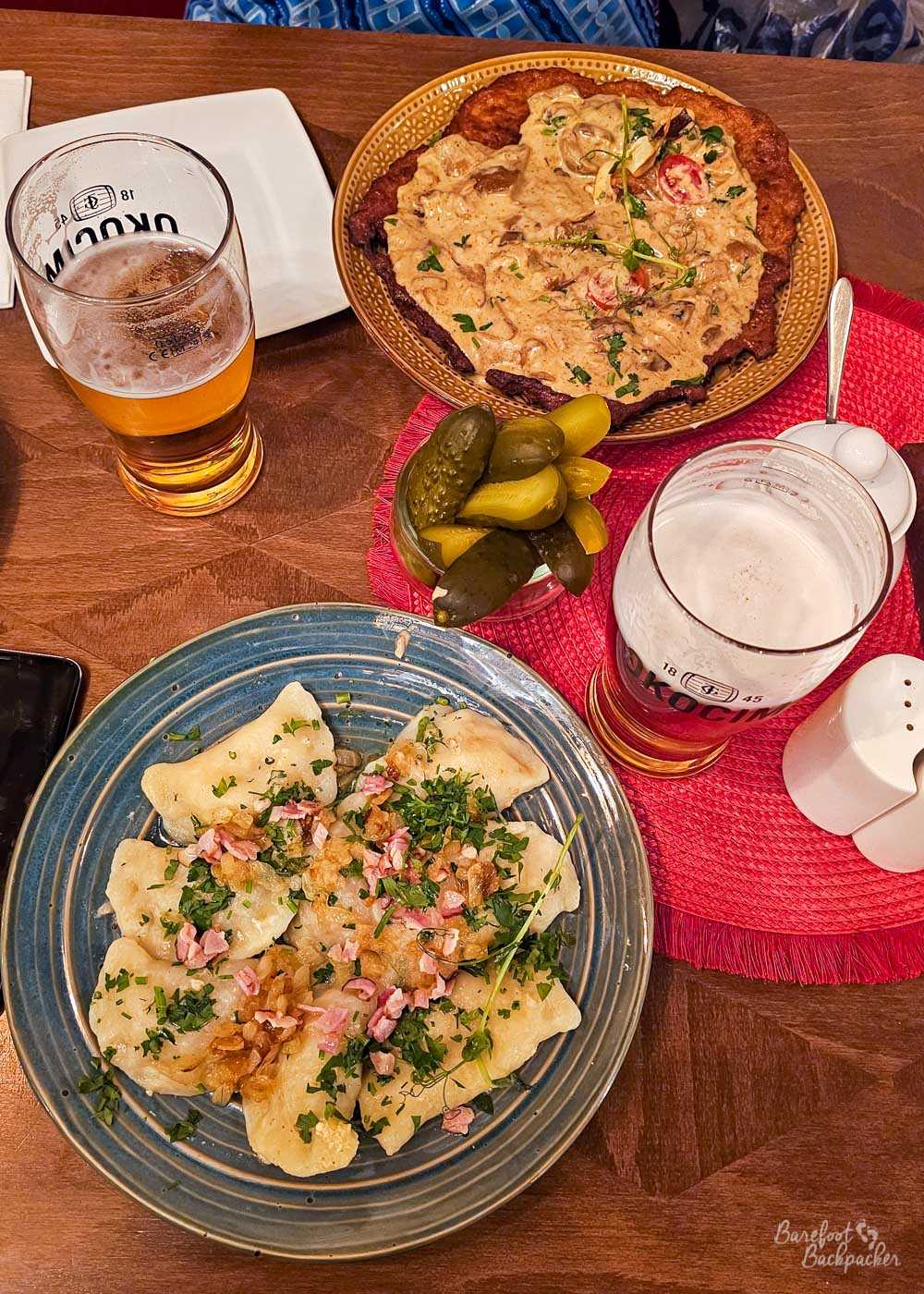
Our dinner in the Czerwone Korale restaurant.
On our first full day, we went to a restaurant on Mikołajska, just slightly east of St Mary’s Basilica, called Czerwone Korale – which Google Translate helpfully tells me means ‘Red Coral Beads’. It had a very ‘Polish’ aesthetic, in the sense that it looked exactly like you’d imagine a restaurant in Poland to look like, with wooden chairs and tables, and mostly plain upper walls decorated with colourful ribbon. We shared some mixed meat pierogi, a potato cake with mushroom (placek z grzybowym), and a pot of pickled cucumbers. Laura was disappointed they weren’t also fried – apparently fried pickled cucumbers are something more popular the further east you go. All that, plus a couple of beers, came to 154zl, or just under £30.
Our second night had us visit Kuchnia u Doroty, a small but traditional restaurant on Augustiańska, which was pretty much just on the opposite side of the main road near our hotel. This felt like quite a popular little restaurant, and we had tow ait about 20 minutes to be seated. But it was worth the wait. We shared duck (kacza) pierogi as a starter, then I had a pork schnitzel with chanterelle sauce (poledwiczki w sosie kurkowym), while Laura had beef stroganoff. Which was more like goulash, though I honestly don’t know if I’d know the difference. The food was so lush we persuaded ourselves to have a dessert; apple pie (szarlotka) and summer fruit pierogi cake (z owocami). No beer this time; we made do with two ‘cappy’ brand fruit juice. Total cost: 219zl (just over £42, and worth every grosz).
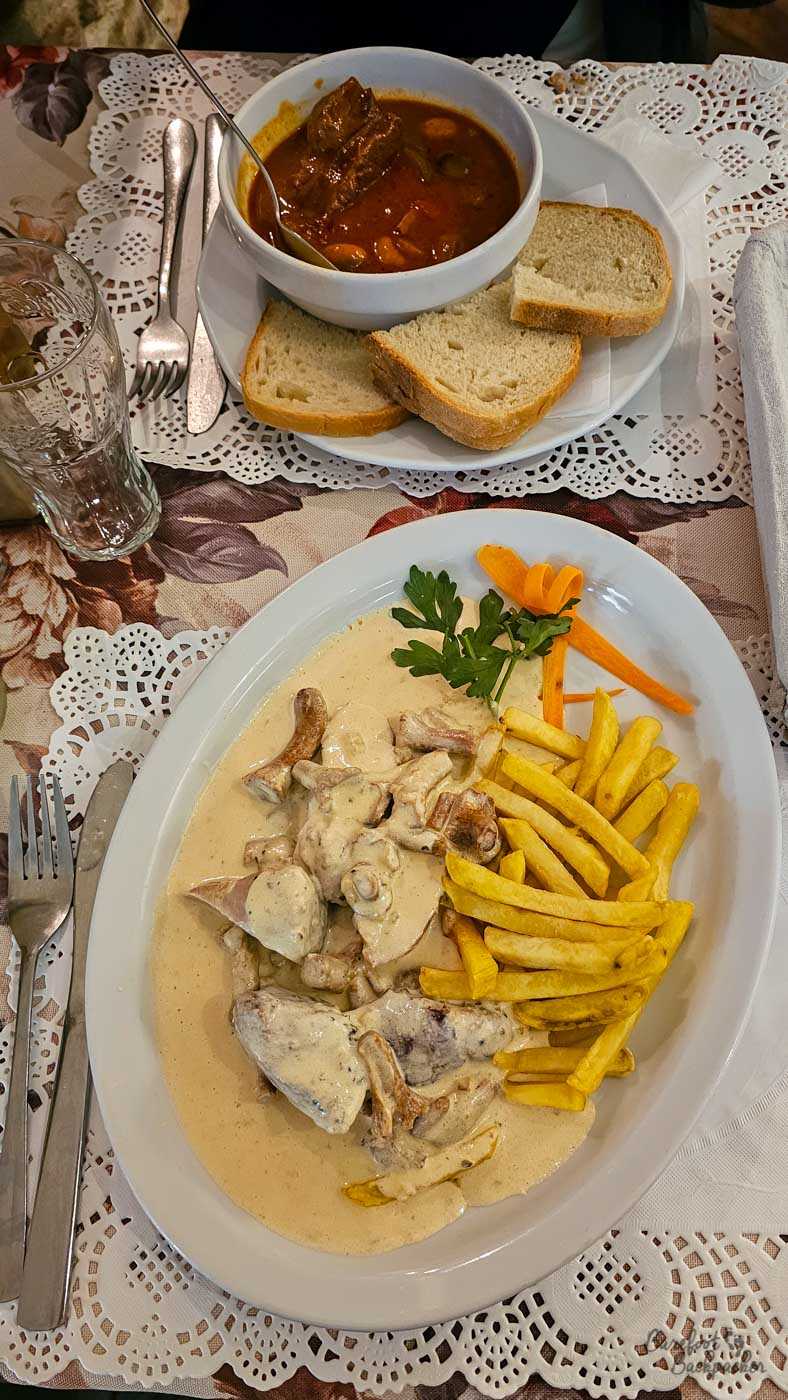
Our dinner in the Kuchnia u Doroty restaurant.
On our final night we ate at a restaurant on the main square. Partly this was driven by indecision, and partly this was driven by timing; it looked like there was going to be a storm coming and we wanted to not still be walking around looking when it hit. There’s lots of places to eat on the main square; they all kind of run into one another and they’re all fairly standardly touristy, both in terms of price and quality.
The one we ended up at was called Max 18. Again we shared pierogi to start, this time filled with cabbage and mushroom (z kapusta I grzybami), before our mains of Hunters Stew (bigos) and Pork Tenderloin (poledwiczki wieprzowe). Beers were also involved. The total price was 239zl (£46), demonstrating that you pay for the convenience of the touristy centre. It was nice to eat outside though, and get the ambiance of the main square at night.
Snacks and Drinks
We had a couple of late-night Kurtoszkalacz from a shop on our way back to the hotel. These are originally Hungarian in origin, and look a bit like big industrial chimneys, hence the common English name of ‘Chimney Cake’. They’re made of twisted sweet dough, covered with butter and sugar, and then ‘topped’ with all manner of spices and condiments as we wish, including cinnamon, jam, peanut butter, hazelnuts, or strawberries. Each was around 15-20zl each (£3.50ish) and lasted well into the next day.
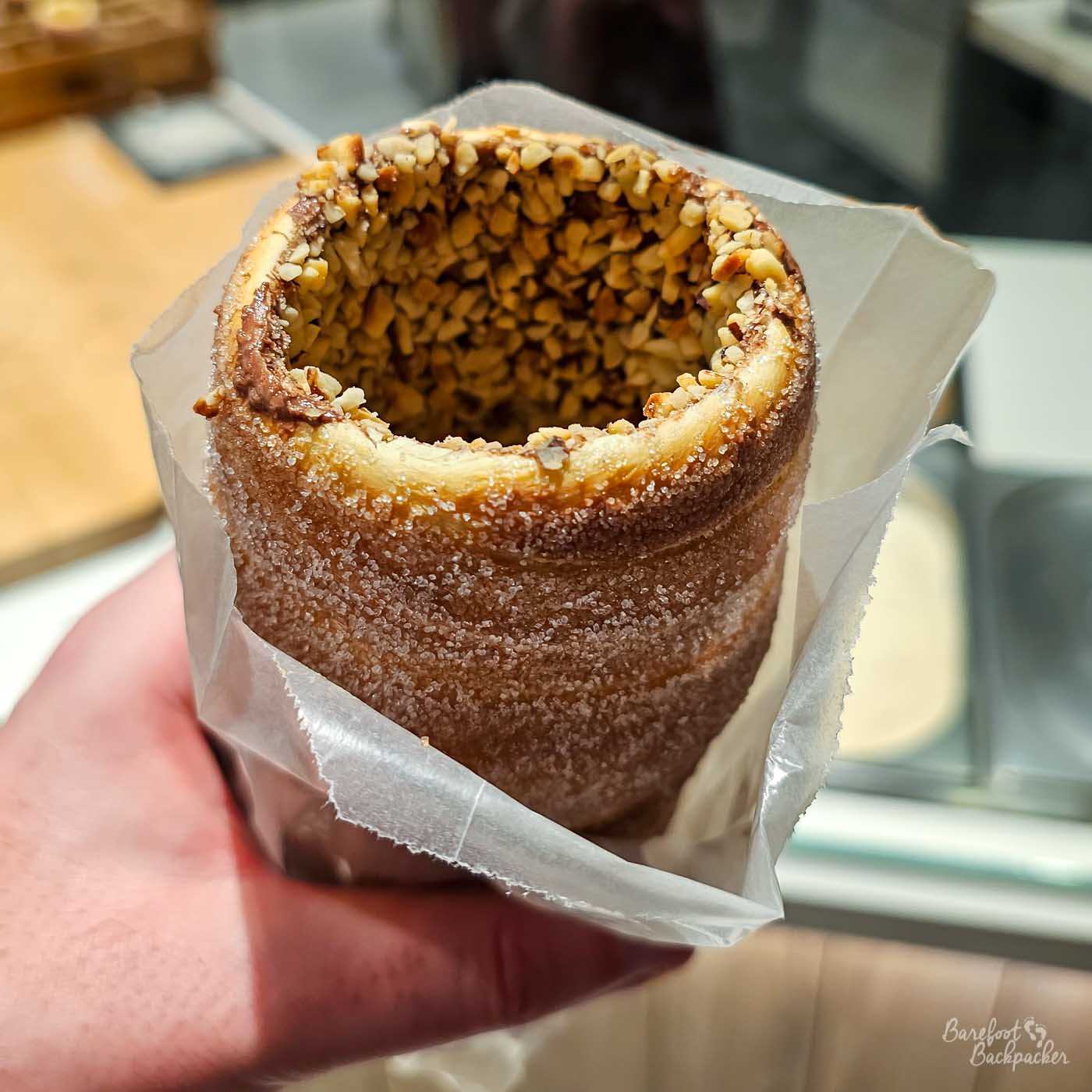
A fine example of a chimney cake, taken in-store and pre-nibble.
Across our days in and around Krakow we also had a fair few pretzels and snacks; and by pretzels I mean the big bready Germanic snack available everywhere but especially from stalls in shopping centres and at railway stations, that come with all manner of toppings. Ones we had included sesame/mozzarella and chilli/mozzarella.
On our last day we had a lunchtime drink at Karmello Chocolatier; it’s always nice to have a proper hot chocolate as so many places just make it thin and watery. There’s several locations around the town, but the one we went to was at “plac Wszystkich Świętych 11”. For 19 Zloty each, you got a mug of thick, gooey, hot chocolate made from milk, dark, or white chocolate, and then served either plain or with an additional flavour. We both got mint, but other options included coconut, hibiscus, or apple/cinnamon. Each was also served with a shot of water, to either loosen the hot chocolate (sacrilege!), or to freshen your mouth afterwards. So, so good.
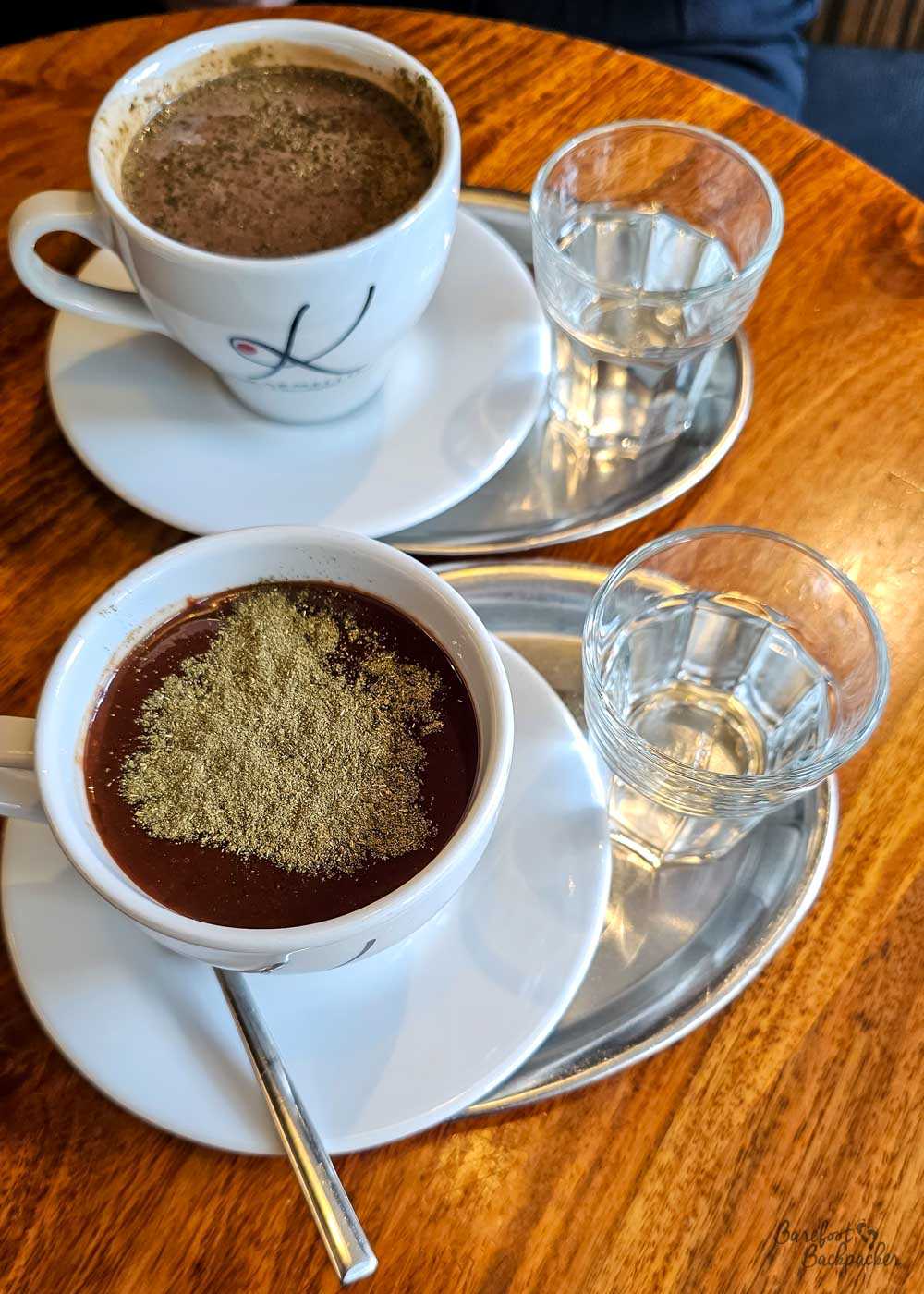
Our gorgeous hot chocolates, before they were sipped.
I’ll probably do a separate post on Polish/Krakow beer, but needless to say we went into a few pubs, and we’d especially recommend House of Beer, at the eastern edge of the Old Town, and Viva La Pinta, just north of St Mary’s Basilica. They both offer a good range of Polish beers on draft, a wide international range in bottles, and serve a large menu of pub food, just in case you’re missing your fish & chips. We didn’t eat in either but I imagine both their food is much better than Wetherspoons.
The Hotel
We stayed at the “Hotel Indigo Krakow – Wawel Castle”; a four-star hotel where rooms are available for around £100/night if you book in advance, so while obviously more expensive than a hostel, you get a decent amount of luxury in a popular city for less than the price of a London Travelodge. It’s part of the Hotel Indigo by IHG chain – there’s another in Krakow’s Old Town, and they have branches across the world.
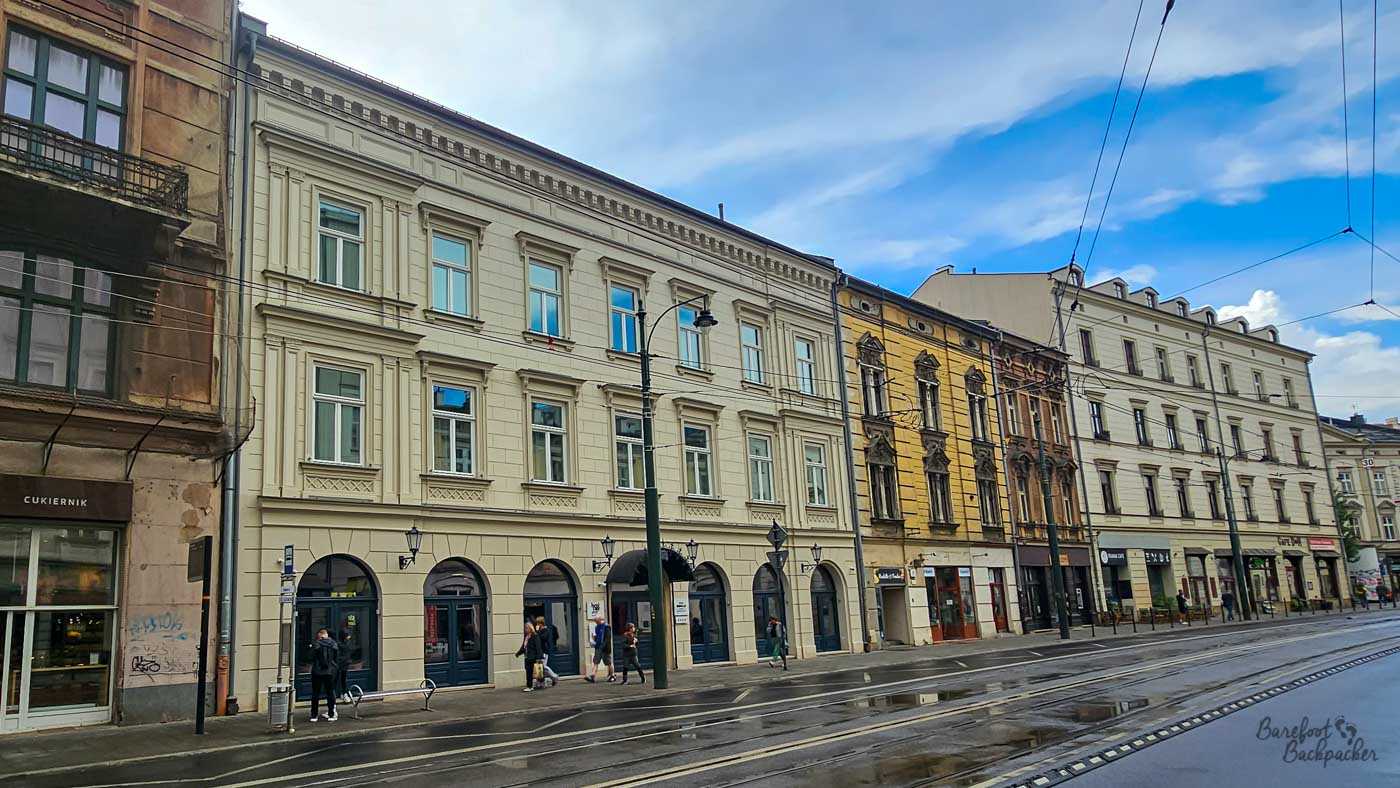
The frontage of the Indigo Hotel.
It’s located close to Wawel Castle, between the Old Town and the Kazimierz district, close to a main road and the Stradom tram stop. There’s two entrances – the main one on Stradomska, and a smaller one to the rear that we arrived at because the map suggests it’s on that street instead. Reception is available 24hrs, so very useful when you have a late flight.
Immediately you’ll notice the décor – it’s all very lovely, artistic, and also quite homely. The atrium has marble flooring and soft settees aside a replica woodburner, The dining room is sizeable and very airy, with a mesh ceiling letting in large amounts of light, and comfortable and soft seating by big tables next to light brick walls. This charm even extends to the rooms. Our room, twin-bedded, was a very impressive size, with fridge, coffee/hot chocolate machine, and some nice flourishes, including a retro dial phone. The far wall was basically window, with a small balcony, and a view that was almost worth sitting on with a glass of wine.
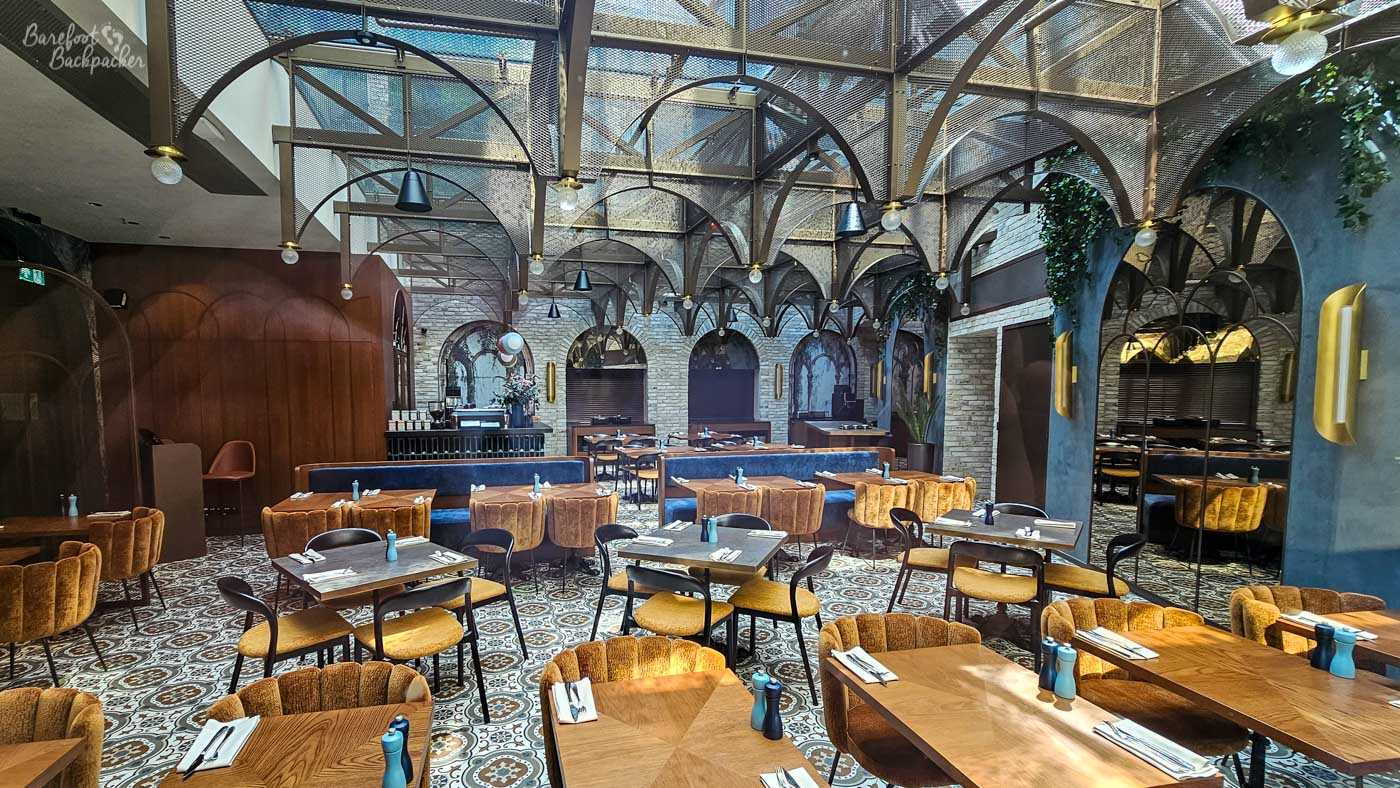
The restaurant inside the Indigo Hotel.
We only ate at the hotel for breakfast, but it’s arguably the best hotel breakfast we’ve had. Mostly it’s a buffet breakfast, but the options available are legion and the quality is fabulous. We’re not talking simple sausage, bacon, egg, toast, and crumpets here. No, what was on offer made us still pretty full and content even after lunchtime; gourmet sausages, maple bacon, potato cakes and sponges, a whole salad bar; everything was cooked to perfection. But wait, there’s more. Also from the menu you could choose an additional extra item, included in the cost of breakfast. These are specially-plated, the size of a starter maybe, so not insubstantial, and options include scrambled or fried eggs with toppings, omelettes, very-well-topped sourdough toast, or pancakes.
The hotel also has a number of amenities, including a spa, a gym, and its own bar. We didn’t get a chance to make use of any of these, because we were too busy exploring the city, but if they’re you’re thing, I imagine if the rest of the hotel is anything to go by, they’ll be fabulous.
How to spend three days in Krakow
A brief summary, then:
Day One
- Explore the old town
- Visit St Mary’s Basilica and the Town Hall Tower
- Walk a loop around The Planty
- Have a lunchtime Chimney Cake snack
- Visit as much or as little of Wawel Castle as you like (tickets willing)
- Eat at Czerwone Korale
- Drink at House Of Beer
Day Two
- Visit Museums:
- Ethnograhphic Museum
- Jewish History Museum
- Schindler’s Factory (remember to buy tickets in advance)
- Eat at Kuchnia u Doroty
- Drink at Viva la Pinta
Day Three
- Take a trip to one or more of the sites a little outside town
- Auschwitz
- Wieliczka Salt Mine
- The Zoo
- Eat on the main square; because why not?!