We didn’t know much about Dominica before we arrived for our three-day trip while travelling the Caribbean on a budget; all we knew was that it was a small Caribbean island that was largely green on the map.
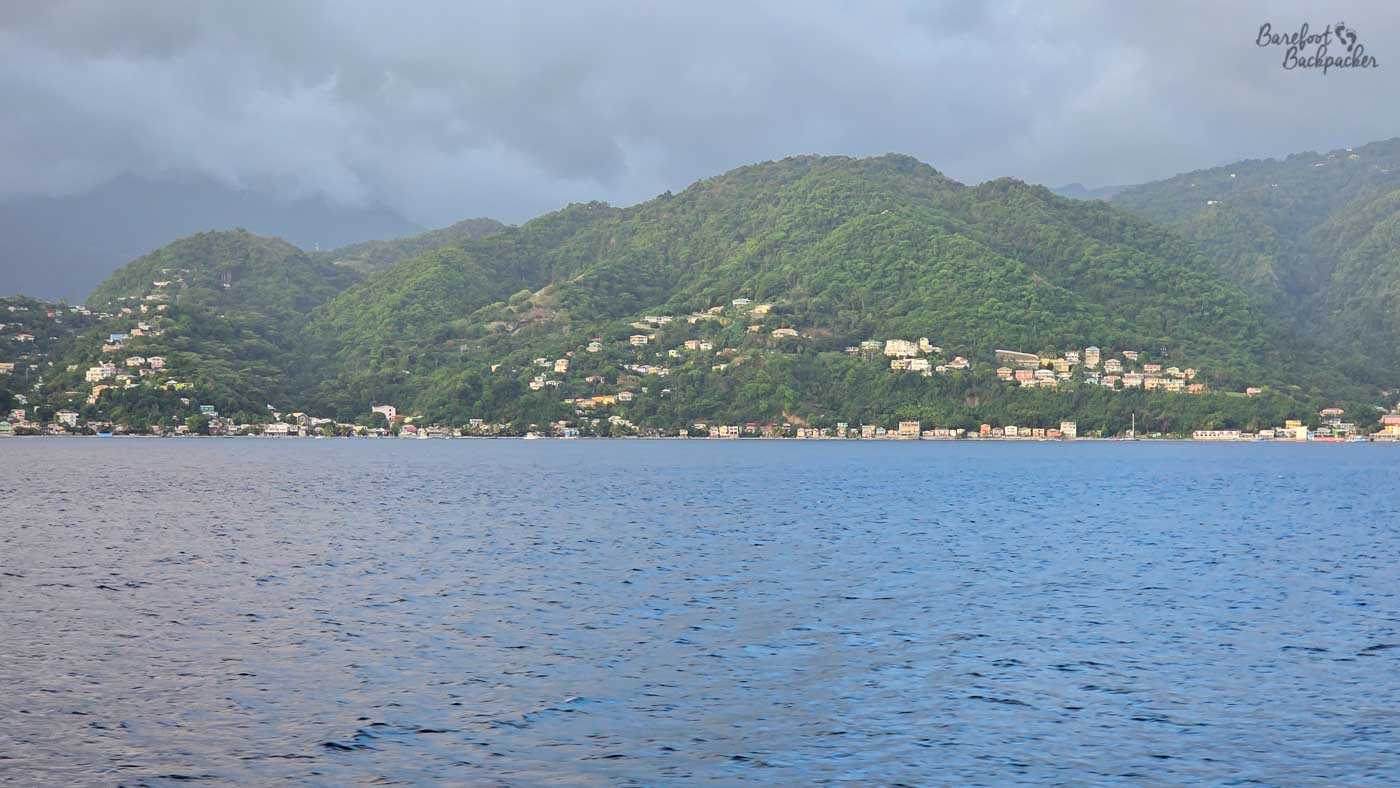
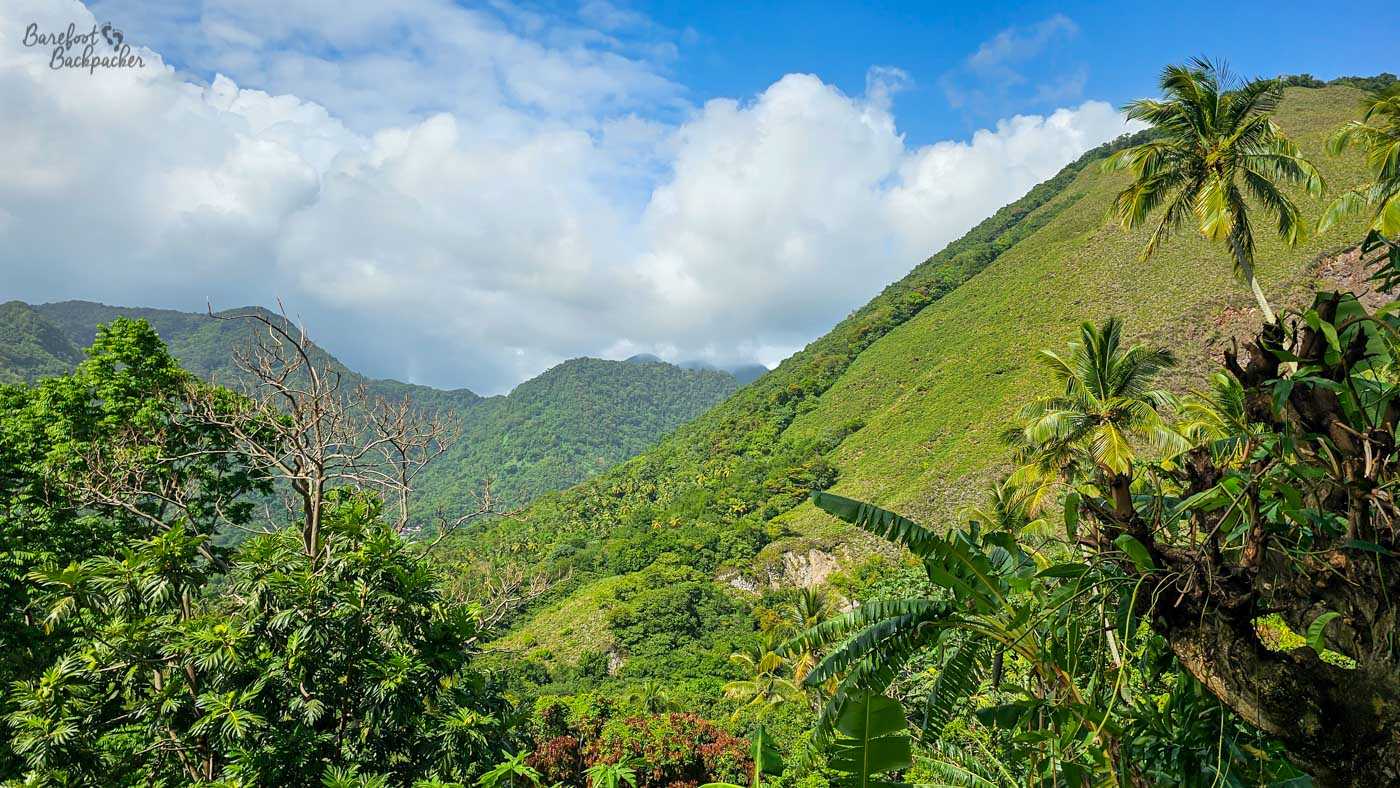
The coast of Dominica – you can easily see how green and hilly it is.
Dominica is not very big. The population of the island nation is only about 71,000 – slightly smaller than Crewe – and it covers an area of about 750 km² – about the same size as New York City. It should not be confused with the Dominican Republic, a much bigger nation at the north end of the Caribbean, and as such searching for information about Dominica tends to be slightly more difficult than it should be.
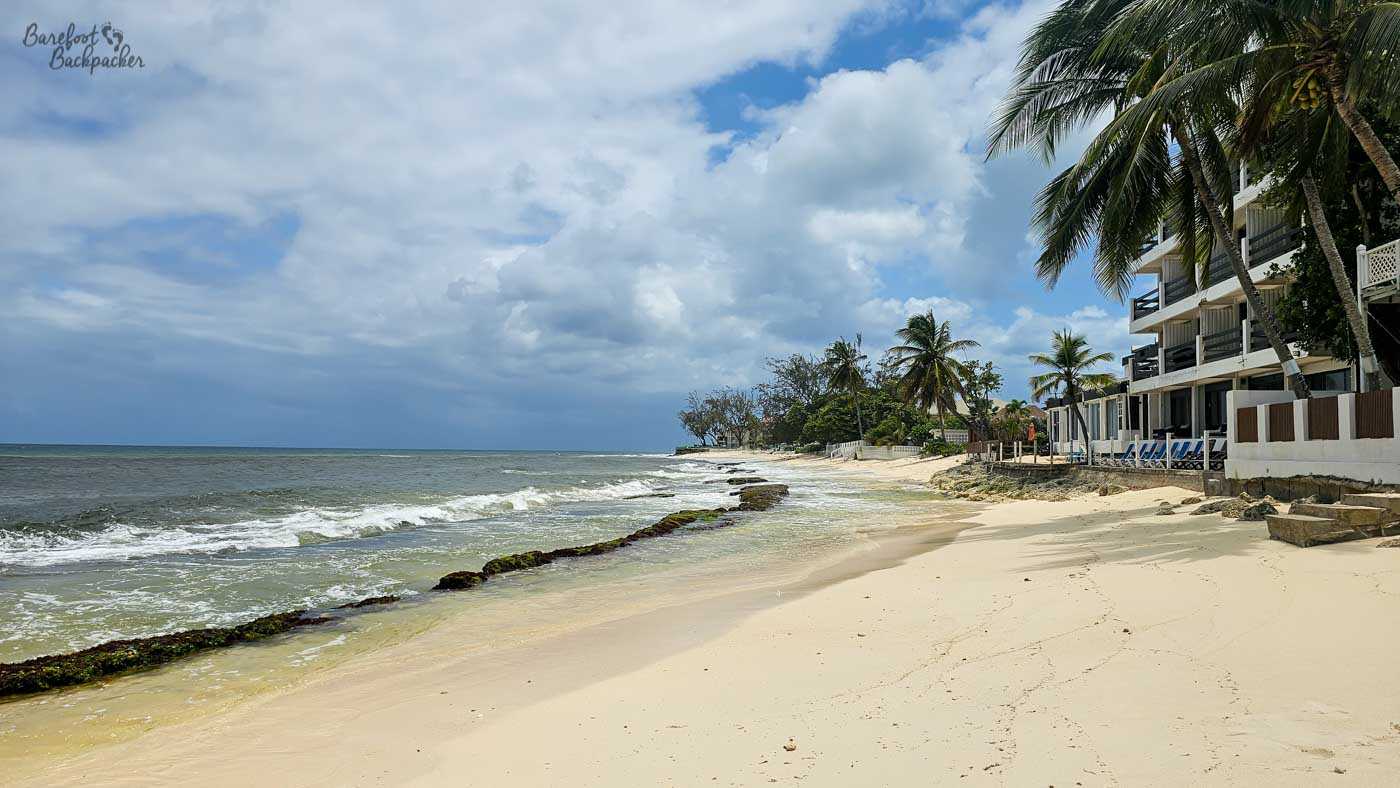
You should also note that Dominica isn’t a beachy island – it’s far too rocky and mountainous for that – but that’s not why you’d go there; rather you’d go for the scenery and the forest. Indeed, the name of the island itself in the he native Carib language is ‘ Waitukubuli’, and means something along the lines of ‘tall is her body’, reflecting the mountainous nature of the island.
We were there in early June; as it turns out our first full day in the country was a public holiday (Pentecost) and nothing would be open or running. This proved only slightly problematic in the end but it’s definitely something to be aware of if you’re staying anywhere outside Roseau.
Roseau
As international capitals go, Roseau ranks as one of the smallest, with a population of around 15,000. This makes it very slightly smaller than my current local town of Todmorden.
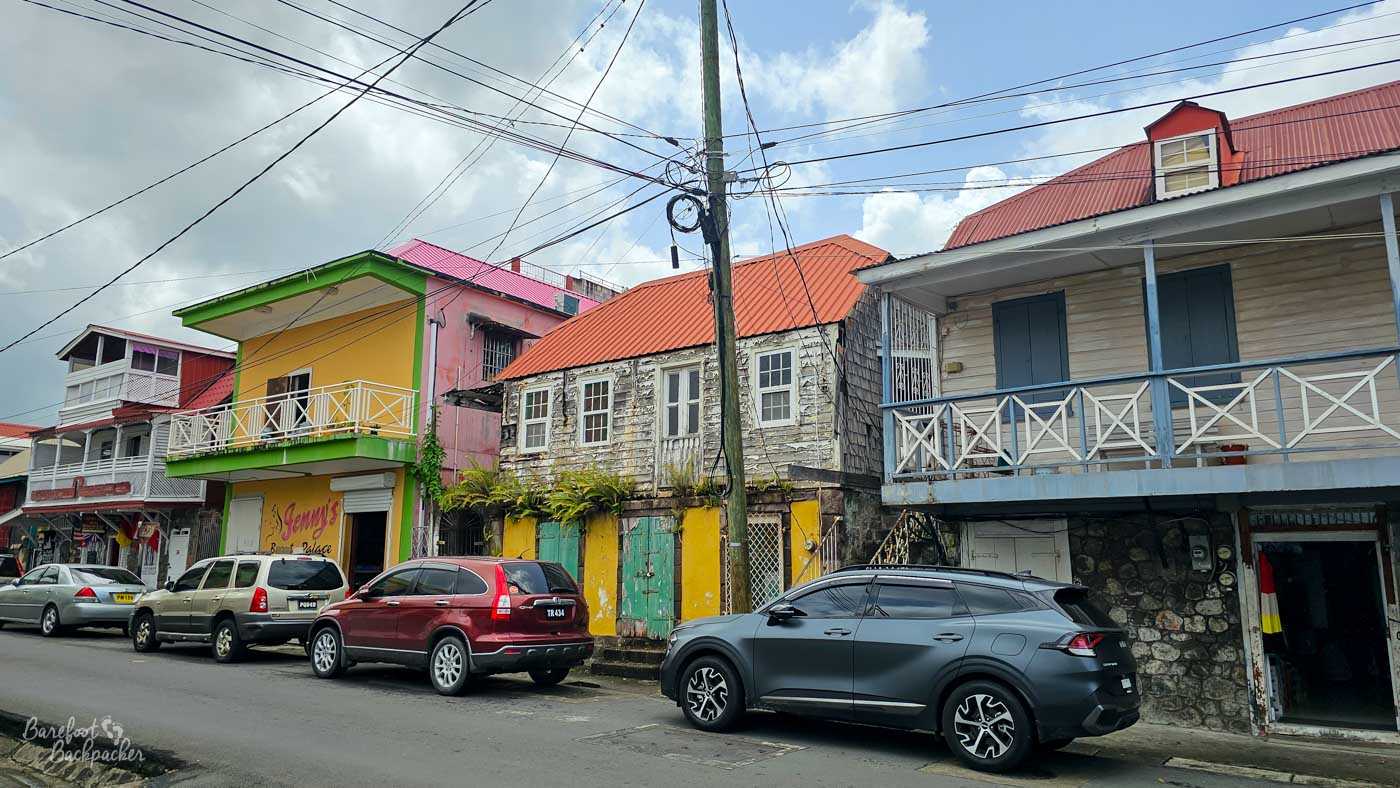
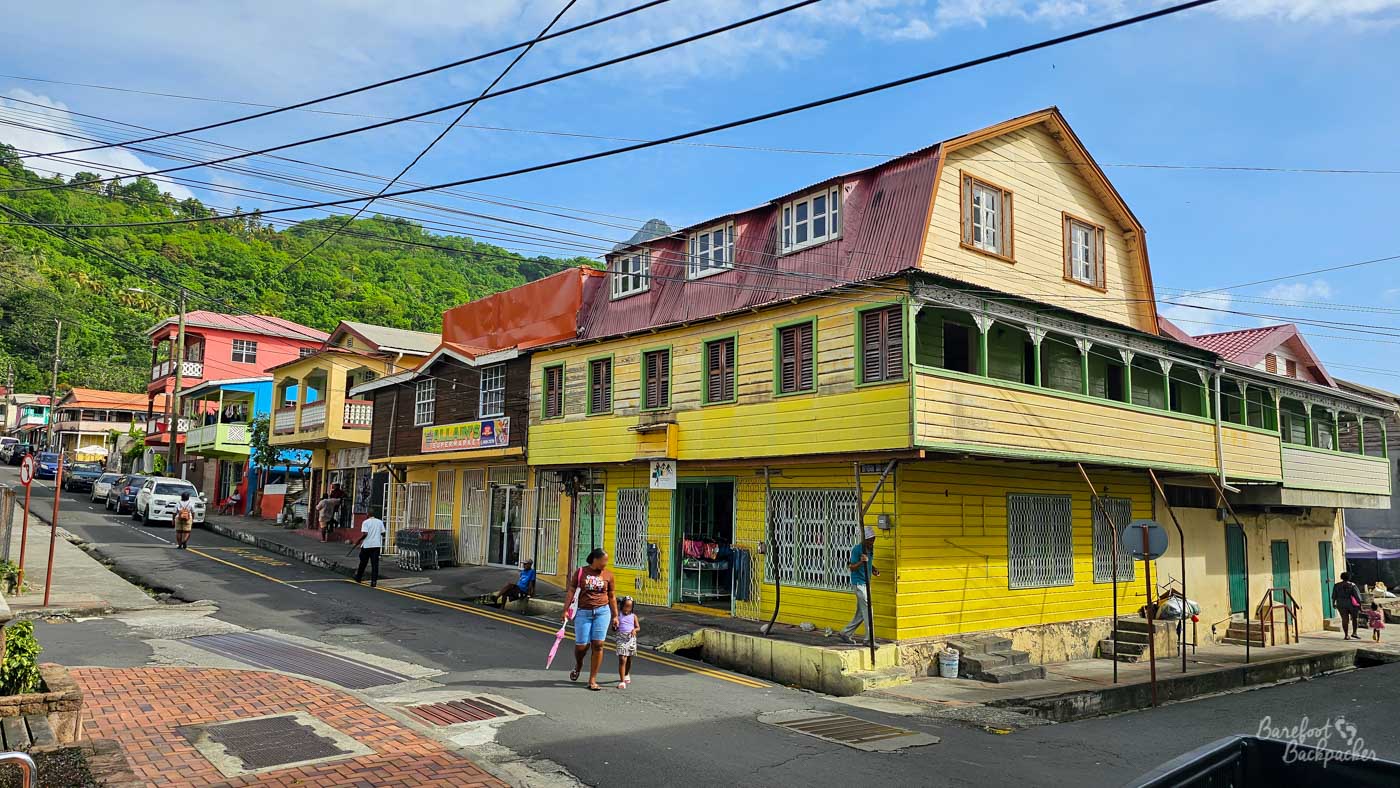
A street scene in Roseau.
I found it similar to Soufrière, in that it’s made up of a rough grid pattern, and along each street – but especially at the corners – the houses and shops are generally quite vibrant with colour or design. This could be the way they’re painted, or the styling of their walls, or the décor on and around the balconies and canopies. Even the main church, which otherwise is mostly plain and slate-grey / yellowy-beige has a crenellated tower roof and fancy arched windows.
It’s probably going to be easy to get ‘bored’ by Roseau if you spent a large amount of time here, and there’s no beach near the city centre to distract you, but as capital cities go, it’s definitely reflective of the country it represents, and let me tell you now, that’s definitely no bad thing. It does have all that you need to get by though, certainly as a tourist. There’s a couple of banks and ATMs, at least one of which (possibly Zuma, Kennedy Avenue) takes foreign cards without any issue. There’s also at least one supermarket in the centre (Whitchurch IGA, Old Street) that’s pretty decently-stocked.
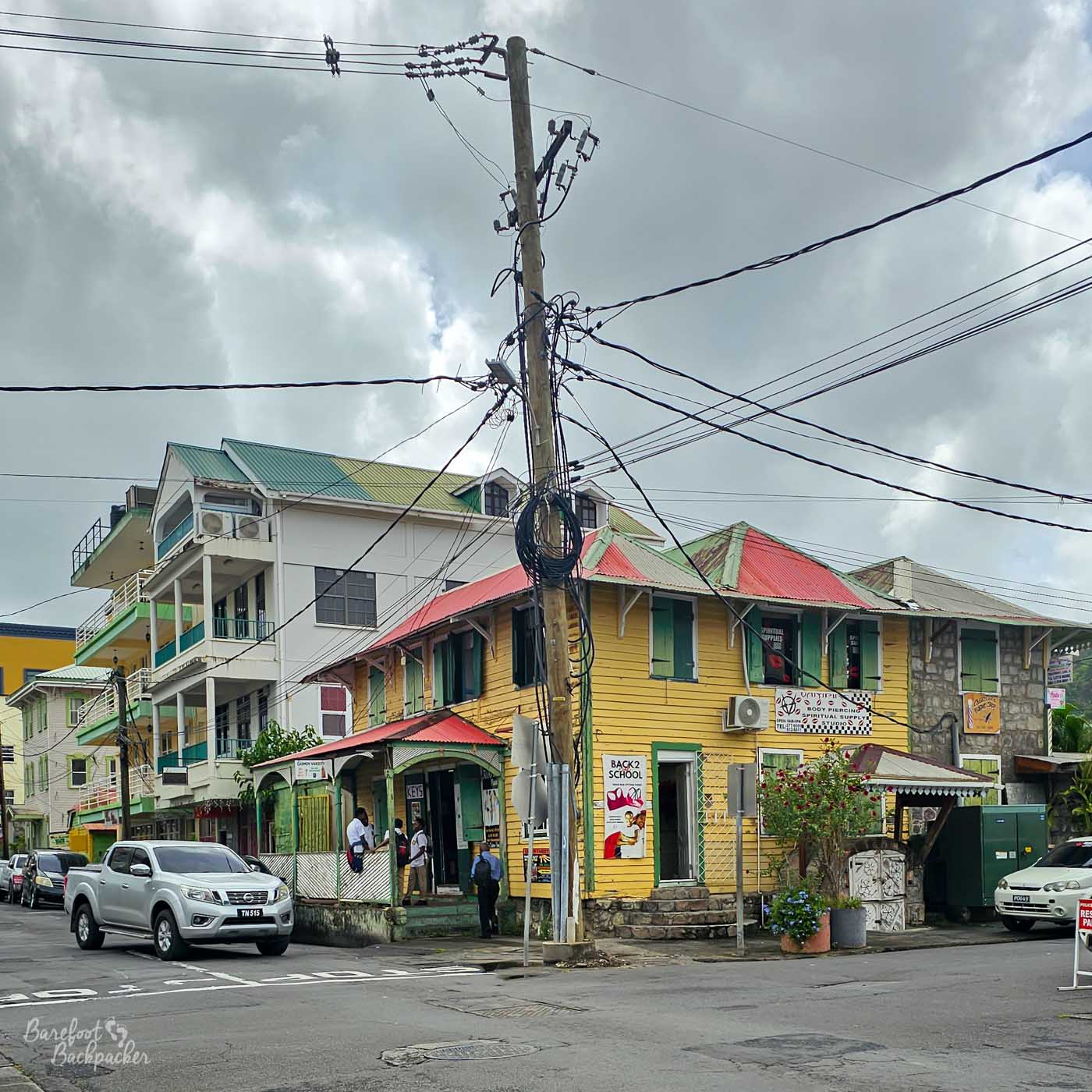
Another street scene in Roseau.
As for cafes, we weren’t in town that long on either of our days there; we were using it more as a ‘we need money’ visit, but we did come across a small bakery place a block inland from the pier and lighthouse (The Nook) that served *the* most delectable bagels for lunch; I had an ‘everything bagel’ with a fabulous smoothie. Also in Roseau I bought a bottle of what was described as ‘peanut juice’. It looked distinctly beige but drank very much like a peanut milkshake. I would definitely have again; nicely textured and creamy, but with a very nutty vibe.
Accommodation in Dominica
We stayed in a guesthouse about 4 miles out of Roseau. But that doesn’t tell the whole story. The road from Roseau was uphill pretty much for the entire length; it was a winding country lane through the rainforest; thick tree coverage on either side, and an occasional side lane leading to a small collection of houses and the occasional B&B. The hotel itself was down one of these side roads, in the middle of a very small village made up entirely of houses, a church, and a sports field. There was one building that looked like it would have been some kind of small drink stall had it ever been open when we passed it. At the junction with the main road was what purported to be a mini-mart but again I don’t think I ever saw it open.
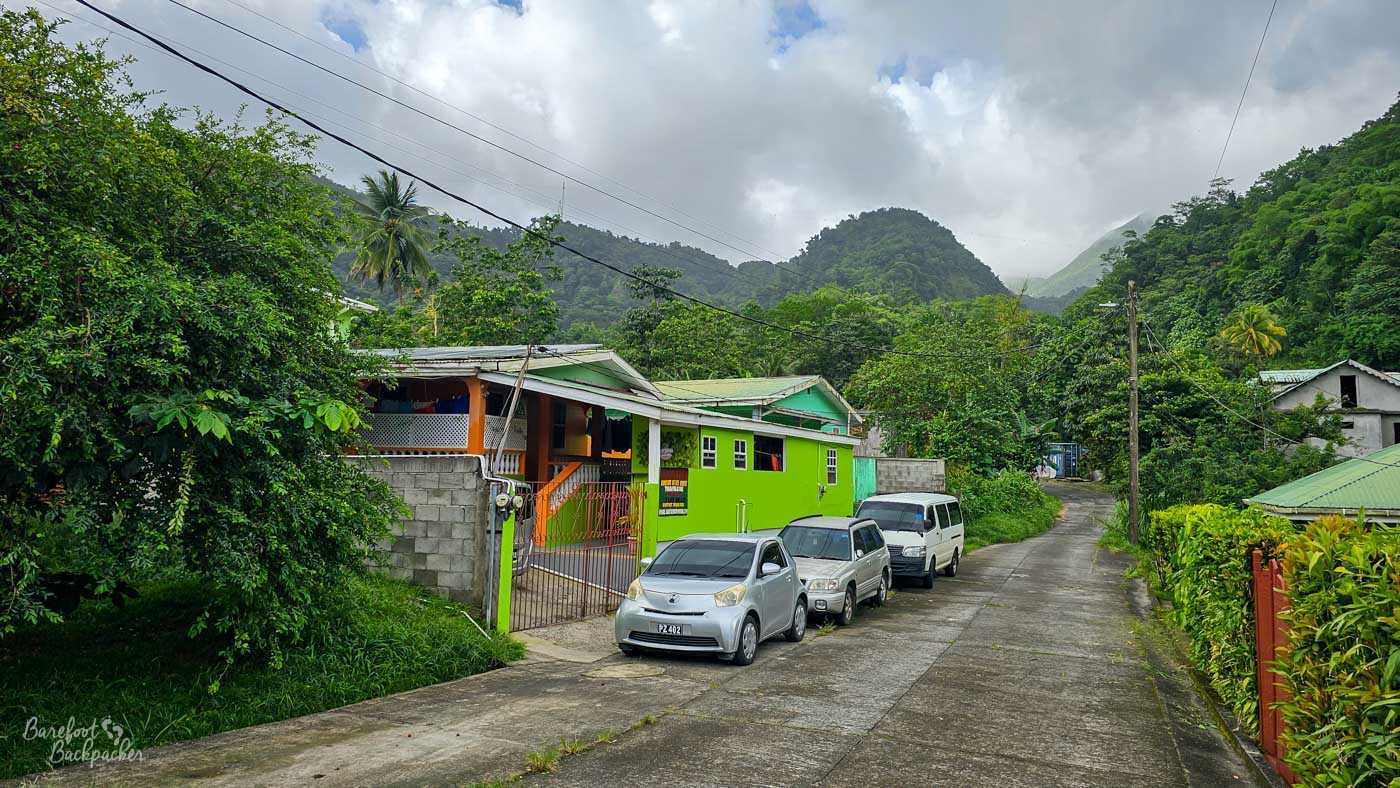
The outside of our hotel in Dominica.
The guesthouse itself vibed a bit like a few outhouses in someone’s house; I had the strong impression we were the only people staying. Our room was long, and contained two decent sized beds at one end, and a bathroom at the other. The room had no aircon, and while the room contained one large fan on a stand, the humidity and stickiness meant we had to ask them to bring us a second one so we could effectively have one each; fortunately it not being tourist season meant this wasn’t a problem. Indeed the only issue was we spent three nights negotiating a series of scattered wires in the dark, due to a lack of convenient power sockets. In front of the house, down a narrow alleyway, was an open-plan living-room in the yard, with a small attached kitchen and a couple of settees. The main house was on a kind of dais alongside this open area. The shower in our room seems to have been fed from a house-wide rainwater collection tank, and we were casually advised not to use it for too long lest we run out of water, but, in fairness, it was a few hundred metres up a hill in a rainforest so it’s not as if we were in any danger of drought conditions.
Had we booked it in advance, we could have eaten there – they could have made extra of their evening meals and plated it up for us. I did not. Because I did not think that far in advance, and nor did I realise that our first full day in the country was a holiday where nothing would be open.
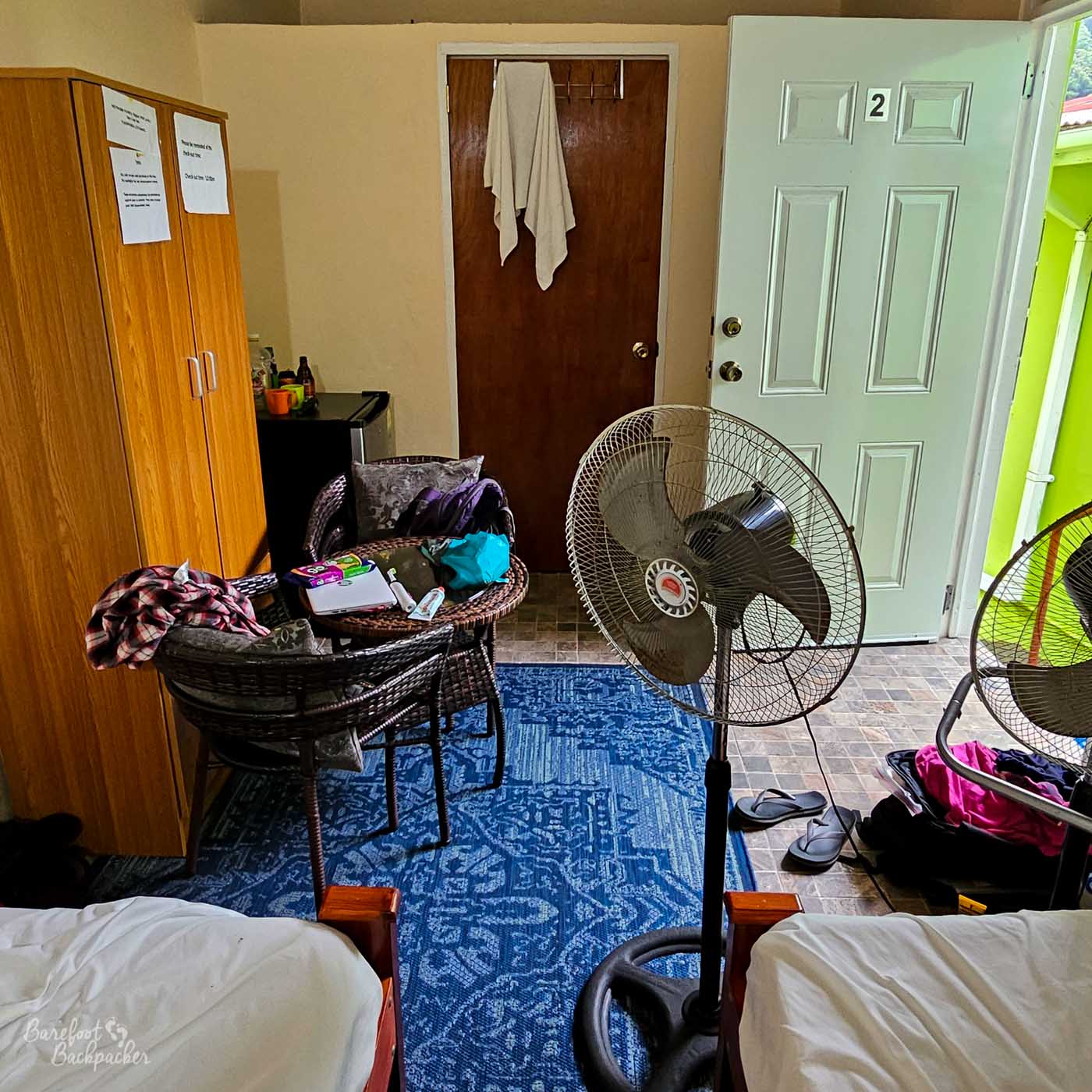
Our room in the hotel in Dominica. Note the fans.
When I was researching places to stay on the island, most of the options seemed similar – guesthouses run by local families, mostly in small villages in the hills, all the way up the west coast. There seemed to be very little available in Roseau itself. The area around Wotten Waven was the most popular, but there were places to stay uphill from the coast most of the way to Portsmouth in the north of the island.
Dominica’s Rainforest
As the guesthouse was in the rainforested hills, much of our time was spent walking along the lanes and through the trees. And it was an incredibly chill and ideal place *to* just have a calming wander. The main road continued up the hill and past a scattering of other houses, before splitting in two. One way went deeper into the rainforest and ended at a car park serving a pathway to a waterfall, the other turned back on itself and meandered to another small village, albeit a bigger one than ours. This was Wotten Waven, and contained a couple of street bars and one restaurant, and three small sulphur springs.
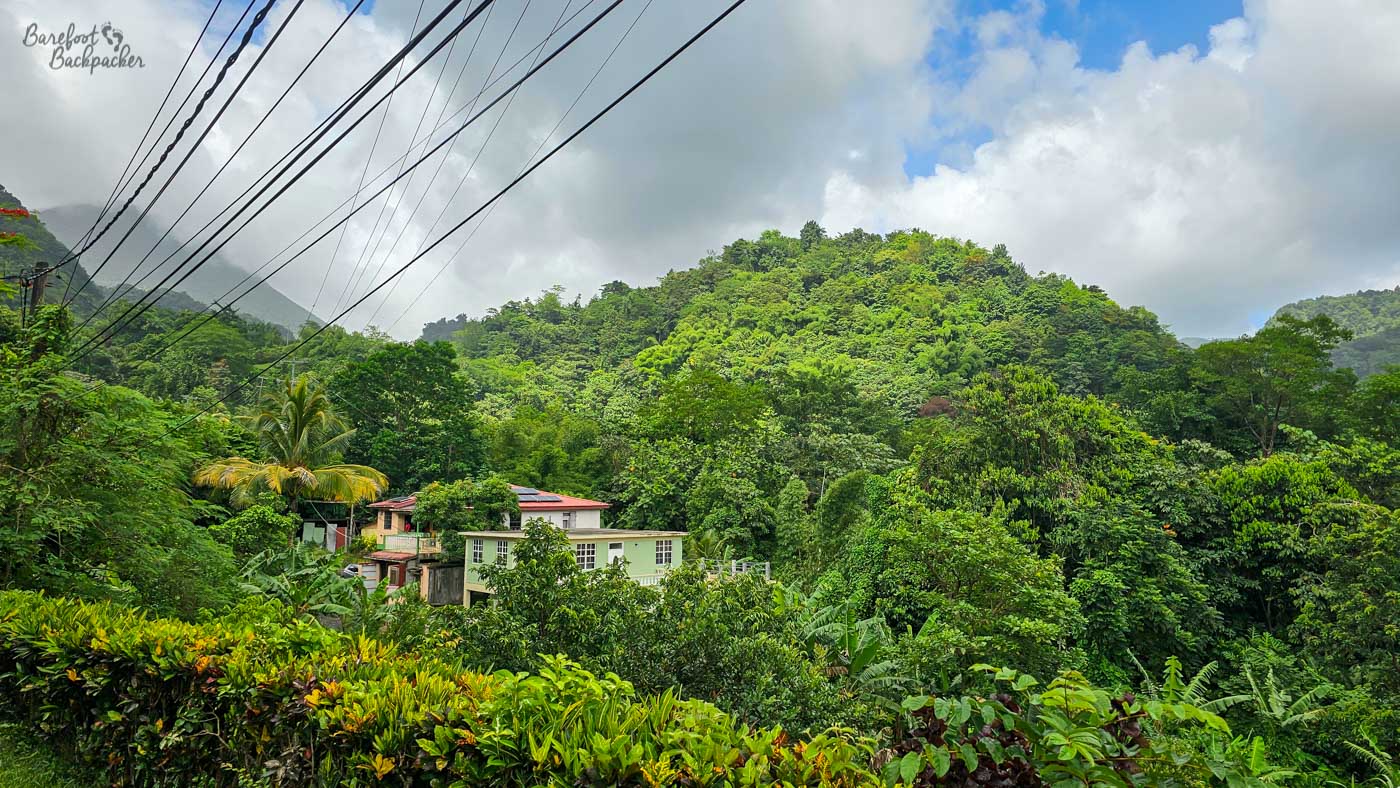
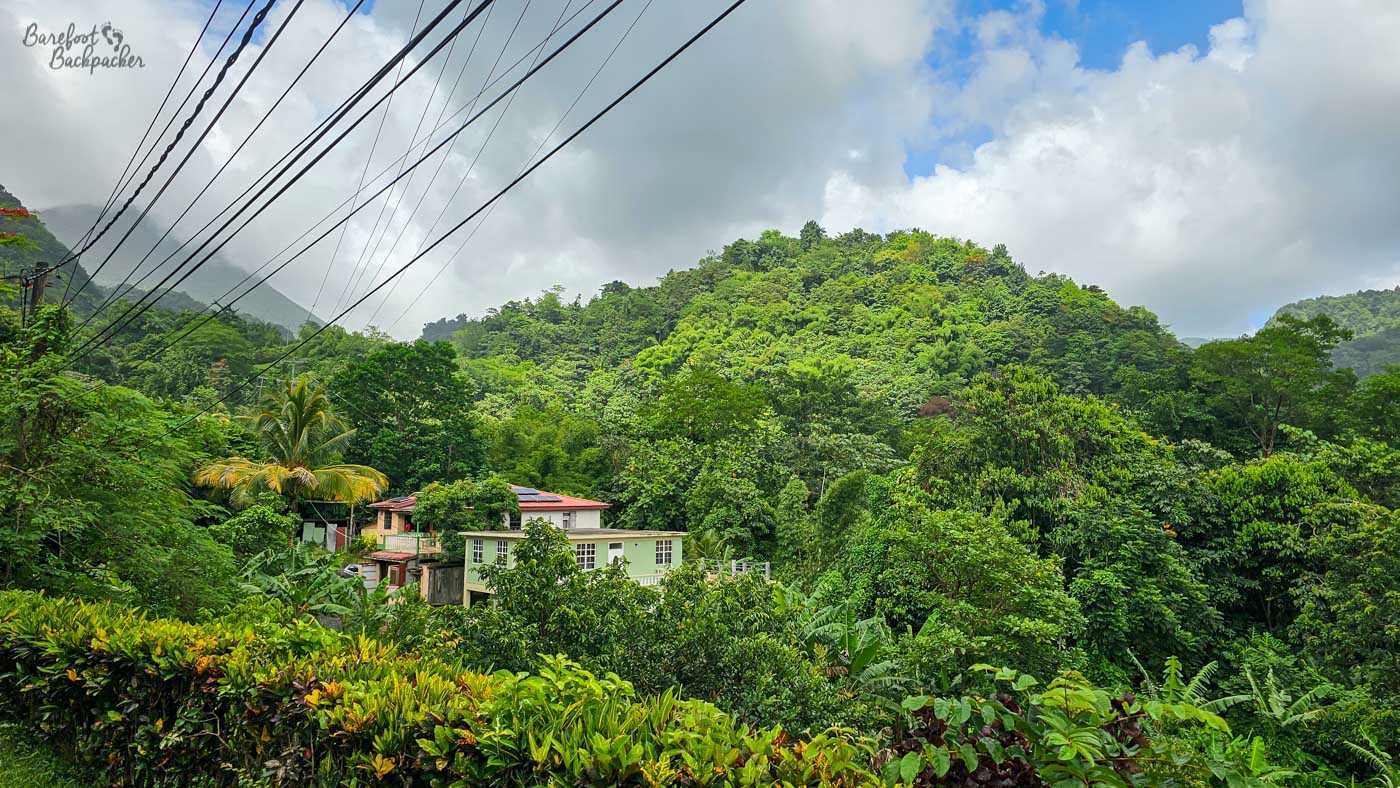
A typical view in Dominica. It was all trees, hills, and the occasional building. I hate to use the phrase ‘nestled quaintly’, the bane of travel bloggers since at least 2010, but here we go.
I need you to imagine the setting here though. Though without pavements/sidewalks, the roads were pretty wide and not at all busy; the number of vehicles that passed us in either direction were probably countable without recourse to toes; and on either side the trees were huge and dense – even just looking down some of the footpaths meant you could barely see the cabins in the woods they went to, and since the roads were quite undulating, it was incredible to stand on one of the crests and look out at nothing more than rainforest below and to the sides, Everything was so green and so quiet; it was hard to believe we were only four miles from the capital. We felt very much on our own, surrounded primarily by birdsong and small lizards. It would be a great place for a writing retreat or something similar. In addition, there was almost not street-lighting, so once the sun set it got *really* dark and, rather than it feeling foreboding, it actually felt kind of special and exciting. It didn’t feel at all scary or troublesome.
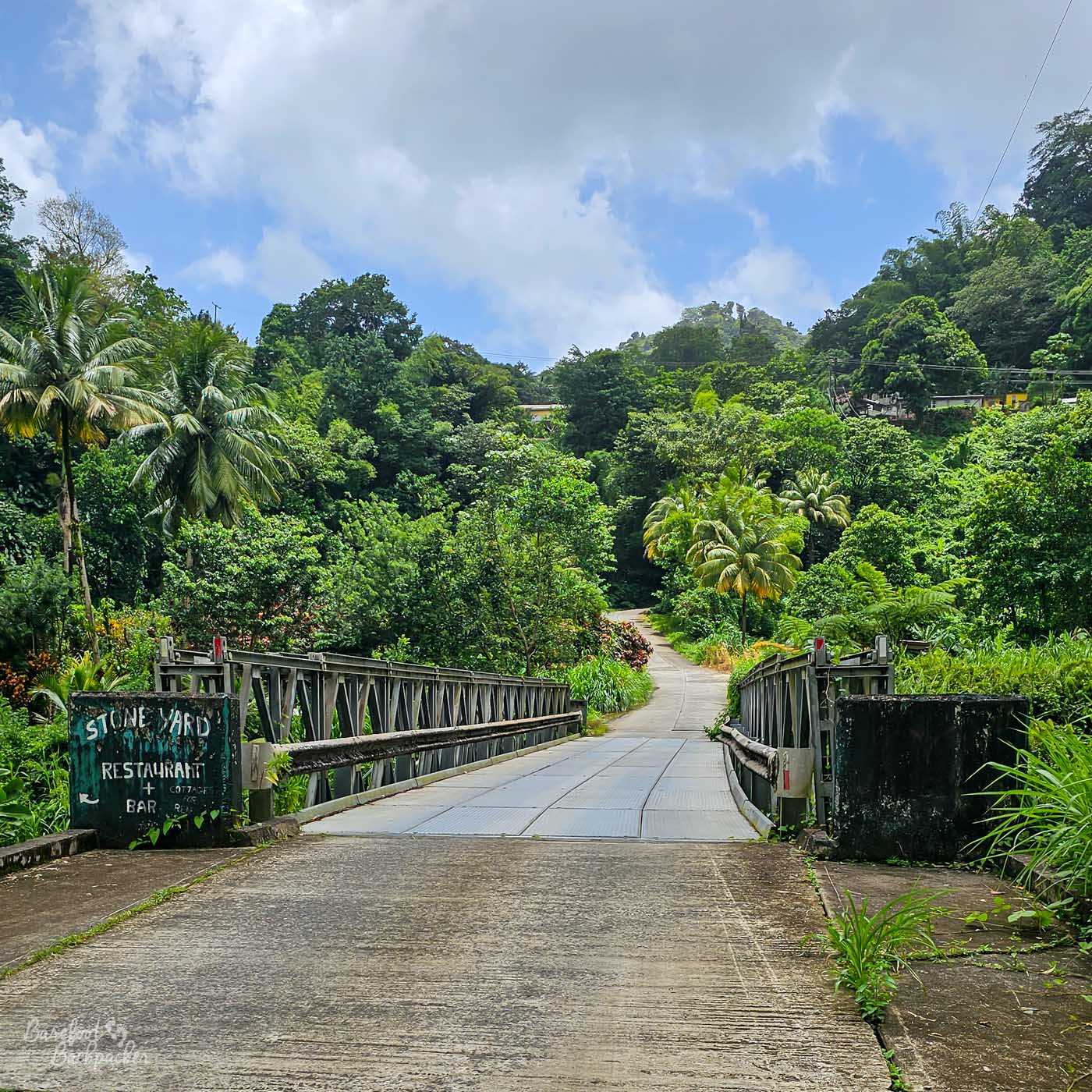
The country lane to Wotten Waven. It’s just an empty road, lots of trees, and nothing else.
We were in Dominica for three full days, and in fact we spent quite a bit of all three just wandering the lanes. Pretty much all the buildings we passed felt, to me at least, like they’re not at all out of place in the environment they’re in; they all feel quite natural, rather than appear at odds with it. Or maybe I’m just used to a world of grey and brown buildings everywhere, regardless of the location. Many were two storey, with balconies, and brightly-coloured – no 1960s grey here – but they felt dwarfed by the surrounding trees, and at no point did it feel that we as humans were invading the rainforest; indeed I got the impression the trees could probably squash us all if we even *looked* like we were about to come at them with an axe.
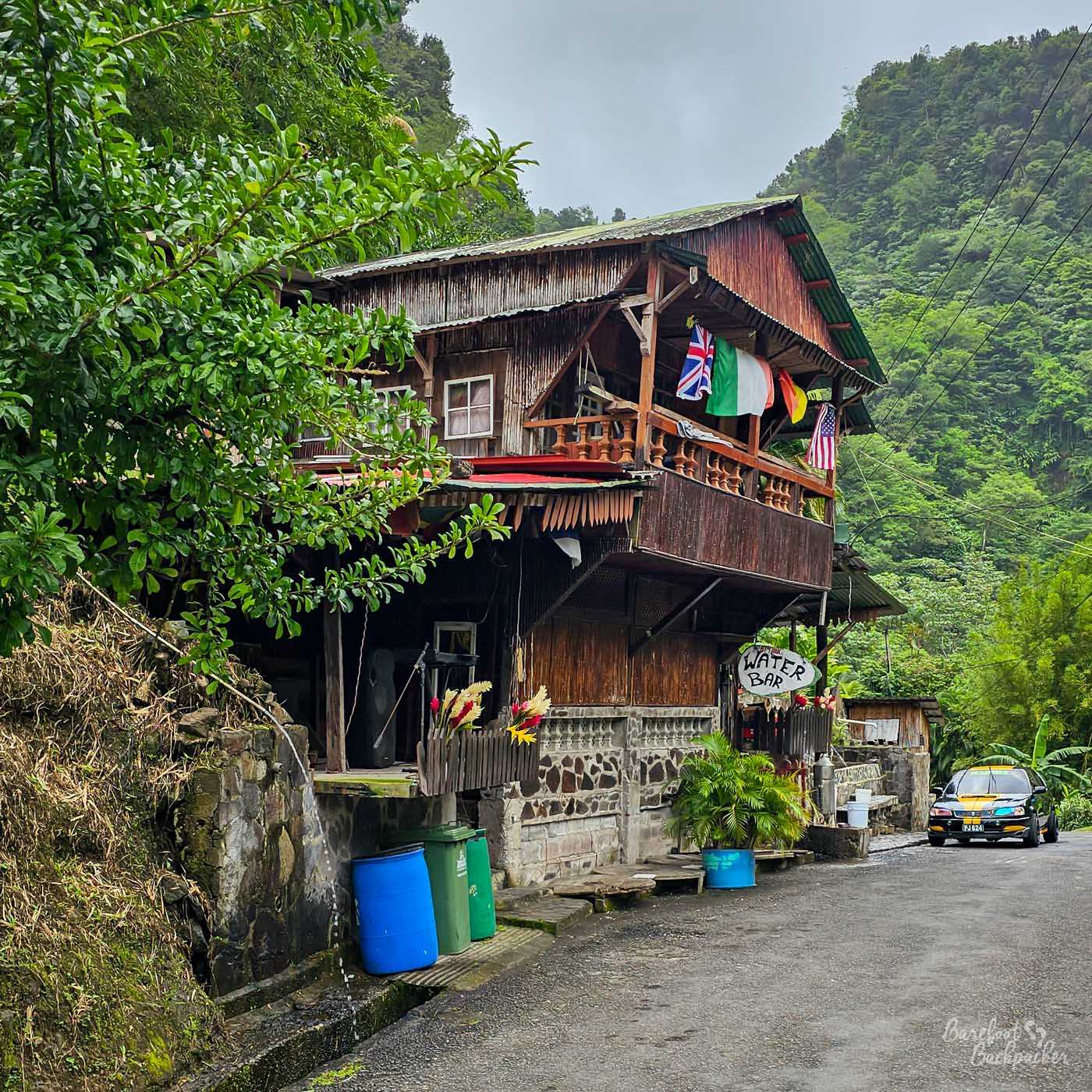
One of the buildings on the country lanes near our village in Dominica. I think this was normally a bar/cafe.
There’s a through-hike across the entire island that’s waymarked and advertised – the Waitukubuli National Trail, and it’s about 115 miles (185km) long. That might not sound much compared with other routes I’ve talked about, but it not only covers a total altitude gain of several thousand metres, but also it’s likely to be very humid and uncomfortable for much of the way, so definitely one to be fully prepared for.
Food and Drink in Dominica
On both the Tuesday and the Wednesday evenings we wandered to Wotten Waven for food and drink, The Tuesday we had chips (fries) and fried chicken from a simple shack on the road (Dan Bar), and it was incredibly lush, thought it loses marks for the incredibly loud radio that was on. And it was radio, not YouTube or Spotify, given we had a news and politics programme at one point, which really doesn’t vibe with a Caribbean drinking shack. The chicken was obviously it was washed down with the local lager (Kubuli) which I seem to have noted on UnTappd as ‘drinkable’. I am aware the Caribbean is much more of a rum-centric region but let it not be said I’d forgo beer.
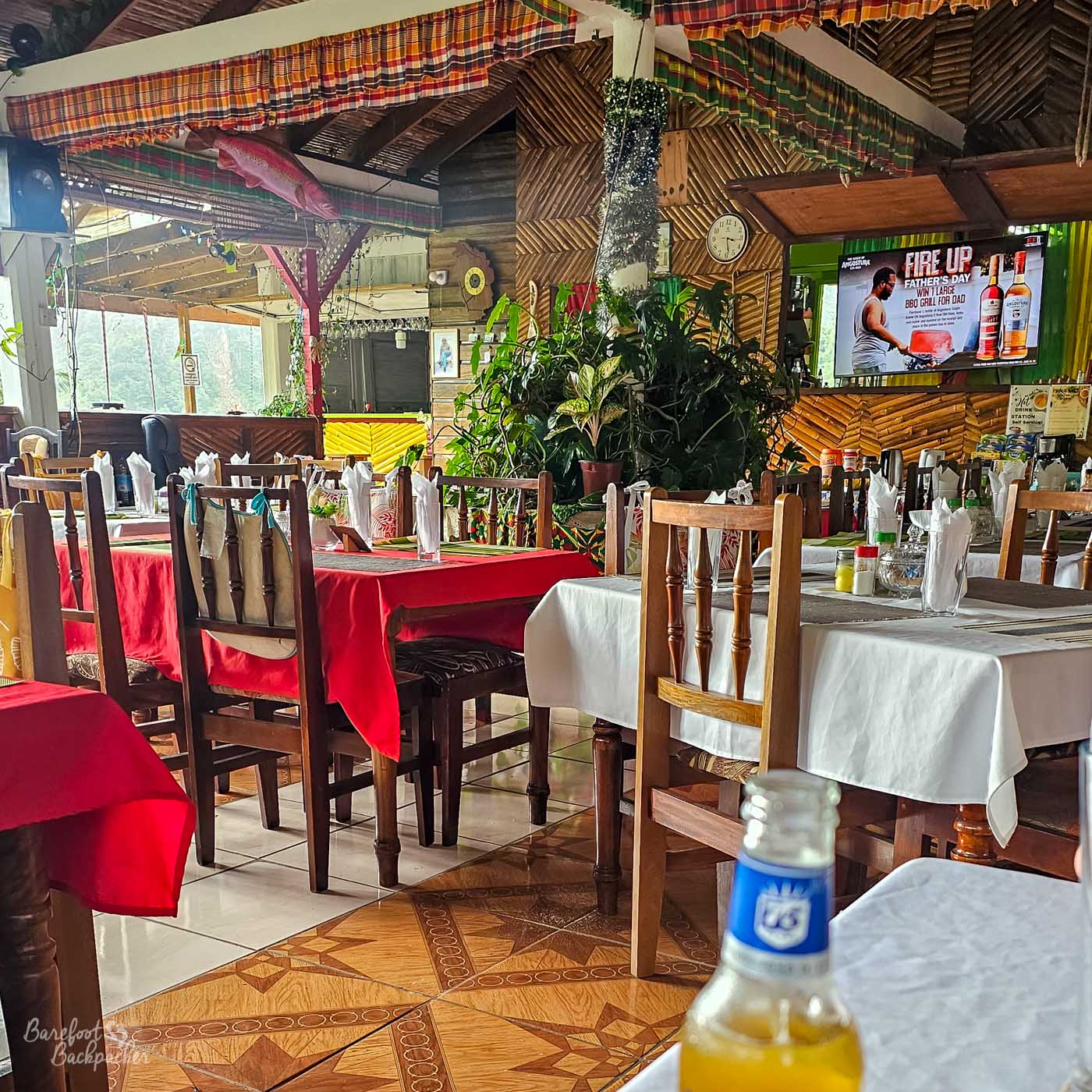
The inside of the restaurant in Wotten Waven. View from the toilet not pictured, but be sure it was impressive.
The following day we ate in a restaurant (Le Petit Paradis); the idea that there *was* a restaurant in a small village in the hills in Dominica that was open while not in the tourist season impressed me. It was attached to a guesthouse, but we only saw one other person there for the entire time we were there; an older white man who, in a parallel universe, would very much have hit several boxes in ‘Colonialist British Bingo’.
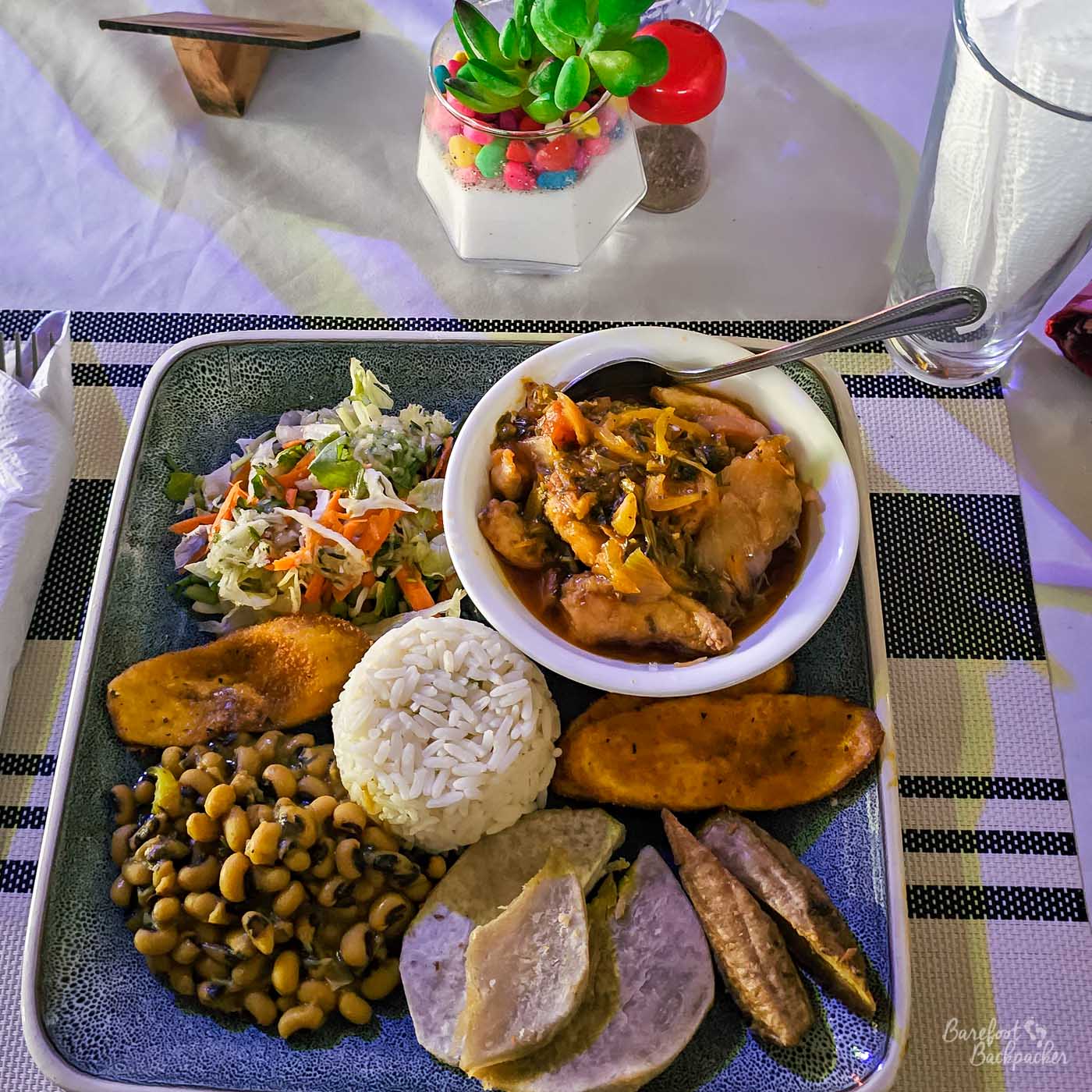
Another very nice Caribbean meal.
It was a lovely setting for a meal; the dining area was on ground level with regard to the road, but it was built in the side of a hill so the balcony edge looked out over one of the many valleys and the views across the landscape were green, lush, and wide. All we were really missing to complete the ambiance was a thunderstorm, although that would have made our walk back to the hotel a little dubious. And even the view from the toilet was similar; the window looked out over another edge of the hill so all you could see in the closet was a valley side covered in forest. The meal we had was very nice and again a good mix of meat, plantain, rice, vegetables, and flavour.
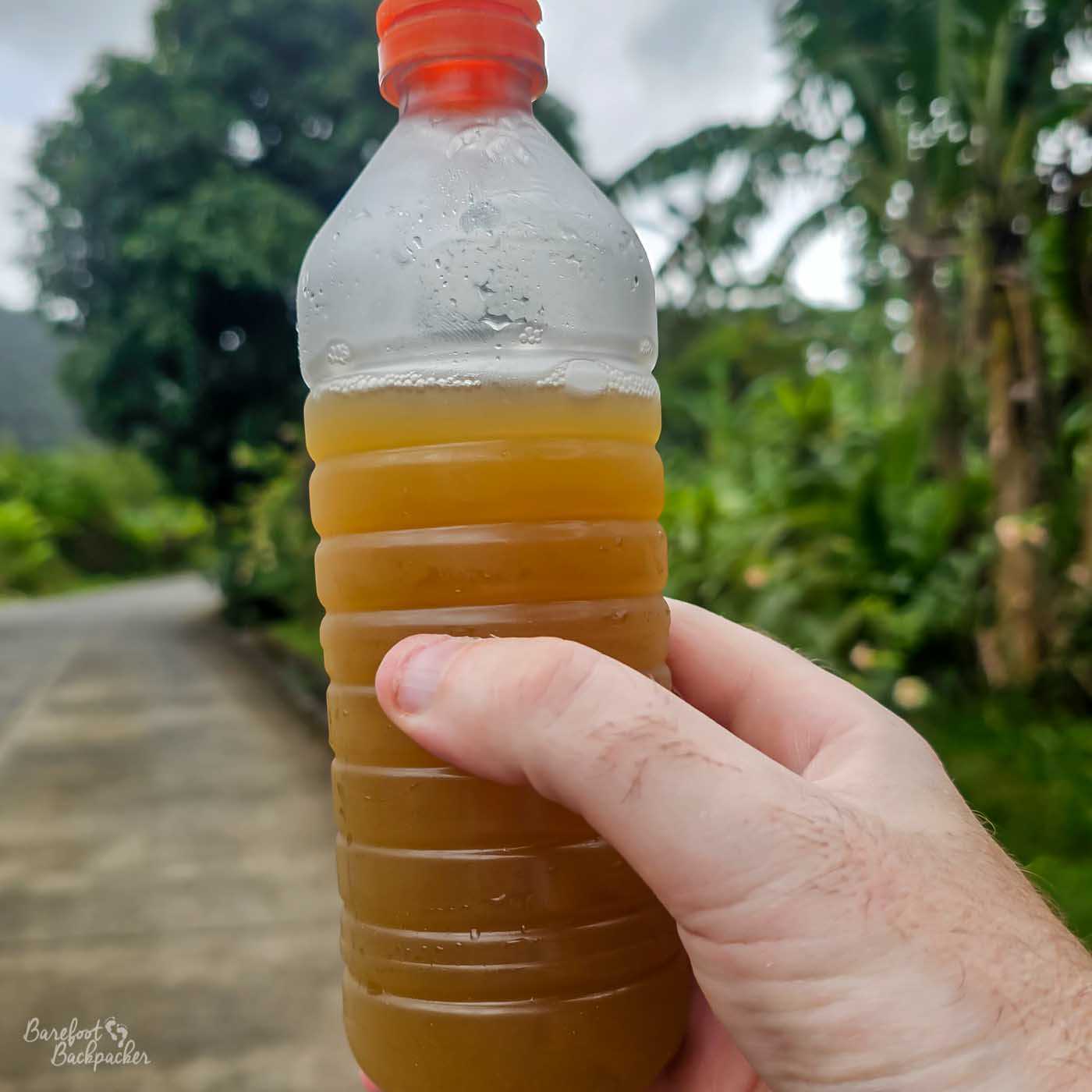
Sugar Cane juice. Pure energy drink.
On the way to the restaurant we passed by a very colourful street shack that sold sugar cane juice, in plastic bottles that in another setting would have made it look like moonshine or possibly distilled petrol. It was not moonshine; it was very sweet and sugary and probably unhealthy for you, but at least in a way that’s easily trackable.
Visiting Dominica’s Sulphur Spa
Dominica being another of the very active volcanic islands in the region meant that we could visit another Sulphur Spa, like we did in St Lucia. Compared with there though, the spas in Dominica felt very much more low-key. In fact one looked quite deserted when we popped by it; the only life being a guard dog who barked at us. The one we eventually went into was attached to a small restaurant and guesthouse in the centre of the Wotten Waven, and at first also didn’t seem to be staffed – we hung around for a few minutes wandering through the clearly closed tables of the dining area until someone finally noticed us and said ‘yeh, it’s just down the stairs, take your time, no worries’. I don’t remember how much it cost but it wasn’t more than US$10.
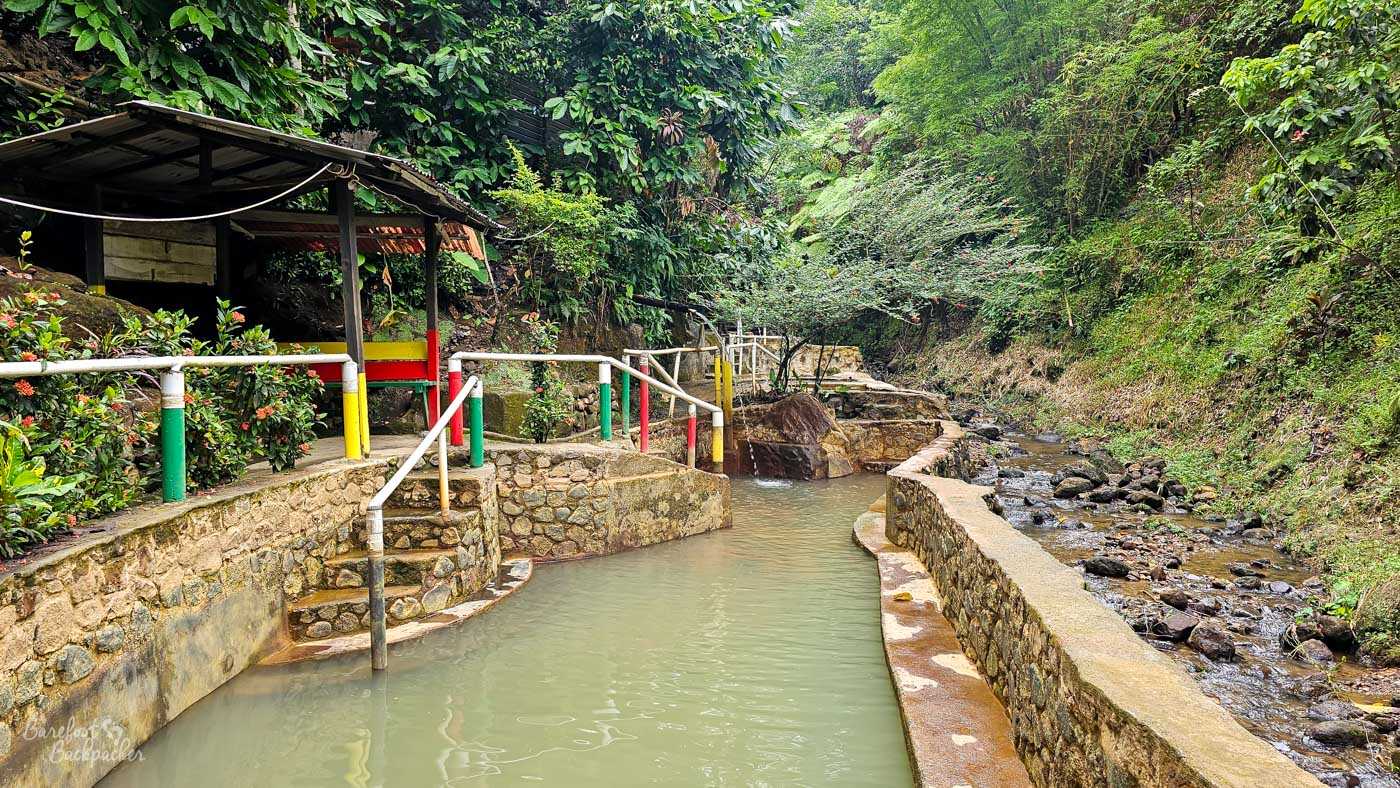
The view of the sulphur springs in Dominica, nestled quaintly in the trees.
It was a long flight of stairs down, surrounded by intense flowers. The spa was a much, much, smaller affair than the one in Saint Lucia, but probably a nicer setting and ambiance. It was located very much in the deeps of the rainforest, so all around were trees rather than barren rocks, and that also gave it a bit more of an intimate vibe. It had far fewer facilities – a couple of shelters right next to the pools to store your stuff, two changing shacks, and that was about it.
There were several pools, set on a couple of ledges, and one of them was much hotter than the others, and took a few more tentative steps to get used to, though in the end it was fine. This spa felt like a place to chill, rather than a place to go for a health vibe. They didn’t have mud to exfoliate yourself, but then they also didn’t have people around to apply it – it was literally just you and the trees.
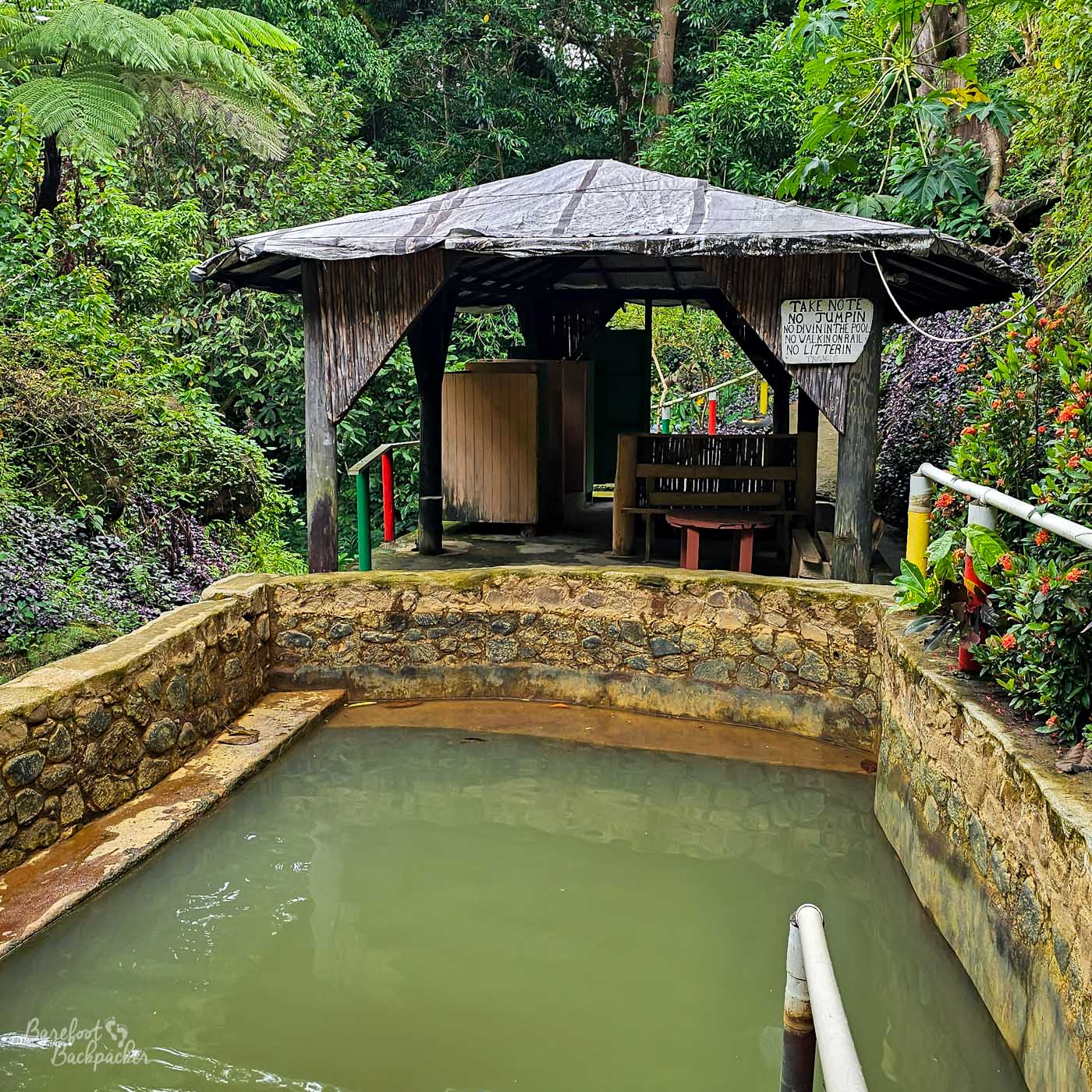
The sulphur springs in the opposite direction. Smaller than St Lucia but much quieter.
As far as rules go, here there was just a hand-written sign that said ‘no diving, no jumping, no littering’. It was very much more low-key, and that made for a different atmosphere. In addition, we were there for maybe an hour and the only other people we saw were another couple of popped by for maybe twenty minutes; they stayed in one of the lower pools and we relocated to the uppermost one, so both of us could feel we were there on our own.
Getting in and out of Dominica
We came in to Dominica by ferry from Martinique, on the regular if infrequent L’Express des Iles service that also serves Saint Lucia and Guadeloupe. It’s about two and a half hours from Martinique, and while our crossing was pretty fine, I’d imagine it can be quite rough at times.
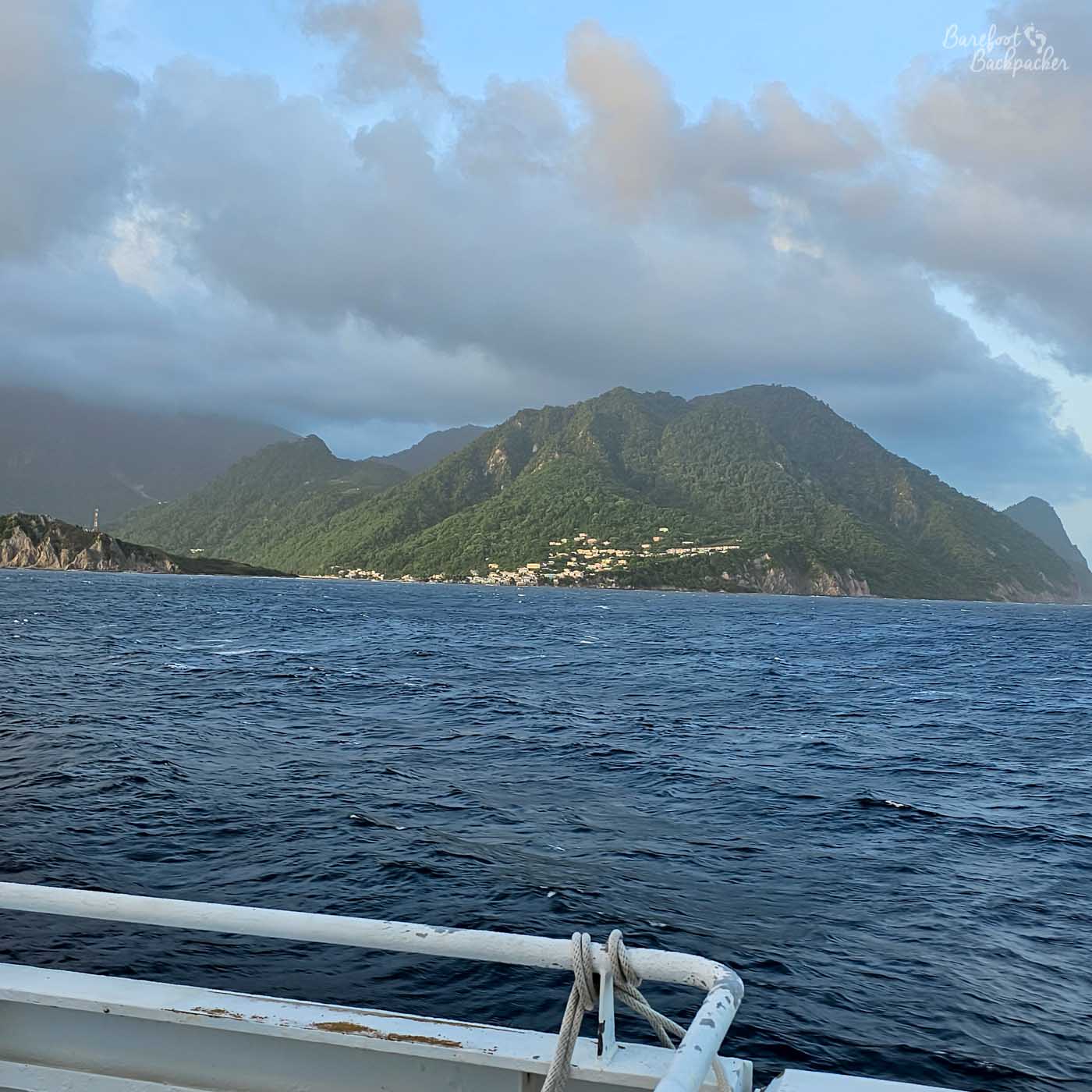
First view of Dominica from the ship.
Our entry was quite slow, partly due to a relative dearth of border officials both at passport control and at customs, but mainly because the customs officers were checking everything that everyone was carrying through. In front of us one lady was checked very thoroughly and ended up being taken into one of the side rooms – we were stood behind her in line for pretty much the whole of sunset. When it was finally our turn, we were given no more than a cursory glance and sent on our way, but don’t rely on that.
Many of the B&Bs, guesthouses, and lodges are outside of Roseau, and the ferry is likely to arrive after the last bus. It’s wise to book a transfer through your accommodation, or get them to source a taxi, as once you’re out of Roseau it’s all hills and no street lights, and that would make for an unpleasant arrival.
We left Dominica by plane. The airport is on the opposite side of the island to Roseau – something common to many islands in the region is the airports are nowhere near the towns they serve. As the islands are small and mountainous, there’s very little flat land to build on. The settlements tend to be on the western sides where building towns is easier and more useful, but the prevailing winds mean the airports are much better located on the eastern sides where the weather’s a bit calmer.

The outside of Dominica’s airport. Quiet, for an international gateway.
This means that while flights are less likely to be cancelled, virtually the only way to get there is by taxi. The road from Roseau crosses directly over the centre of the island, through the rainforest and past the cocoa plantations, and makes for quite a pretty journey.
The airport itself is quite small, and set between the hills and the seafront so it’s a very nice location. It’s also not a terribly busy airport, with only a handful of flights a day. The airport only has three passenger gates, all at ground level, and they’re all accessible from the same seating area, which has huge windows you can easily see planes landing and taking off through. Our flight was delayed by an hour or two but it honestly didn’t really matter. As an aside, to reach check-in from outside you have to pass through an x-ray security machine, which always stymies me.