The Caribbean isn’t normally noted as being a place to travel ‘on a budget’, as it were, being known mainly for cruise and resort travel. This is, of course, why we went – to prove that it was possible, much in the same way as we did for Maldives earlier in the year.
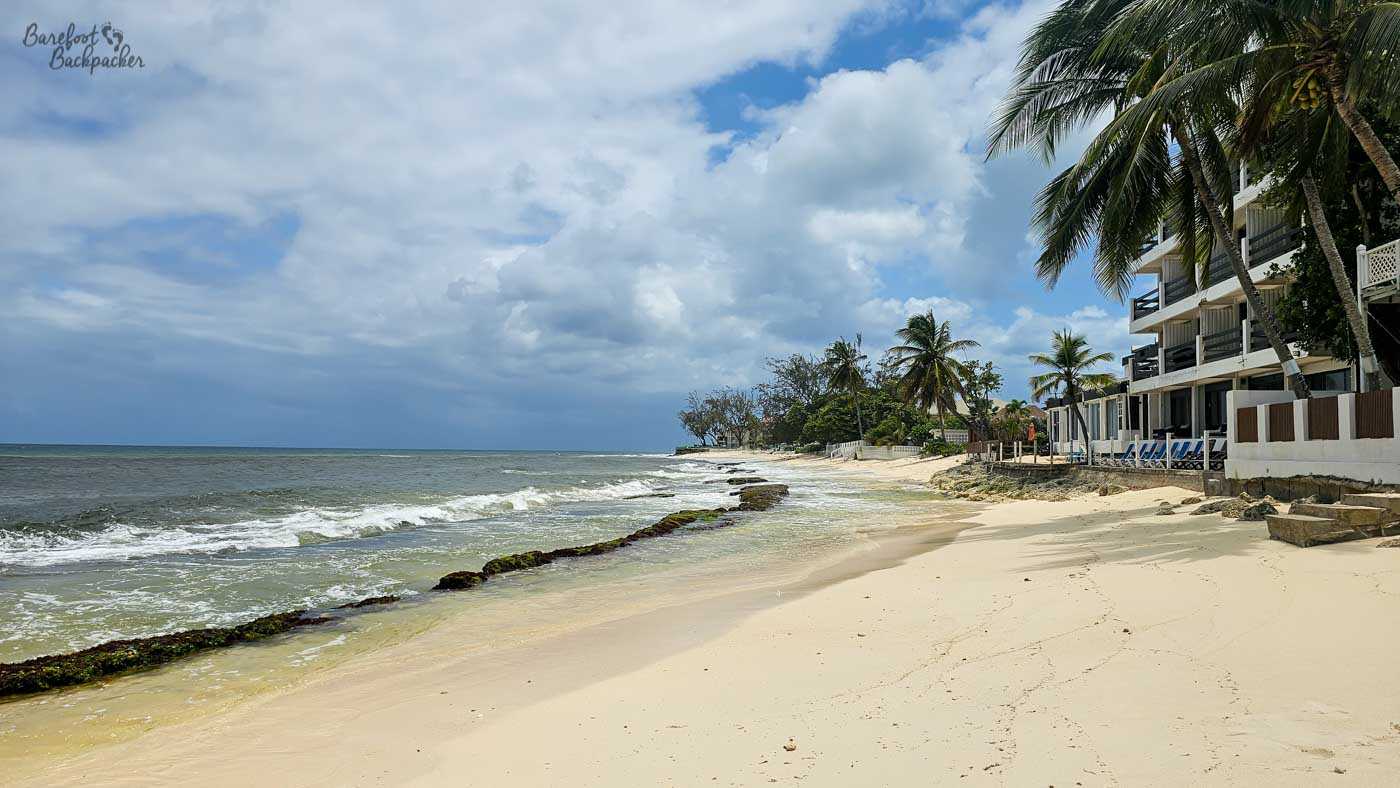
A beach in Barbados. Not pictured – the sharp drop to deep water.
The Caribbean isn’t a part of the world I knew a lot about, and I’ll be honest I’d never really looked into. Partly this is because in my head they were a series of small hot islands full of honeymooners, and it never occurred to me that I’d want to go. Even if I had looked into them more I think they’d’ve been the sort of place I wouldn’t necessarily have thought to go to on my own, because I’d be worried I’d get a bit bored.
As I say, we’d been to Maldives earlier in the year, and Laura was still hankering after a decent beach trip. For me I figured it would also be interesting to compare and contrast with a different kind of tropical destination; a whole style of trip I still have very little experience of and which is slightly outside my comfort zone as a result. In addition, there was also the thought of, like Maldives, the Caribbean is generally a place you go to for resort holidays, but with the additional option of cruises. Who reading hasn’t got in their mind right now a two-week cruise popping by some of the lovelier Caribbean islands, and Haiti, for excursions or overnights in exclusive walled compounds surrounded by retired white people.
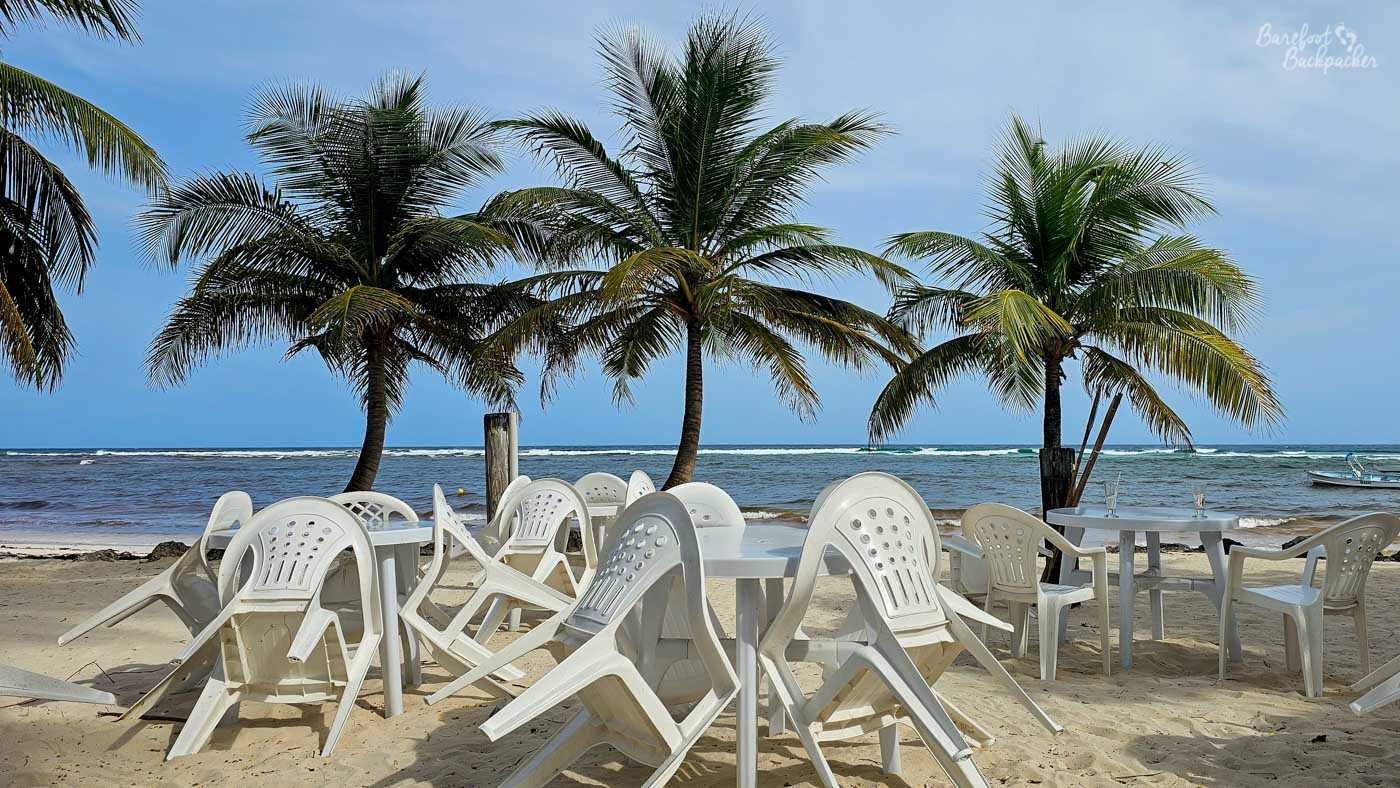
The beachfront of a cafe in Barbados – one imagines in the height of tourist season this would be full of drinking tourists.
But our Caribbean trip would, of course, not be like that. We were interested to see if it were even possible to travel independently, slowly, and locally, through the region they way most holidaymakers don’t. Because we’re trend-setters, and on a budget. You can hear more about it, by the way, on two podcast episodes – links and shownotes are here for Part One and Part Two.
Choosing how and where to travel in the Caribbean
The first task was to work out which countries to visit. We had two weeks, and Laura was insistent that we visit Saint Lucia; it had been on her bucket list for years. In addition, when she was looking at the cheapest and easiest flights in and out the region for our dates, Barbados consistently came up as a good place to leave from.
In fact, as it turns out, Barbados is a very useful hub to visit much of that region, including parts of South America like the Guyanas. The Caribbean doesn’t have the same industry of budget flights as other parts of the world, but they do have a lot of small airlines flitting between the islands. This is useful to know, given the lack of international ferries.

The international airport in Barbados, the only place I’ve ever seen check-in outdoors.
Although plenty of ferries exist domestically, especially within larger groups like The Grenadines, the reason there are so few international ferry services is geographic. Stiff breezes with rough waves, occasional hurricanes, infrastructure issues, and a low population (Saint Lucia’s population is around 178,000 which makes it one of the larger ones) means that demand for international ferry services is surprisingly low. In addition, as most tourists visit either on a cruise, or stay on one island for their entire trip, there’s a lack of tourists doing exactly what we were doing, meaning even less demand for such ferries. A couple of companies have apparently tried in the past to connect more islands, but they’ve never been profitable.
For example, there was an infrequent ferry service between Grenada and one of the islands in the Grenadine archipelago, however a hurricane a few years ago knocked out one of the ships. A second ship was sourced … which itself got knocked out in the hurricanes the following year. And to the best of our research, was never replaced. Indeed only one company seemed to offer any kind of international services at all; L’Express Des Iles, which operate ferries between St Lucia and Guadeloupe via Martinique and Dominica.
In the event this is what swung us to do the trip we did. While going South would take us to the remote tropical beaches of St Vincent & the Grenadines, and the quite picturesque-sounding island of Grenada, it would have to be done entirely by short, expensive, flights. Going North meant visiting Martinique, which of all the islands was the one that least inspired us, but it was at least on budget and quite convenient, especially given the airports in the Caribbean tend to be on the opposite side of the islands from the towns they serve, for reasons to do with prevailing wind.
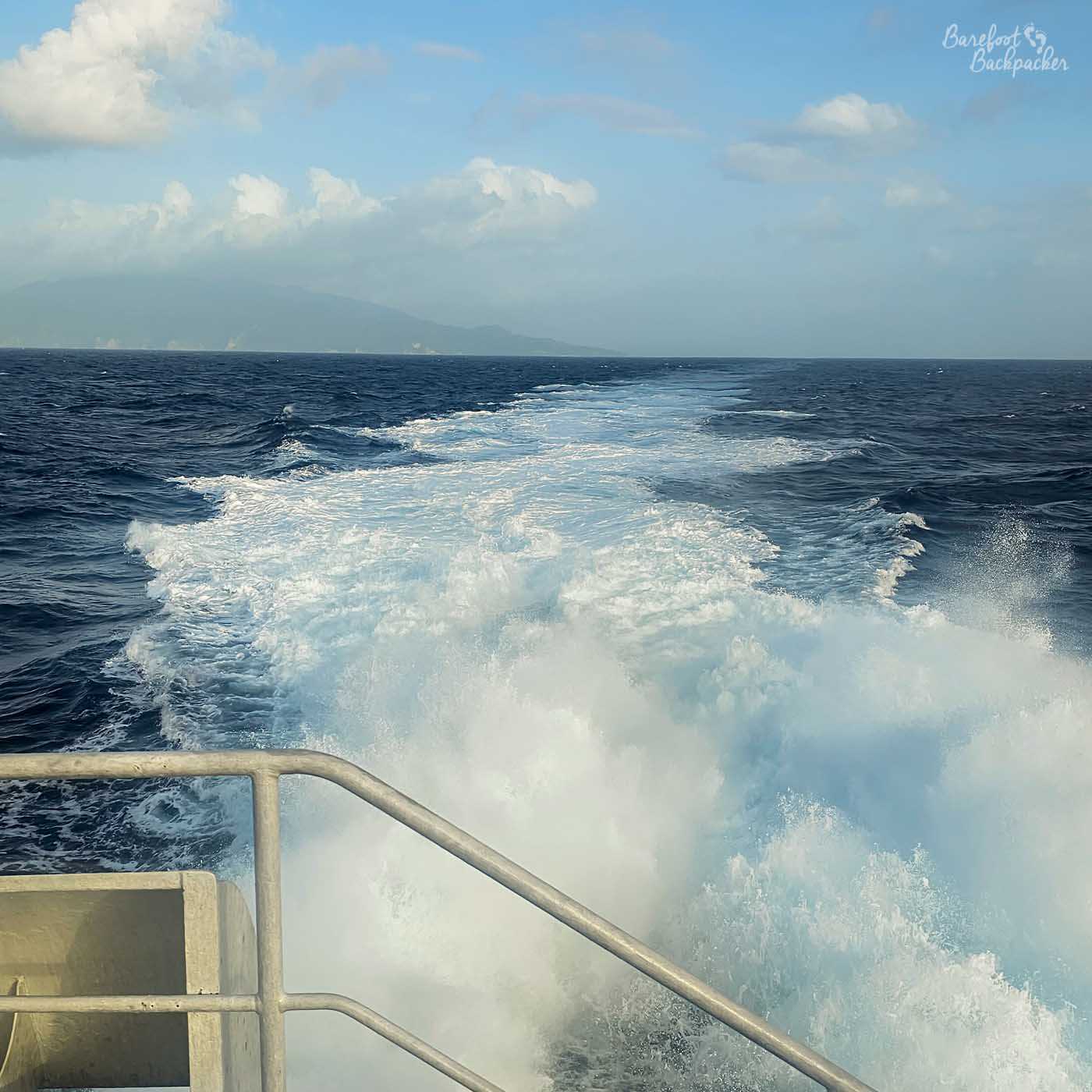
Sailing away from Martinique; we were never far from land but it was a little more turbulent than you might hope. I found it difficult to stand.
Note too we were going in early June, which is kind of the very back end of the tourist season. This is because officially the hurricane season starts on 1 June. Obviously the natural world doesn’t care about arbitrary dates created by human culture, but we’d be there for two weeks and obviously the later in the trip we got, the more likely hurricanes would be to form. Previous hurricanes had affected the south much more than the north – indeed a couple of islands in the Grenadines were still nowhere near recovered from ones that hit in 2021-2022. Laura’s aversion to flights, especially on small planes in bad weather, meant she’d rather take the ferry. We decided one regional flight was enough and we should head North.
Can you have a budget Caribbean trip
Can you travel the Caribbean on a budget? I’d say you can, but with a couple of caveats, one of which is obviously: you need to define what budget means to you.
Accommodation
Important to note: we were travelling as two people, so sharing the hotel costs – I don’t know if the rooms would be cheaper as a solo traveller or if they were a standard price, because I wasn’t checking that. Of the four countries and territories we went to, Dominica had the cheapest hotel, working out at $70/night for the room. Saint Lucia was roughly an average of $89.30/night, Barbados $101.50, and Martinique the most expensive at $119.50. So the most we were spending was $60 pppn; I don’t think that’s terribly bad, especially compared to a city break in a city like London where you could easy spend double that. Accommodation’s one of the biggest expenses of any trip and these aren’t South-East Asia prices, but equally it’s likely cheaper than many of your home countries so consider your budget accordingly.
One thing I will say about hotels for us personally is that we were always needing to book twin rooms. I’m sure if you were a married couple you could travel independently for cheaper than we managed as you’d have more choice – when I did some preliminary searches on Booking Dot Com, in St Lucia I was finding about 140 hotels with rooms for two people, but when I specified ‘twin beds’, that figure dropped to just 6.
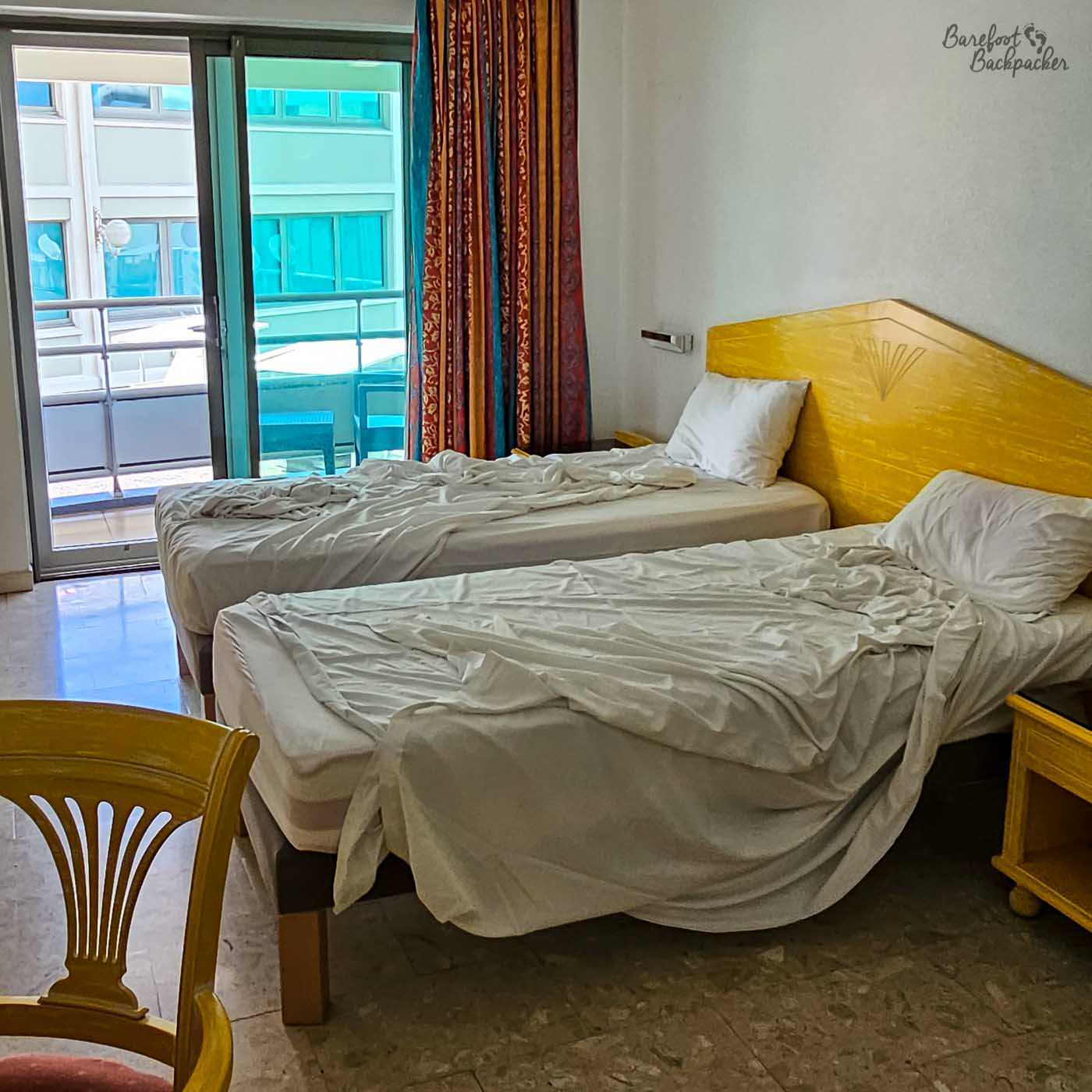
The inside of our hotel in Martinique; functional twin room, no frills.
The other thing to bear in mind around accommodation is it’s much easier to get to the more instagrammable beaches if you spend more to be in a more resorty type hotel. To the extent that staying in more budget hotels and taking taxis to those beaches because they’re a bit out of the way might well not work out any cheaper. But if beaches aren’t your thing, then this won’t be as much of a concern, so maybe it’s easier to visit the Caribbean on a budget if you’re more interested in hiking, rum, and photography.
Transportation
Getting around was a mixed bag. We took one flight, from Dominica to Barbados, which was $130 each, to which we’d have to add on the cost of the taxi across Dominica from our hotel to the airport, which was about an extra $50 or so. We also have to add on another $20 for the taxi from the ferry terminal in Dominica to the hotel on our first night.
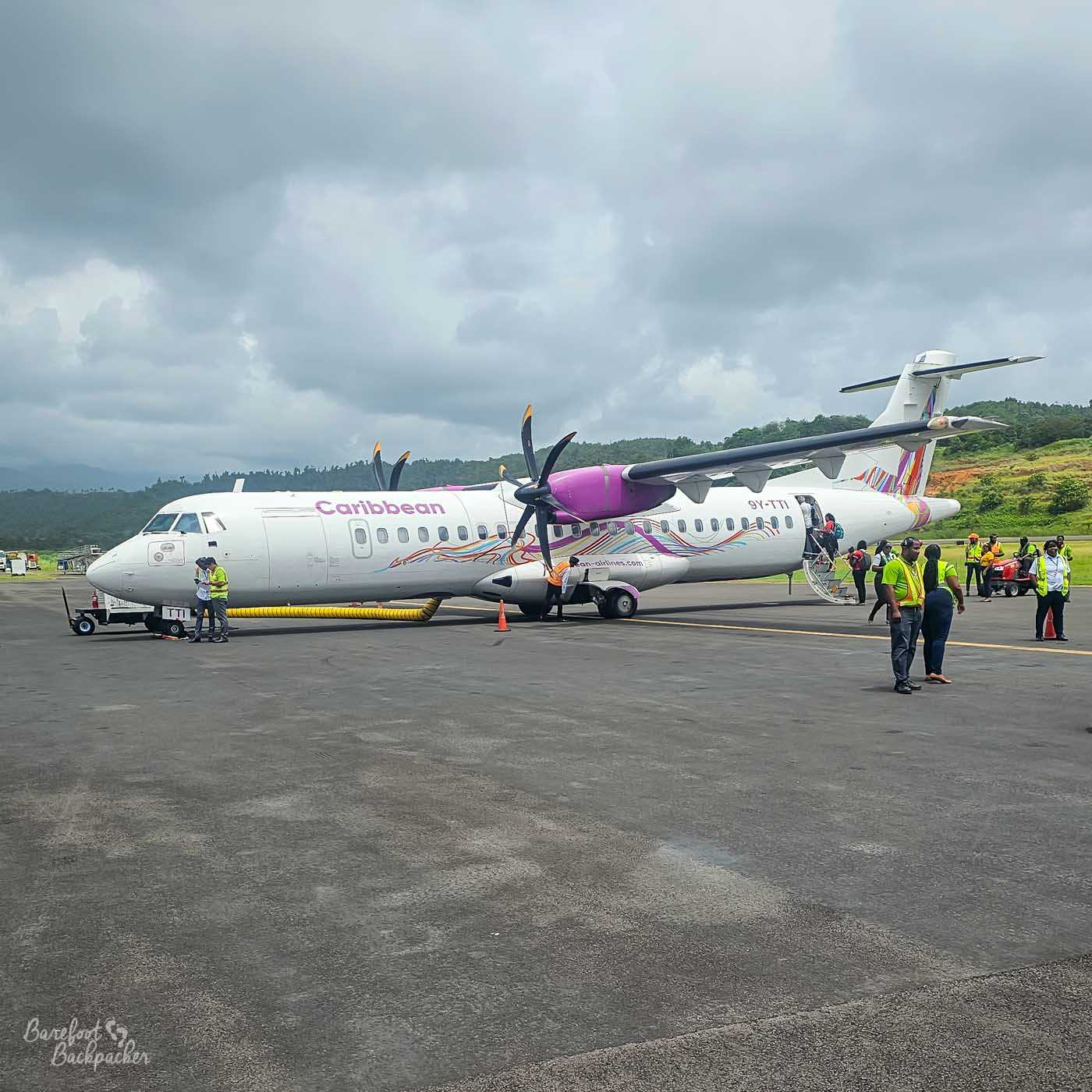
The plane at Dominica airport that would fly us to Barbados. It was a pretty comfortable ride.
The two ferries we caught were both €79 each, or $92. The buses in Saint Lucia were, if I remember correctly, about $1.50 (USD), as were the buses to/from Roseau in Dominica. The bus to/from the airport in Barbados was about $2 USD. I don’t know how much the bus in Martinique was supposed to cost because during our visit the system wasn’t working so bus travel was effectively free.
The benefit of travelling by bus is that they’re cheap. The malefit is that there’s a lot of the islands that the buses simply don’t serve, so if you want to get to the better beaches, that’s going to cost you much more in taxi fare than we were prepared to spend. As with Maldives, if you pay budget prices you get budget experiences, but in a place like Caribbean, even a budget experience is still a very pleasant one.
Food
Disappointingly for travel bloggers, we didn’t make many notes as to how much our food cost. However it felt comfortably in proportion to the accommodation.
Our decent lunches in Saint Lucia tended to be around $6-$7 each, and a more substantial curry with all the trimmings (plantain, rice, salad, all-told very large, filling, and tasty) tended towards $10-$12 each. Dominica was similar; on our first day in Dominica with no food, no money, and nowhere open, we had a portion of grilled chicken and can of coke from a snack stall for around $2.

Caribbean curry with all the trimmings. Very nice.
Martinique was obviously the most expensive of the places we went, where a pizza from a place inside the out-of-town shopping centre next to the hotel went for around $20.
The beers we were having tended to be around $2 USD per bottle, so nothing excessive.
Caveat
Something that may affect cost comparisons is that we were travelling a little outside the tourist season. As I say, June 1st is the start of the designated Hurricane Season, so fewer tourists visit, and prices might have been a bit lower for us than they would be if you went a month or two easier. The flipside of travelling in a more budget season of course is there’s fewer options to see and do, and probably to stay too. It’s all a balance. For the record, no hurricanes were even predicted, never mind formed, during our stay, though we *were* keeping a very close eye on two of the hurricane watch websites.
Money
At the time of our visit, Saint Lucia and Dominica both used the East Caribbean Dollar (XCD), 1 of which was roughly $0.37 in USD. However this exchange rate is fixed, and since the majority of tourists visiting the Caribbean would either be Americans, or using USD as their standard travel currency, the US Dollar tends to be accepted everywhere. Be aware though that transactions conducted in shops in USD are often at disadvantageous rates rather than the fixed rate, so it always helps to carry XCD were possible.
Barbados uses the Barbadian Dollar (BBD). This is also fixed to the US Dollar, with 1 BBD equal to $0.50, which is a far easier conversion rate to do in your head. However no, you can’t use XCD in Barbados even though it would theoretically be a fixed rate between them too.
One thing we did find awkward on arrival in Barbados though, that you may need to be aware of if you’re coming in from elsewhere – especially the UK. Barbados Airport has no money exchanges. Or, in fact, ATMs. It’s not that we couldn’t find any, or that they were in an obscure corner up two flights of stairs. No. We asked at the help desk and were told that, no, there wasn’t one of either on site, and the impression we go was this was perfectly normal. They suggested buying something with USD and we’d get the change in Barbadian currency. So yes, change your money into USD before you go.
Martinique uses the Euro exclusively, so that should hold no problems for most people to obtain and use.
The other thing of note is that acceptance of plastic was quite hit-and-miss. Two of our hotels (in Soufrière and Dominica) didn’t take card, and many of the restaurants and cafes in both places also ran exclusively on cash. Conversely, if I recall correctly, our hotel in Barbados *only* accepted cards. Also, make sure you tell your bank you’re here before you go, otherwise they might block your card. That was frustrating.